
Black holes were supposed to grow slowly. Scientists believed the first black hole seeds formed after massive stars died inside already-existing galaxies.
Then, they spent billions of years merging and feeding on surrounding material until they became the supermassive giants seen today.
But a strange object from the early universe is making researchers rethink that whole story.
Black holes that were born huge
Using NASA’s James Webb Space Telescope (JWST), astronomers have found strong evidence that some supermassive black holes may have been born huge from the start.
They may not have needed generations of stars to build them. In fact, one supermassive black hole seems to have existed before a proper galaxy even formed around it.
That finding has scientists talking about one of the oldest mysteries in space: Which came first, the galaxy or the black hole?
“This is a remarkable finding,” said Roberto Maiolino of the University of Cambridge. “It’s a paradigm shift, a total revisiting of the classical scenarios of how black holes form and grow.”
A tiny object with a giant secret
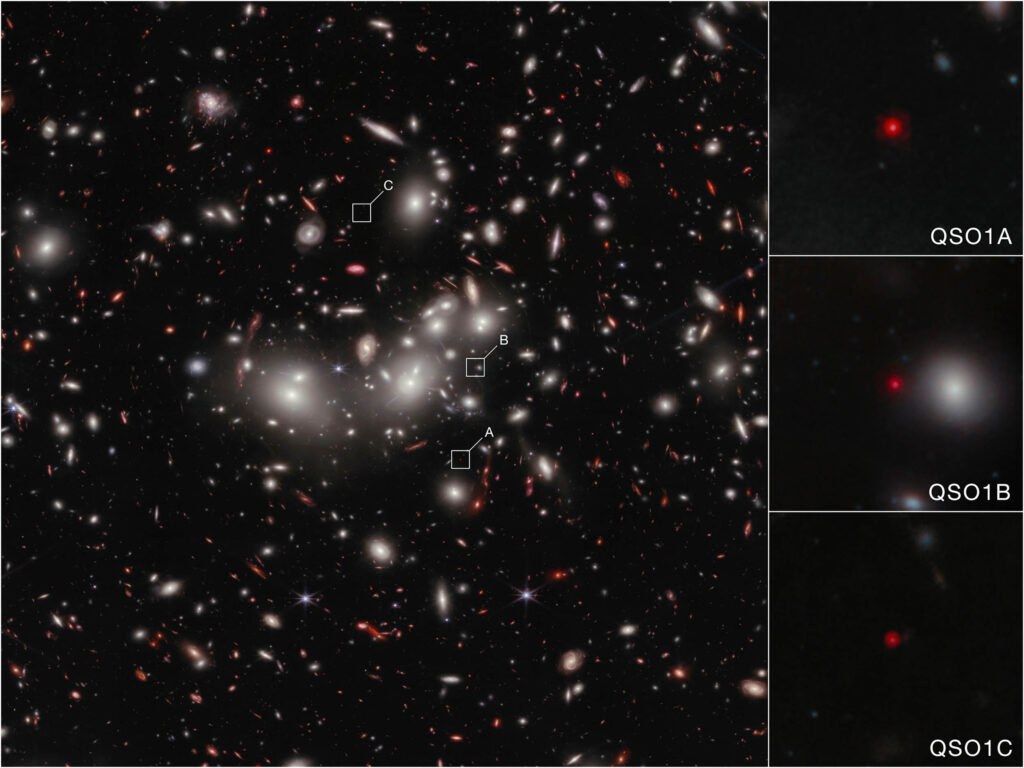
The object at the center of this discovery is called Abell2744-QSO1, or simply QSO1. It belongs to a group of mysterious objects astronomers call Little Red Dots.
These objects are tiny by galactic standards. QSO1 stretches only about 1,300 light-years across. The Milky Way, by comparison, spans roughly 100,000 light-years.
Yet despite its small size, QSO1 appears to contain a black hole with a mass around 50 million times greater than the Sun.
Black holes in the early universe
What makes this even more shocking is its age. Scientists are seeing QSO1 as it existed just 700 million years after the Big Bang. In cosmic terms, that is incredibly early.
The James Webb Space Telescope has already discovered thousands of massive black holes from the early universe.
The problem is that standard theories struggle to explain how they got so large so quickly. Growing from the remnants of dead stars should have taken much longer.
QSO1 now adds weight to a different possibility. Maybe some black holes did not start small at all.
Studying gas around a black hole
The breakthrough came from studying the gas moving around the black hole.
Researchers used Webb’s Near Infrared Spectrograph, known as NIRSpec, to map the movement of hydrogen gas surrounding the object.
Instead of chaotic motion, the gas followed a clean orbital pattern known as Keplerian motion – the same basic behavior seen when planets orbit the Sun.
“This is important because it tells us that most of the mass of QSO1 is concentrated in the black hole at the center,” said Ignas Juodžbalis, a Cambridge graduate student involved in the study.
“If the mass were more distributed, as it would be if there were a lot of stars, the gas would not have this perfect Keplerian rotation.”
Measuring the black hole’s mass
The data provided the first direct measurement of a black hole’s mass in an object seen less than a billion years after the Big Bang.
“Before now, all of the mass measurements of black holes in the early universe have been indirect, based on assumptions from what we know about them in the local universe,” said study co-author Francesco D’Eugenio.
“We didn’t know if those assumptions really apply to the distant universe.”
The measurements showed the black hole accounts for at least two-thirds of the object’s total mass.
In nearby galaxies, black holes usually make up only a tiny fraction of the galaxy’s mass. That imbalance suggests the galaxy itself barely existed yet.
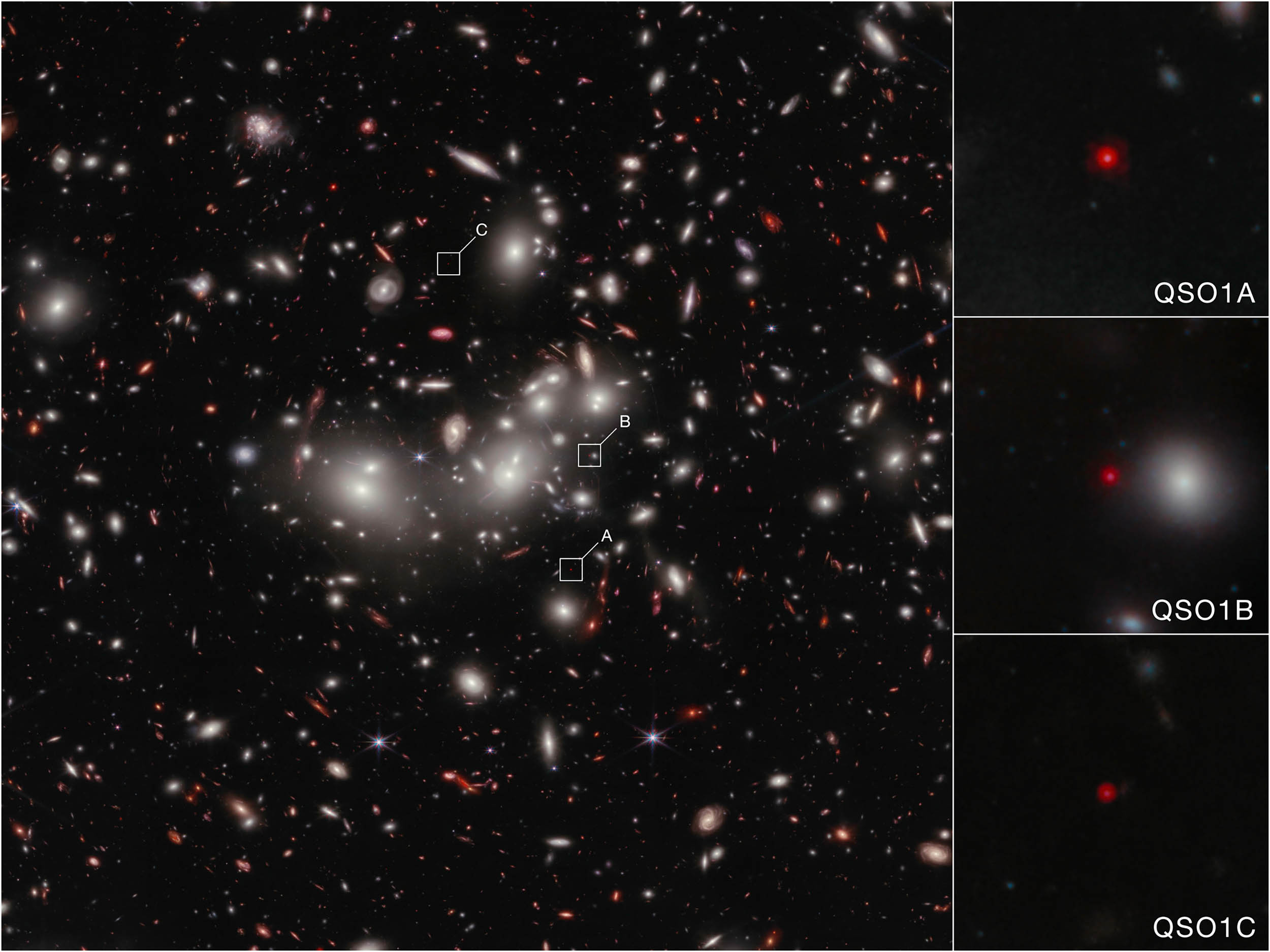 An image from NIRCam on NASA’s James Webb Space Telescope shows Little Red Dot Abell2744-QSO1, magnified and triply imaged by galaxy cluster Abell 2744 (Pandora’s Cluster). Credit: NASA, ESA, CSA, Lukas Furtak (Ben-Gurion University); Image Processing: Alyssa Pagan (STScI). Click image to enlarge.Almost no signs of stars
The gas around QSO1 also carried another surprise.
Astronomers found it contains almost entirely hydrogen and helium, the two simplest elements created after the Big Bang. Heavier elements such as oxygen were nearly absent.
That matters because stars create heavier elements over time. A mature galaxy packed with stars should contain far more of them.
Instead, QSO1 appears extremely pristine. Its metallicity, or abundance of heavier elements, is less than 0.5% of the Sun’s.
“This is a phenomenal result,” said Maiolino. “It is the first direct measurement of a black hole mass within the first billion years after the Big Bang, and it is consistent with the previous measurements.”
The lack of stellar debris strengthens the idea that the black hole did not grow slowly inside a developed galaxy. It may have formed first and only later started building a galaxy around itself.
A different kind of black hole birth
Scientists have long debated whether giant black holes could emerge through another path entirely.
One theory involves “direct collapse black holes.” Instead of forming from dead stars, massive clouds of gas could collapse straight into huge black holes.
Another idea points to “primordial black holes,” which may have formed during the violent conditions immediately after the big bang.
Until now, there has been little direct evidence for either idea.
“It seems that we have found a black hole that does not have a substantial host galaxy and that has predated stellar processes,” said Juodžbalis.
“This is very exciting because it is evidence for primordial black holes or direct collapse black holes, which have been theorized but not confirmed.”
Future research directions
Researchers are now studying more Little Red Dots to see whether QSO1 is unusual or part of a much larger population hidden in the early universe.
If many of these objects turn out to be black holes that formed before galaxies, astronomers may need to rewrite a major chapter in the story of cosmic evolution.
For decades, galaxies were thought to be the builders of black holes. QSO1 hints that the relationship may have worked the other way around.
The research is published in the journal Nature.
—–
Like what you read? Subscribe to our newsletter for engaging articles, exclusive content, and the latest updates.
Check us out on EarthSnap, a free app brought to you by Eric Ralls and Earth.com.
—–