
Using data from the NASA spacecraft MAVEN, a team at West Virginia University have found evidence of the atmosphere of planets being protected from solar winds, even without strong magnetic fields, also known as the Zwan-Wolf effect.
The Zwan-Wolf effect was first described in 1976 and had only been observed in planetary magnetospheres, not in atmospheres. But findings reported in Nature Communications have observed the effect in Mars’ atmosphere, bringing new understanding to how our Sun interacts with planetary bodies in our solar system.
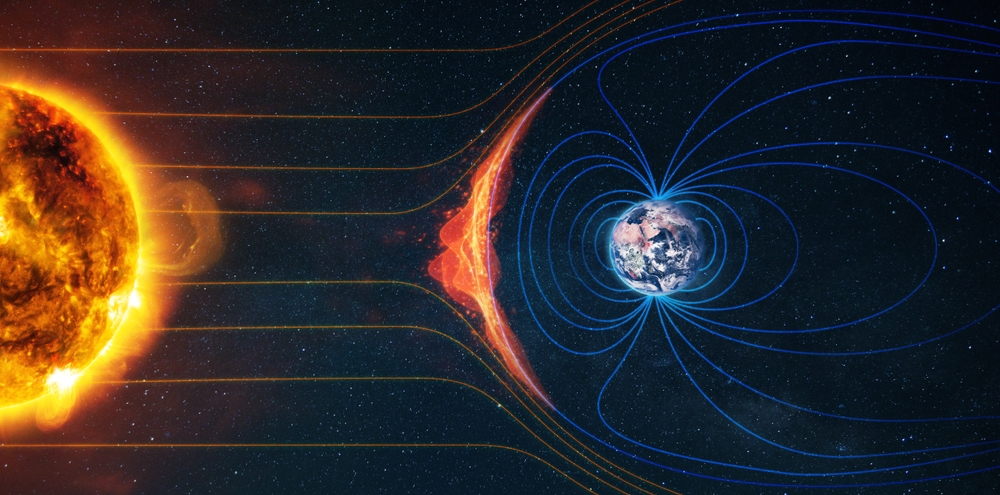
The sun emits a continuous flow of plasma, known as solar wind. When this plasma flow encounters large objects like planets or comets, it is deflected around them, similar to the flow of water around a rock in a stream.
“However,” said Christopher Fowler, planetary scientist at West Virginia University, “because the water in that stream is relatively dense, physical collisions between water molecules bumping into each other and the rock determine how the water is diverted. In contrast, the environment in space is so tenuous that solar wind particles do not bump into each other. Instead, electromagnetic forces control how particles are deflected around these bodies.”
“Very interesting wiggles”
When the solar wind curves around a planet with a strong magnetic field, like Earth, the Zwan-Wolf effect is observed as the plasma is squeezed by those electromagnetic forces through “magnetic flux tubes”- regions of space created by parallel magnetic field lines.
“The squeezing helps move the solar wind plasma around the planet, and it makes the plasma less dense in front of the planet,” Fowler said.
“By finding this effect in the atmosphere of Mars, we are discovering new ways in which our sun can interact with and affect planets in our solar system. It’s amazing to think that an eruption on the sun can disturb the atmosphere of Mars 142 million miles away.”
Fowler spotted “very interesting wiggles” in 2023 data from MAVEN, NASA’s Mars Atmosphere and Volative Evolution mission. “I would have never guess it would be this effect, since it’s never been seen in a planetary atmosphere before.”
Observing the rare event could help protect future explorers from the impact of space weather
“We think this effect could occur in the Martian atmosphere all the time, but it’s usually such a small effect that our instruments aren’t sensitive enough to detect it,” Fowler said.
“The solar storm really hit Mars hard and disturbed the entire space environment around the planet. This seems to have amplified the Zwan-Wolf effect so that we could observe it during this time period. We got lucky, being in the right place at the right time with MAVEN to see this.”
“We observed these signatures all the way down to the lowest altitudes that MAVEN sampled, suggesting that it impacted the atmosphere even below the spacecraft,” Fowler said. “Understanding how these space weather events impact our solar system is important, not only for keeping our robotic — and potentially, human — explorers safe in the future, but for protecting the space assets that we rely on for our everyday technology here on Earth.”