
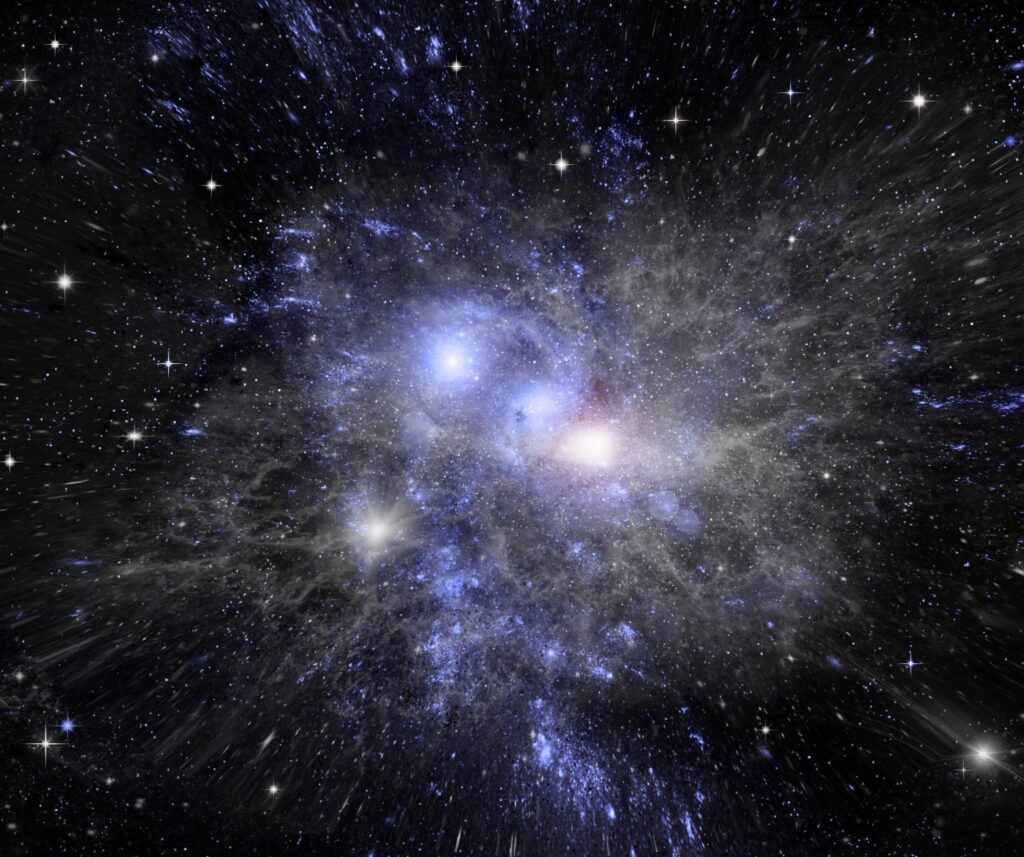
Dark energy has one job: explain why the universe is flying apart faster and faster. The idea is so successful that it appears in every cosmology textbook and is thought to make up roughly 70 percent of the cosmos.
The evidence for dark energy comes from a Nobel Prize-winning discovery.

For almost 30 years, the physics community has treated it as settled.
A team of mathematicians now says the model dark energy was invented to rescue was never stable to begin with.
In their view, the problem is not a minor flaw but a fundamental one. The model sits in a mathematically unstable state, where even the slightest disturbance pushes it away from the solution.
In physics, a solution that cannot survive a nudge is generally not considered physically realistic.
A flawed foundation
Blake Temple, a distinguished professor emeritus of mathematics at the University of California, Davis (UC Davis), had a different interpretation.
Working with Christopher Alexander of University College London (UCL) and mathematician Zeke Vogler, Temple wasn’t disputing the observations – the universe really is speeding up.
His problem was with the model dark energy was drafted to explain.
At the heart of the standard model sits a Friedmann universe – a tidy picture where matter spreads perfectly evenly and the whole thing expands in lockstep.
It’s clean and easy to calculate. And also, Temple argues, the wrong starting point.
The story runs back to 1915 and Albert Einstein’s equations for general relativity, his theory of gravity.
To stop the universe collapsing under its own gravity, he added a term he called the cosmological constant – a built-in outward push.
The instability problem
In 1929, astronomer Edwin Hubble showed that the universe was expanding on its own, with no static balancing act required. Einstein reportedly scrapped the extra term, later calling it his “biggest blunder.”
The constant came roaring back in the 1990s, when telescopes caught distant exploding stars looking dimmer and farther away than a steady expansion allows.
Those measurements revealed a cosmos speeding up, and the discarded term – now rebranded as dark energy – became the fix.
Here’s the snag Temple kept circling back to. A Friedmann universe is a valid solution to Einstein’s equations, but valid isn’t the same as stable. He likens the standard model to a pencil balanced upright on its sharpened tip.
Every force is balanced, so technically the pencil stands. But balanced doesn’t mean stable. In physics, a solution that collapses the instant it’s nudged is treated as a fiction.
You can write it down, but you’ll never catch the universe sitting in it. It’s real on the page, but nowhere in the sky.
Running the numbers
To test the hunch, the team rewrote Einstein’s equations, fusing gravity with the physics of flowing fluids – the toolkit for modeling galaxies, black holes, and cosmic expansion.
In that framework, the smooth Friedmann universe appears as a rest point. That’s a spot where everything sits balanced and still.
The real question was whether it could stay there. Mathematicians had long suspected the balance was shaky, but until this study no one had mapped the full picture.
The team proved that every version of the Friedmann universe is unstable to a nudge – not just at small scales, but at the largest scales too, right back to the Big Bang. By their account, the most unstable solution of all.
So what does an unstable universe become? Give it the slightest nudge away from perfect evenness – a region with a touch less matter than average – and the math shows it accelerating outward on its own, then gradually settling back over time.
That result, Temple says, appears to rule the standard model out as physically viable – dark energy or not.
The acceleration falls straight out of Einstein’s original equations, with no extra ingredient required.
A special place in the universe
If the universe accelerates because it drifted away from that perfectly smooth theoretical ideal, then the acceleration we measure depends on where we happen to be standing.
That bumps into the Copernican principle, the bedrock assumption that Earth holds no special address in the cosmos.
The team’s math suggests the universe would look smooth near a central point, with stronger accelerations the farther out you look.
Physicists have long probed whether that principle can even be tested, since a universe with a center would place us near it.
Temple’s point is blunt: if a special spot disqualifies one model, it should disqualify the standard one too.
What comes next
Here’s what’s changed. The smooth, expanding universe at the foundation of modern cosmology has now been shown, in rigorous math, to be unstable from the Big Bang onward.
It may be the one configuration nature never actually produces.
Dark energy fills roughly 70 percent of that standard universe, and a whole branch of physics has spent decades hunting it.
Recent surveys have already hinted it may not be the fixed constant the model assumes. Those observations reopened questions that seemed to be settled.
An instability built into Einstein’s own equations could explain the same acceleration with none of that machinery.
The cosmic push everyone has hunted for may have been hiding in his original theory all along. No dark energy required.
The study is published in the journal Proceedings of the Royal Society A.
—–
Like what you read? Subscribe to our newsletter for engaging articles, exclusive content, and the latest updates.
Check us out on EarthSnap, a free app brought to you by Eric Ralls and Earth.com.
—–