
Back to Article List
Today in the history of astronomy, 10 founding European States form the third-largest space power.
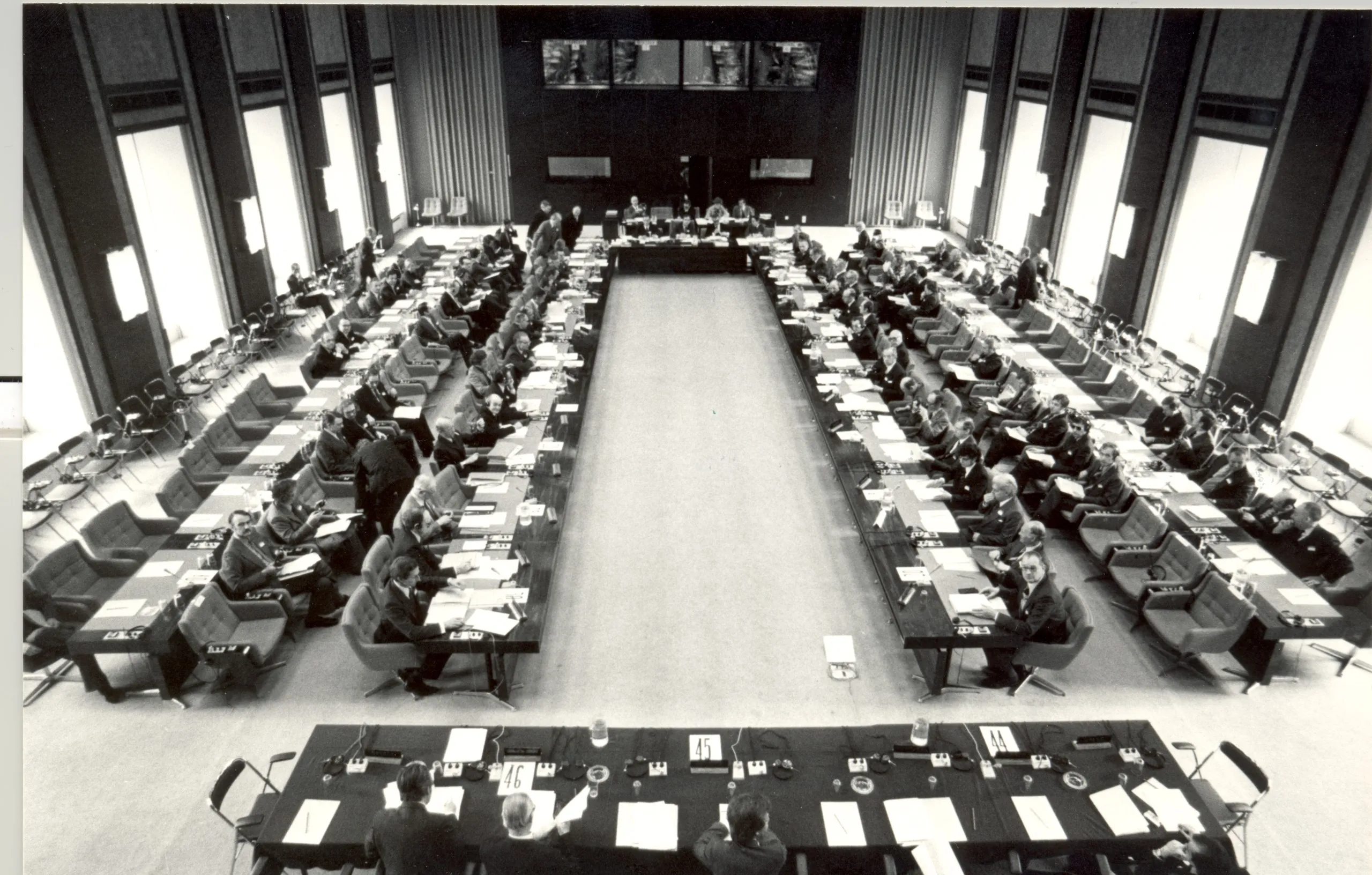
The European Space Conference, held April 15, 1975, in Brussels, approved the final draft of the ESA Convention. It was signed at the end of the following month, and ESA began operations. Credit: ESA
In the 1960s, two organizations were formed for cooperation around a European presence in space: the European Space Research Organization, which focused on scientific research, and the European Launcher Development Organization, which concentrated on engineering launch systems. By the end of the decade, however, dissatisfaction was growing with this split structure, and in 1968, the European Space Committee chose to merge the two into one agency. It was hoped the new European Space Agency would bring more ambitious space projects and successes to Europe.
After a series of conferences, the formal ESA Convention was signed on May 30, 1975, by 10 founding countries – Belgium, Denmark, France, Germany, Italy, the Netherlands, Spain, Sweden, Switzerland, and the United Kingdom. The newly formed agency became the third-largest space program in the world, following the U.S. and Soviet Union, and on May 31, began de facto operations. The convention would be ratified and the operations become fully official in 1980. Today, ESA is a collaboration of 23 member states plus associates, has its own launch capabilities, and is a pioneer in deep-space exploration.