
In 2019, astronomers recorded a distant star doing something unexpected.
For about an hour, its brightness gently flared before settling back down to baseline levels.
Its behavior matched no obvious stellar phenomenon – too long for a stellar flare, too brief for a supernova, and too smooth for most known kinds of stellar variability.
Now, after a careful probe into the event’s properties, astronomers say it could be a signal from one of the most elusive objects in the Universe: a tiny primordial black hole weighing only about as much as three of Earth’s Moons.
A black hole of that mass would have an event horizon about the same size as the period at the end of this sentence.
A team of astronomers led by Renee Key of Swinburne University of Technology in Australia say that no other explanation fits the event’s statistics quite so well, and so they’ve named the candidate black hole Phoebe.
“Phoebe suggests a population of compact, lunar-mass objects associated with the dark matter distribution of the Milky Way, and potentially opens a new window to the physics of inflation,” the team writes in a preprint posted to arXiv.
 frameborder=”0″ allow=”accelerometer; autoplay; clipboard-write; encrypted-media; gyroscope; picture-in-picture; web-share” referrerpolicy=”strict-origin-when-cross-origin” allowfullscreen>
We tend to think of black holes as really weighty, large objects – with masses starting at at least a few Suns, and ranging all the way up to tens of billions of Suns.
This is because of the way they form, starting with the death of a massive star whose giant core then collapses under gravity, giving birth to one of the densest known objects in the Universe.
Just after the Big Bang, however, conditions may have been just right to create much, much smaller black holes. Quantum fluctuations in space-time could have created overdensities in the expanding Universe that collapsed much as a stellar core can today.
These black holes are known as primordial black holes, and currently, they are only known to exist in the world of theory.
This could be because they are hard to detect. A primordial black hole the mass of Earth would be just 1.8 centimeters (0.7 inches) across.
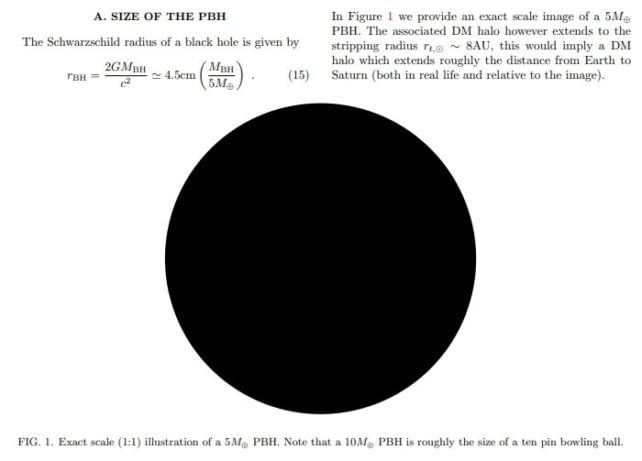 Actual size of a 5 Earth mass black hole, from a 2019 paper speculating on the nature of Planet Nine. (Scholtz and Unwin, arXiv, 2019)
Even if such a black hole did manage to have an accretion event, the light screaming from the material caught in its gravitational grasp would be barely a pinprick – not detectable from Earth with our current instruments.
But that’s not the only way we could detect a primordial black hole.
Even at very tiny diameters, the gravity around these objects would be extreme enough to bend space-time outside the event horizon.
This region of strongly curved space-time can act as a cosmic lens, and any background light passing through it would be magnified, producing a brief, gentle brightening before returning to normal levels – what is known as a microlensing event.
That’s exactly the kind of signal the Dark Energy Camera (DECam) recorded in 2019 when it turned its gaze in the direction of the Large Magellanic Cloud, about 163,000 light-years away from Earth.
The event took place on December 18, when DECam ran for five consecutive nights as part of the Asteroid-Mass Primordial black hole Microlensing (AMPM) survey.
For about 60 minutes, the light of a star in the Large Magellanic Cloud grew in brightness when its neighboring light sources did not.
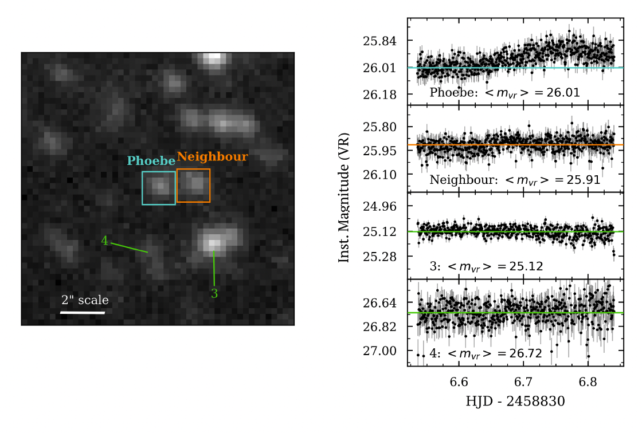 An image taken at the peak amplification of Phoebe, with light curves showing how its brightness flared when that of neighboring stars did not. (Key et al., arXiv, 2026)
Microlensing events are rare, but not unknown. Previous microlensing events have been attributed to stellar-mass black holes, tiny, dim stars and their attendant worlds, or rogue exoplanets drifting through space untethered from a star.
To find whether Phoebe could be a black hole, the researchers had to first rule out glitches in the instrument, stellar flares, contamination from other stars, and stellar fluctuations.
Then, they had to model different microlensing scenarios: a free-floating exoplanet in the Milky Way; a free-floating exoplanet in the Large Magellanic Cloud; and a primordial black hole in the Milky Way’s extended dark matter halo, away from the concentration of matter in the galactic plane.
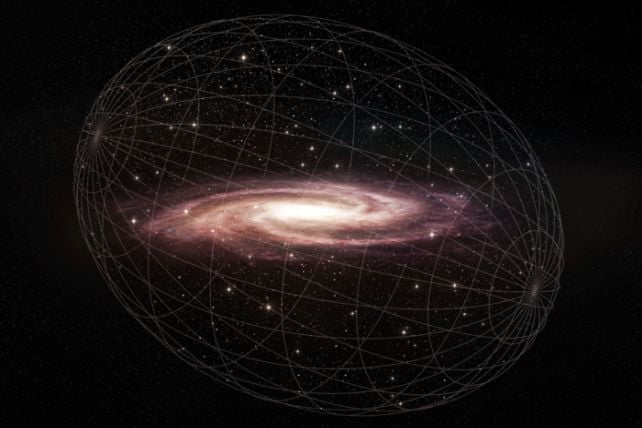 The Milky Way’s halo is the extended region around the galaxy disk. (Melissa Weiss/Center for Astrophysics | Harvard & Smithsonian)
According to their calculations, the lensing body, Phoebe – whatever it is – is five orders of magnitude more likely to belong to the Milky Way’s dark matter halo than to known stellar populations in either galaxy.
The preferred explanation is that Phoebe is a primordial black hole, about three times the mass of the Moon, located around 59,630 light-years away.
That doesn’t rule out a rogue exoplanet in the Milky Way’s halo. In fact, the rogue exoplanet is still firmly on the table, given that, observationally at least, rogue exoplanets are far more likely to exist and be detected.
But, in the Milky Way’s halo, which is only sparsely populated at best, a black hole is far more likely than a rogue exoplanet, which are generally thought to be more populous in regions of space that have a lot of stars.

The discovery lands smack-bang amid another debate.
In February 2026, astronomers in the US and Japan, analyzing data from the Subaru Telescope, identified 12 microlensing candidates toward Andromeda that, they said, could be due to primordial black holes.
Then, a different team from the University of Warsaw, Poland, reanalyzed the same data and uploaded their rebuttal in March, finding that every one of the events could be attributed to normal, known stars.
Related: LIGO May Have Detected The First Primordial Black Hole, Scientists Say
This new discovery is grist for this debate.
Key and her colleagues say their finding supports the original interpretation of the Subaru data that the events are consistent with primordial black holes.
Which means only one thing. We’re going to need a more sensitive telescope.
“Our detection motivates the Roman and Vera C. Rubin Observatory microlensing programs to support high cadence, sit-and-stare observations to boost the sensitivity to low-mass microlenses,” the team writes in their paper.
We can’t wait.
The preprint is available on arXiv.