
 ”
”
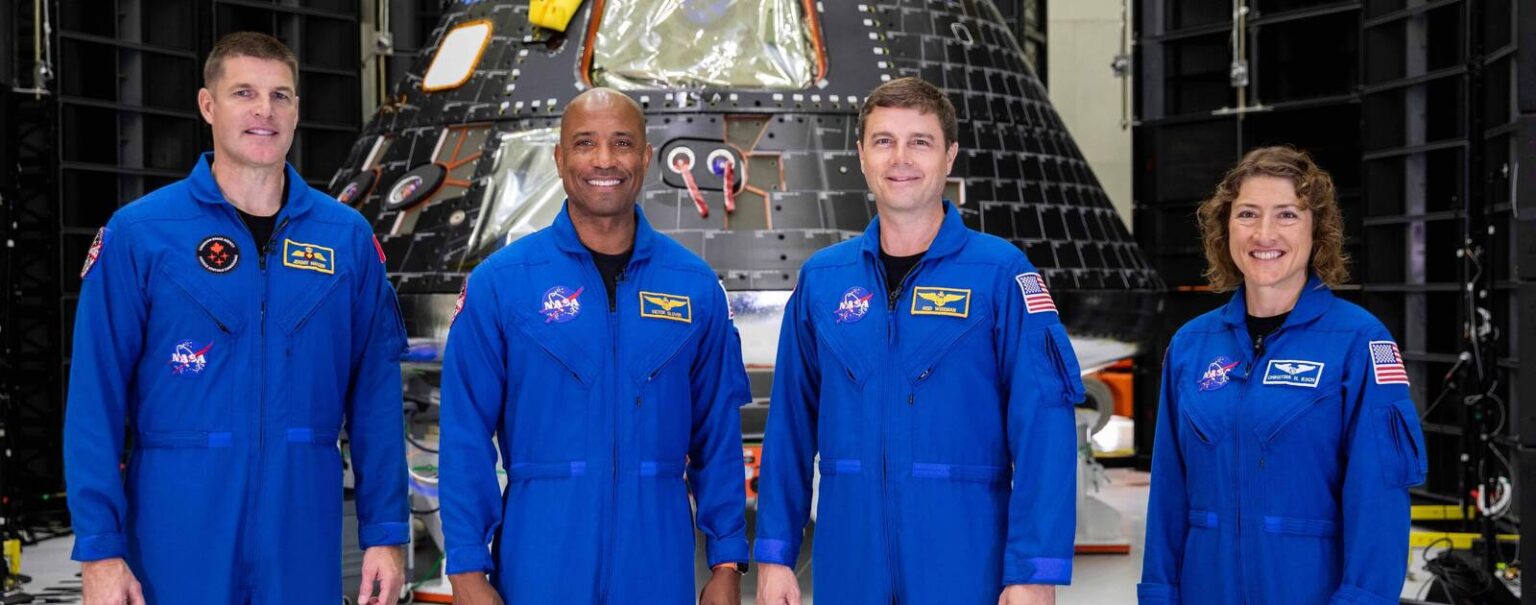
The Artemis II crew, featuring Jeremy Hansen, Victor Glover, Reid Wiseman and Christina Koch (pictured from left to right). Nasa
On Apr. 1, 2026, NASA’s Artemis II rocket officially launched, marking the first crewed lunar mission in over a decade. Breaking NASA’s record for most-watched launch, millions of viewers tuned in to see the rocket ascend into space, uniting our nation in a shared moment of great human achievement. The goal of this mission was to test deep space exploration systems to “establish an enduring human presence on the lunar surface” and to take “a crucial step toward eventually sending crews on to Mars,” said a press release from NASA. During a time when division seems so prevalent, the Artemis II mission has created a shared sense of pride. This pride is reflected in the diverse crew, being partly composed of Christina Koch, Victor Glover and Jeremy Hansen — the first woman, person of color and Canadian to fly to the moon, respectively.
The Artemis II crew reflects the great work NASA has put into making fields of science more accessible to people of all backgrounds. Programs at the forefront of this effort include the Minority University Research and Education Project (MUREP), which invested over $25 million last year in minority-serving colleges to provide hands-on experience that students need to become the next generation of space explorers. The MUREP initiatives include competitive research programs, internships, funding opportunities and various STEM challenges. These initiatives create a pipeline for those who have been historically underrepresented in the aerospace workforce. Through equitable STEM programs, NASA guarantees that any student, regardless of their ZIP code or socioeconomic background, has a fair chance at joining the next generation of leaders in space discovery.
This dedication to creating opportunity seems to have inspired common ground in Washington. In Jan. 2026, Congress passed the Commerce, Justice, Science and Related Agencies Appropriations Act, 2026, which rejected the Trump administration’s FY 2026 proposal to cut NASA’s budget by 24 percent. By rejecting the budget’s suggestion to enact major cuts to STEM engagement and a termination of the MUREP, which the Trump administration deemed “woke and misguided,” Congress saved the dreams of the 704,000 students reported by NASA to have participated in STEM engagement activities in 2025. In an overwhelming bipartisan victory, Congress passed the appropriations bill (with a 397-28 House vote and an 82-15 Senate majority), ensuring that the path to space exploration remains equitable and accessible.
Beyond politics, these missions are a reminder of our shared humanity as citizens of the Earth. Looking down from space, one does not see defined borders or cities, but instead one planet that belongs to everyone. As crew pilot Victor Glover puts it, “From up here, you all look like one thing … no matter where you’re from or what you look like, we’re all one people.” This perspective echoes the call of Pope Francis in “Laudato Si’” to hear “both the cry of the earth and the cry of the poor,” reminding us that our effort to achieve scientific accomplishments must match the effort we put in to care for one another on Earth. Ultimately, while these missions help us to better understand the physical world in which we live, they also help us remember the undeniable truth that we are all unified through our unique humanity.