
Welcome back to the Abstract! Here are the stories this week that spread life across space, went stir crazy for science, held the colony together, and peacefully sat it out.
First, what if we went all the way to Europa only to find that some earthly bacteria already set up shop there? Then: red rum on the Red Planet, the palace intrigue of tropical wasps, and an afterlife in full lotus.
As always, for more of my work, check out my book First Contact: The Story of Our Obsession with Aliens, or subscribe to my personal newsletter the BeX Files.
That’s one small step for a dust-borne bacterium…
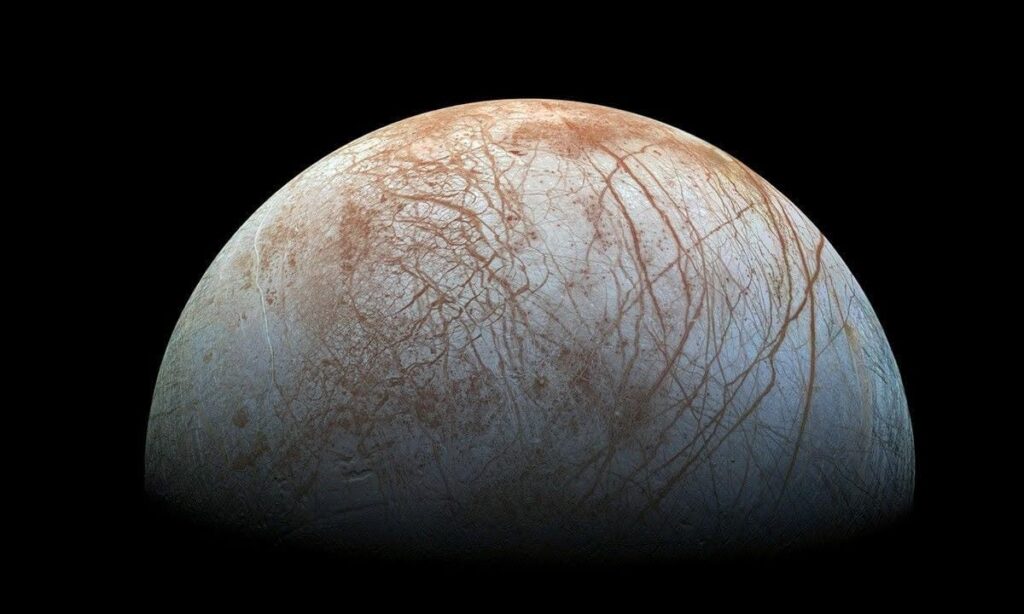
Europa, the ice moon of Jupiter, is considered one of the most promising candidates in the search for extraterrestrial life due to its vast subsurface ocean. But imagine what a trip it would be to not just find aliens on this world, but to learn that they originally hailed from Earth.
That’s the premise of a new study that investigates “the possibility of dust particles containing living bacteria ejected from Earth reaching Europa and landing on its surface,” according to author Zaza Osmanov of the Free University of Tbilisi.
“Life on Earth originated at least 3.55 billion years ago, which implies that for approximately that long, Earth has been shedding life-bearing particles into surrounding space,” Osmanov said in the study. “Hence, if favorable conditions exist elsewhere in the Solar System and can be accessed by dust particles, the transport of life from Earth appears plausible and may have been occurring over the course of several billion years.”
This idea that life might travel between planets, or even star systems, is called panspermia. In addition to Earth life potentially expanding beyond our planet, scientists have previously speculated that life on Earth was itself seeded by microbes from another world, such as Mars.
To game out a scenario in which earthly bacteria might reach Europa, Osmanov estimated the rate at which dust-borne bacteria is dislodged from Earth by impacts and how it might then endure a long journey through space and survive a crash into the icescape of Europa.
He concluded that many trillions of life-bearing dust grains from Earth could have reached the moon’s surface over tens of millions of years. From there, surviving microbes may have spent generations shimmying down through cracks in its ice shell, which is dozens of miles thick, into the dark waters of the ocean below.
A close-up of the fractures in Europa’s ice shell. Image: NASA/JPL/University of Arizona
Though the deck would be stacked against these microbes, the high number of dust particles that Earth sloughs off into space “renders the existence of life on Europa highly plausible,” according to the study.
It’s worth noting that panspermia remains a topic of heated academic debate, in part because there are so many uncertainties about the process. For example, H. Jay Melosh, the late geophysicist and panspermia expert, also assessed the odds that Earth life could relocate to Europa and came to the opposite conclusion as Osmanov.
“If life should be found in the oceans of Europa or Enceladus, it is very likely that it’s indigenous rather than seeded from Earth, Mars or (especially) another solar system,” Melosh said while presenting findings at the 2019 meeting of the American Geophysical Union, according to Space.com.
Ultimately, we won’t know until we go! NASA’s Europa Clipper is currently on its way to Jupiter to take a closer look at its namesake moon from orbit, and to scout out potential sites for surface exploration in the future. Perhaps decades from now we’ll finally be able to answer the tantalizing question of whether the seas of Europa are inhabited—and if so, if the aliens are homegrown or descended from spacefaring Earthlings.
In other news…
The Overlook Hotel, but it’s in space
It’s one thing for a bacterium to make an interplanetary voyage; sending humans across deep space is orders of magnitude harder—and not just because we are flimsy mortal fleshbags. There is also the psychological toll of spending months or years in a confined space on a long-duration mission, such a trip to Mars.
To anticipate these challenges, scientists enlisted 12 crew members on a 10-month overwintering mission at Antarctica’s Concordia Station to self-report feelings of loneliness and paranoia, while wearing proximity sensors that allowed the team to monitor their movements.
The Concordia Station, a French–Italian research facility on the Antarctic plateau. Image: Jessica Struder/ University of Zurich
The results revealed “a progressive deterioration in both individual psychological outcome and team dynamics” in which “loneliness and paranoid thoughts increased over time,” according to researchers co-led by Andrea Cantisani of the University of Bern and Jan Schmutz of the University of Zurich.
The team even singled out one participant who “reported unusually high scores…corresponding to severe levels of paranoid ideation.” Reading the study, it’s hard not to be reminded of John Carpenter’s The Thing, or the descent into space madness depicted in movies like Event Horizon or Sunshine.
Indeed, the authors shouted out Stephen King’s The Shining as a fictional precursor to the study’s finding that “prolonged isolation [and] constant proximity does not necessarily strengthen relationships but can instead amplify tension, mistrust, and psychological strain.”
In other words, if astronauts start seeing ghostly masked revelers, murdered children, and mercurial bartenders popping up in their Mars base, it’s time to pack it in and head back to Earth.
Stirring up a wasp’s nest—for science
Speaking of hostile social dynamics, it’s time to return to the “dynastic violence” beat. Long-time readers of this newsletter will know that I am a sucker for succession battles in eusocial animals such as naked mole rats or matricidal ants—which are ruled over by one breeding female queen.
This week, scientists updated the genre by watching what happens when you remove queens of the tropical wasp species Polistes canadensis, a shift that increased colony-level aggression “approximately tenfold,” according to a new study.
In the ensuing power vacuum, rival females vied for the crown through aggressive behaviors including bites, tackles, stings, and air fights. But even as some females took up arms (and stingers), the team was surprised to observe other wasps stepping into foraging or worker roles they had never occupied before to prevent the colony from collapsing in the chaotic interregnum.
Screenshot from the study. Image: Corbett, Owen R. et al.
“Contrary to our predictions, these findings support the theory that some form of compensatory mechanism exists in this species, buffering the conflict of queen succession,” said researchers led by Owen R. Corbett of University College London. “This system, in which some individuals compete while others compensate, could be what allows species like P. canadensis to maintain colony function despite aggressive contest-based succession.”
To channel Cersei Lannister: When you play the game of thrones, you win or you…compensate. While that doesn’t have quite the same ring as the original quote, the wasp colonies definitely weathered their dynastic struggles better than Westeros in the end.
Live by the lotus, die by the lotus
Last, it’s time to take a seat—for eternity. That’s the idea behind a rare funerary custom called “seated burial,” in which bodies are arranged in an upright sitting posture, in contrast to the far more common practice of being “laid to rest” in a supine pose.
In a new study, archaeologists examined four individuals who lived between the 7th and 9th centuries in what was then called the Chang’an region of northwest China and were buried in seated poses. The study offers “the first direct genetic evidence” to counter predictions that these burials imply a monastic lifestyle or a particular ethnic lineage, according to researchers led by Chenshuang Sun of Fudan University in Shanghai.
“Our genomic data contradicts the hypothesis that seated burials have a unique origin from ancestors in northern or northeastern Asia” as “we find no evidence of significant differences between seated burial individuals and their contemporaries,” the team concluded. “Although Buddhist symbolic artifacts, such as pagoda-shaped jars, were found in one tomb, isotopic evidence contradicts strict adherence to vegetarian Buddhist precepts.”
In addition to refuting the special status of the skeletal sitters, the study also includes interesting asides, such as records of Buddhist monks who ended up in “seated death” after “passing away in the full-lotus position.”
Seated burials have been unearthed across the globe, serving as a reminder to us all that we don’t have to take death lying down.
Thanks for reading! See you next week.