
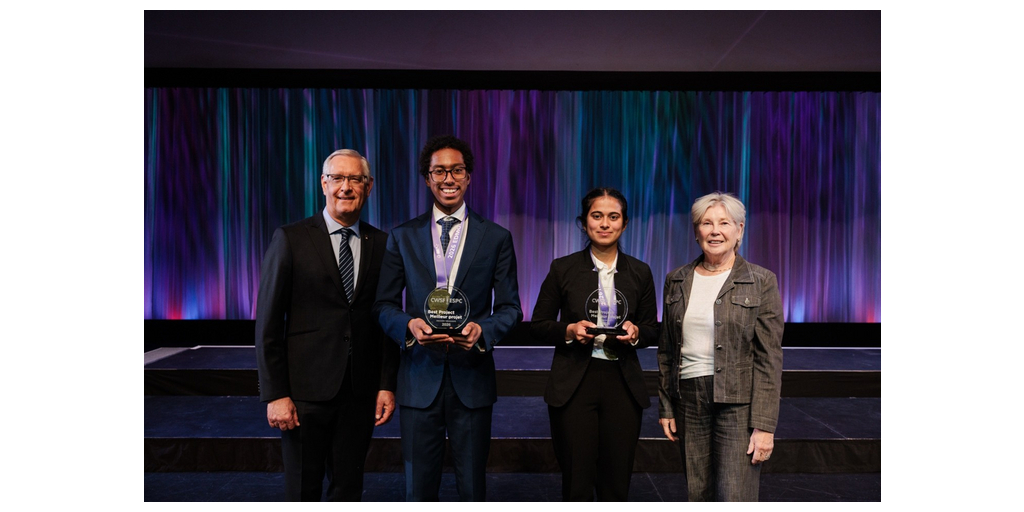
EDMONTON, Alberta–(BUSINESS WIRE)–Youth Science Canada presented the top awards at the 2026 Canada-Wide Science Fair (CWSF) on Thursday evening in Edmonton, Alta., where 390 student finalists from across Canada presented 344 projects and competed for nearly $2 million in prizes at the country’s largest stage for youth STEM projects.
Key facts:
Liam Desre from Kingston, Ont., won the Best Project Award – Discovery for proposing a new model of the universe’s expansion that does not require dark energy
Gurnoor Kaur from Waterloo, Ont., won the Best Project Award – Innovation for eliminating a 35-year-old demographic flaw in blood oxygen sensors
“When a Grade 9 student proposes a credible alternative explanation for the expansion of the universe and a Grade 11 student identifies and corrects a flaw in medical technology that has contributed to preventable deaths for more than three decades, it demonstrates what young people are capable of when their curiosity is encouraged and supported,” said Reni Barlow, executive director at Youth Science Canada. “That is exactly why Youth Science Canada exists, and this year’s CWSF finalists truly embodied that mission.”
Top winners, selected by over 250 judges, include:
Best Project Awards
Best Project – Discovery
Liam Desre, a Grade 9 student from Kingston, Ontario, for ΛCDM+S – Thermodynamic Cosmology: Simulating The Universe’s Expansion Without Dark Energy. His project proposed a new explanation for why the universe is expanding, one that does not require dark energy.
Best Project – Innovation
Gurnoor Kaur, a Grade 11 student from Waterloo, Ontario, for Eigenpulse: Eliminating Demographic Bias in Pulse Oximetry and Remote PPG from First Principles. Her project corrected a 35-year-old flaw in blood oxygen sensors that has contributed to higher mortality among Black patients.
Platinum Awards – Discovery
Best Junior (Grade 7/8)
Siddharth Patel, a Grade 7 student from London, Ont., for Automating Asteroid Detection Criteria to Strengthen Citizen Science for Planetary Defense. Patel, who has personally discovered two asteroids through the International Astronomical Search Collaboration, developed an automated system that helps volunteer astronomers determine whether faint moving objects in telescope images are genuine asteroids, improving the accuracy and reliability of citizen science efforts in planetary defence.
Best Senior (Grade 11/12/Cégep)
Audrey Cowen, a Grade 11 student from Toronto, Ont., for Harnessing Inhibition of Efflux to Reverse Antifungal Resistance. Cowen identified compounds that block the molecular pumps used by a common drug-resistant fungus to expel antifungal medication, restoring the drug’s effectiveness in killing the infection while confirming minimal toxicity to healthy human cells.
Platinum Awards – Innovation
Best Junior (Grade 7/8)
Willem Vuurmans, a Grade 8 student from Vancouver, B.C., for EXODEC: A Rational Design Framework for BBB Ligand Evaluation and De Novo Peptide Engineering. Vuurmans built a computational tool to evaluate potential treatments for brain diseases across five stages of crossing the blood-brain barrier, the biological filter that prevents most drugs from reaching the brain.
Best Intermediate (Grade 9/10)
Siddharth Rajesh, a Grade 9 student from Toronto, Ont., for APTAi: De Novo Aptamer Design for Proteomic Biomarker Detection Using a Physics-Informed AI Model. Rajesh developed an AI-powered platform to design aptamers, short DNA sequences used to detect disease-related proteins, providing a rapid alternative to the expensive, months-long laboratory process currently required to develop diagnostics for conditions such as sepsis.
The 2026 Canada-Wide Science Fair in Edmonton brought together 390 finalists from Grades 7 through Cégep, who presented 344 projects and welcomed more than 7,000 visitors during the public viewing days. The Canada-Wide Science Fair and STEM Expo continue in person at the Edmonton EXPO Centre today, Friday, May 29, until 2:30 p.m. MDT, after which projects will remain available online for public viewing.
The 65th Canada-Wide Science Fair will be held at the Hamilton Convention Centre and McMaster University from May 29 to June 5, 2027.
The Canada-Wide Science Fair is made possible through the generous support of sponsors, including Explore Edmonton, the National Science & Engineering Research Council, the Trottier Family Foundation and Youth Can Innovate, among many others.
The public is invited to meet the Best Project and Platinum Award winners at a panel hosted by Executive Director Reni Barlow on Friday, May 29, from 9:30 to 10:15 a.m. in Ballroom 101-105 at the Edmonton EXPO Centre. The panel will also be livestreamed on the Youth Science Canada YouTube channel.
https://cwsf-espc.link/2026-meet-the-winners
Media members are encouraged to participate.
Resources:
About the Canada-Wide Science Fair
The Canada-Wide Science Fair (CWSF) is Canada’s largest annual youth science, technology, engineering, and mathematics (STEM) event, bringing together top young scientists and their projects selected by the national network of over 100 regional STEM fairs. 390 students are judged across nine challenges, competing for nearly $2 million in awards and prizes. The fair is a program of Youth Science Canada. For more information, visit cwsf-espc.ca.
About Youth Science Canada
Youth Science Canada empowers all Canadian youth to engage their curiosity in discovery and innovation through STEM projects. A registered charity incorporated in 1966, YSC delivers on its mission through national programs, including mySTEMspace, the National STEM Fair Network, Canada-Wide Science Fair, STEM Expo, Team Canada representation at international fairs and Smarter Science professional development for teachers. Through these programs, YSC directly supports the more than 500,000 students who do STEM projects in any given year. For more information, visit youthscience.ca.