
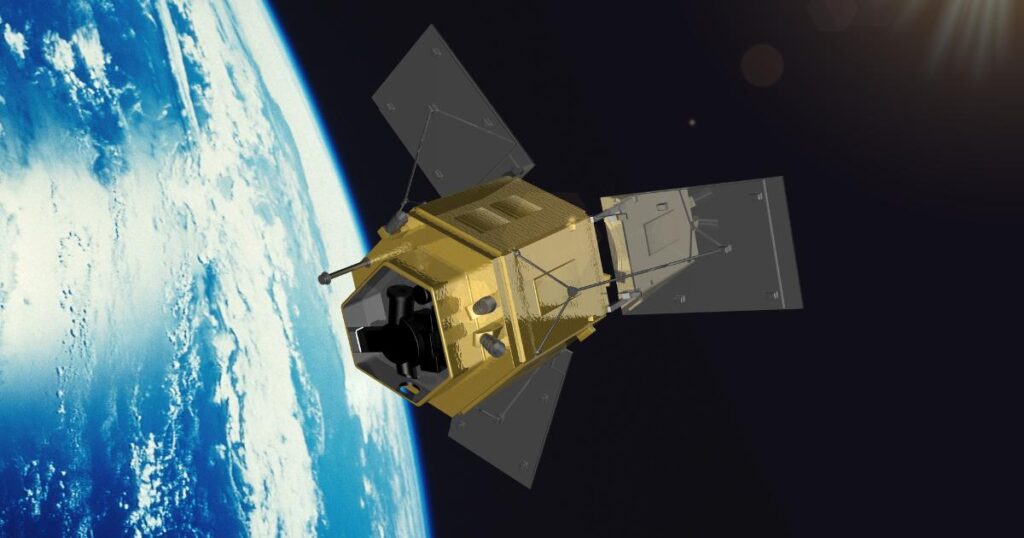
Developed by Leonardo’s space division for the European Space Agency’s (ESA) upcoming FORUM mission, the flight infrared detectors will enable scientists to capture global data on the far-infrared portion of Earth’s outgoing longwave radiation—a vital, previously unmeasured component of the planet’s energy balance.
Sarah Millo, space programme manager at Leonardo, said: “Far-infrared radiation is not usually measured by Earth observation satellites due to limitations of the available detectors for weather monitoring and climate missions.
“Our detectors fill this gap in climate models by validating actual far-infrared emissions against existing models so that a comparison can be drawn.
READ MORE: Port giant announces major leadership appointment
“This is only possible due to the detectors’ broadband of operation which has previously supported the Fourier Transform Infrared Spectrometer (FTIR) on Mars, so it is fantastic to see the technology being used much closer to home.”
The project is a collaboration between Leonardo, Airbus Defence and Space, OHB, and the European Space Agency.
Leonardo’s Southampton-built pyroelectric detectors, which have previously supported missions such as the Mars Rover and Osiris-Rex, will be integrated into a specialised instrument built by OHB.
Airbus was awarded the prime contract for the FORUM satellite in June 2022.
The detectors will help reduce uncertainties in climate modelling.
They do this by providing direct measurements needed to study thin ice clouds and other atmospheric components that impact how Earth loses heat to space.
Their data is expected to improve predictions of long-term climate change.
Felice Vanin of ESA said: “FORUM will provide a completely new class of measurements that have been missing from our observation system for decades.
READ MORE: Southampton firm named one of the best places to work in the UK
“By capturing the Earth’s far-infrared emissions, these detectors enable us to close a critical gap in the planet’s energy budget.
“This is not just an incremental improvement—it’s a step change in our ability to understand how heat is retained and released in the climate system.”
The FORUM mission is scheduled to launch in 2028.
It will enter a sun-synchronous orbit and begin collecting global radiation data to inform climate science.
In addition, Leonardo’s team in Italy is developing a secondary thermal infrared camera for the mission, targeted for delivery in June 2026.