
Enabling & Support
28/05/2026
2 views
0 likes
In brief
Rocket Factory Augsburg (RFA) has tested a new power pack design for an upgraded version of their Helix rocket engine.
Two successful hot fire tests were conducted at Esrange Space Center in Sweden.
The power pack design update and test campaign was financed via a ‘Thrust!’ contract through ESA’s Future Launcher Preparatory Programme.
In-depth
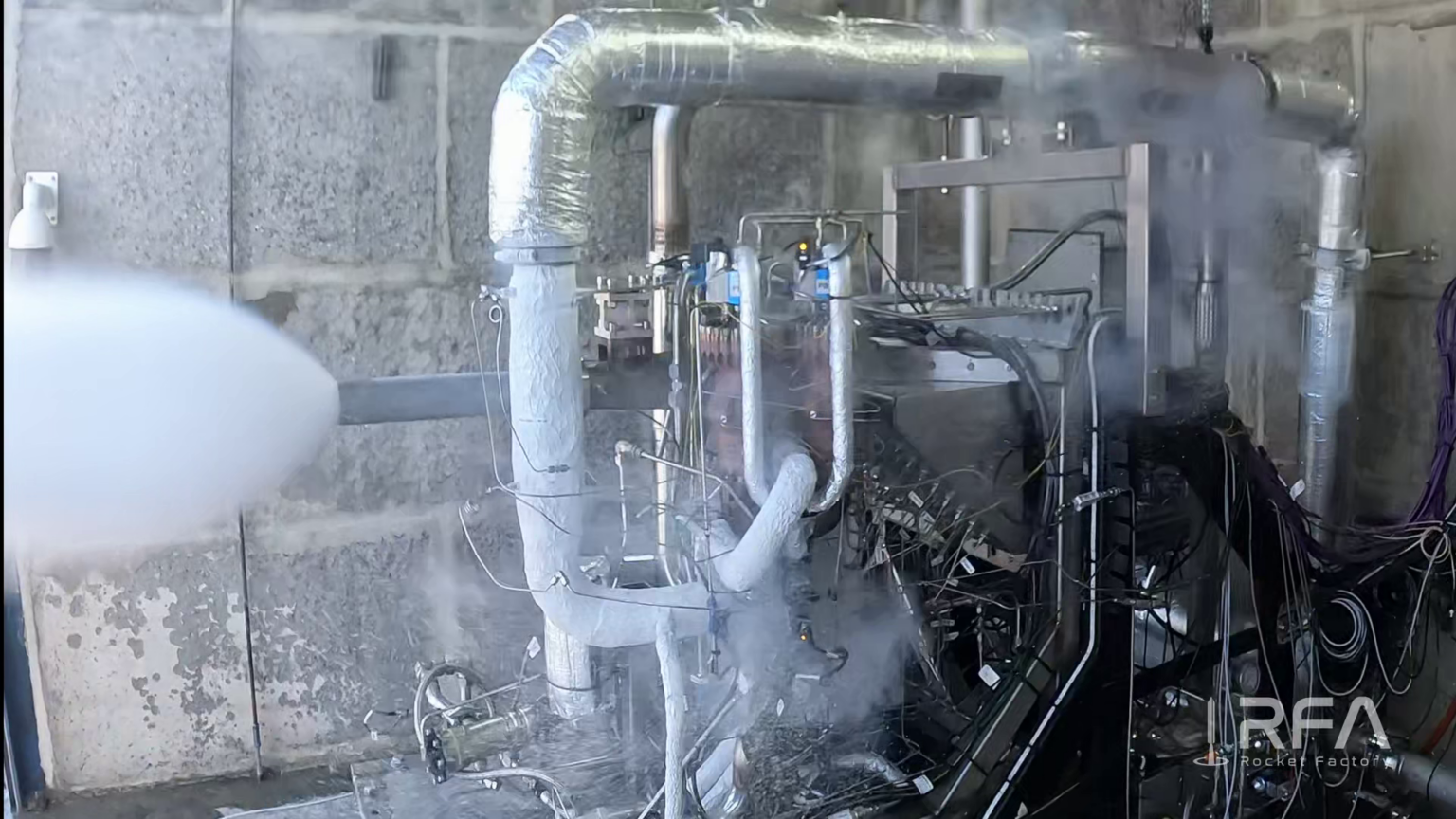
RFA’s Helix 2.0 power pack test fire
Rocket engines are designed and built to operate at the extremes of physics and engineering, burning propellant at incredible rates to propel rockets and escape the clutches of gravity. A typical orbital rocket stage will easily burn through 150 000 kg of propellant in a matter of minutes. Just getting the vast amount of liquid propellants to the combustion chamber at the flow necessary requires a high-powered system of itself: the power pack.
A rocket engine’s power pack provides everything needed to deliver liquid propellants from the tanks to the combustion chamber – exactly the right amount of propellant (fuel and oxidiser) at the right temperature and the right pressure.
In a staged combustion engine, a small amount of propellant is burned to produce hot gas that drives turbines. These turbines power pumps that push the propellants into the combustion chamber at high pressure. The more the pump can raise the pressure of the propellants, the lower the pressure in the tanks needs to be, enabling lighter designs but also the more efficient the engine the better the performance of the rocket. In rocket engine terminology, the pumps and the power pack “close the pressure cycle” – if the system cannot increase the pressure of the liquids as needed, the engine will not work.
Helix hot-fire by Rocket Factory Augsburg
Power pack people
RFA’s Helix 2.0 power pack test team
Rocket Factory Augsburg, based in Germany, has developed and tested their Helix engine – the first European engine to demonstrate staged combustion technology. This engine uses an oxygen-rich staged combustion engine cycle, where a small fraction of propellants is burned in a pre-burner to drive the turbine, and the resulting gases are fed into the main combustion chamber with the remaining propellants – getting every last drop of energy out of the propellant.
RFA are improving on their engine design with their Helix 2.0 model and have now completed a set of tests at Esrange Space Center in Sweden of a new power pack that ran at stable operations and at the physical limits of flow rates. Dr. Stefan Brieschenk, RFA Chief Operating Officer said, “Helix 2.0 is designed to deliver double the thrust, 200kN, for our RFA One launch vehicle, while mass, production technology and costs remain comparable to Helix 1.0. The result for our customers: more payload for a lower budget!”
RFA’s Helix 2.0 power pack test fire
Helix engines run on liquid oxygen and Rocket Propellant-1 fuel, so the power pack needs to pump oxygen at liquid temperatures below −218 °C at enormous speeds and turn it into a gas.
ESA’s Kate Underhill said, “Rocket development takes time and engineers always need to think many years ahead, thinking of new technology and testing for the future, it’s great to see how RFA is showing continuous progress and pushing their technology further.”
Step ahead: RFA One launch
Rocket Factory Augsburg launch tower at Saxavord Spaceport
Before Helix 2.0 roars, supplied by its power pack, a cluster of the first Helix engines are getting ready to power the RFA One on its first test flight. RFA has submitted its first application for a launch window. The RFA One rocket Test Flight 1 will be launched from SaxaVord Spaceport, located in the most northern island of the United Kingdom.
The power pack test was supported by ESA’s Future Launchers Preparatory Programme (FLPP) ‘Thrust!’ Initiative (Technologies for High-thrust Re-Usable Space Transportation), which accelerates the maturation and demonstration of high‑thrust staged‑combustion propulsion technologies in Europe, enabling future reusable launch systems and strengthening Europe’s competitive and autonomous access to space.
Two Thrust! contracts are running, including this one with RFA, with €9 million of ESA funding complementing co-funding provided by RFA, with more to come. Thrust! has the ambitious goal of staged combustion engine hot-fire testing delivering over 1000 kN of thrust in Europe in the early 2030s.
Rocket Factory Augsburg is also one of the European Launcher Challengers selected by the European Space Agency.
Like