
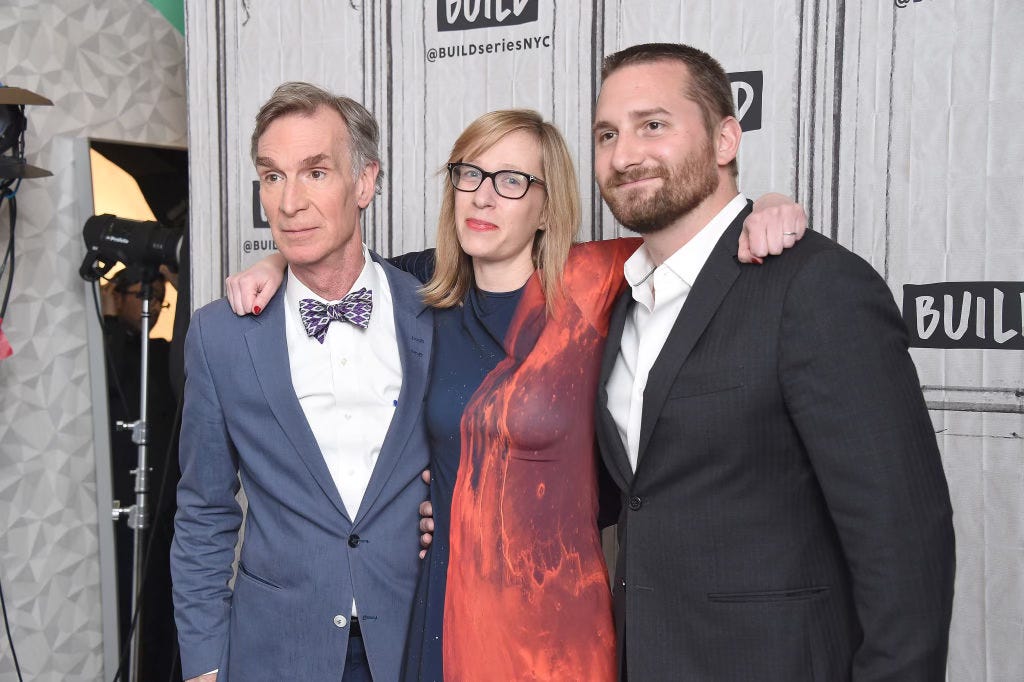
 Bill Nye, Dr. Kate Marvel and John Iadarola on April 18, 2018 in New York City. (Photo by Gary Gershoff/WireImage)
Kate Marvel spent more than a decade at NASA studying the future of life on Earth. Then the Trump administration made that job feel impossible.
“Instead of saying, we value your science and here’s how we’re going to protect it, we were being told things like, ‘Make sure you take your pronouns out of your email signature,’” she told HEATED. “That was the highest priority.”
Marvel, a prominent climate scientist, resigned from NASA in March amid the Trump administration’s sweeping attacks on federal science. Since Trump’s second term started, more than 10,000 federal employees with STEM Ph.D.s have left the government—mostly through layoffs, firings and buyouts—and more than 7,800 research grants were terminated or frozen. It’s, other words, a nerd purge.
In her resignation letter, Marvel wrote that she never expected to voluntarily leave her dream job. For her, NASA had always “conjured up a sense of awe and a promise that America could be a better place, one that provides its people with not only a good life but also wonder and discovery as a birthright.”
”I still believe in that promise,” she wrote. However:
I was wrong to believe it was enough to simply do good things, to think that the benefits of knowing about our home world would be self-evident. I anticipated that our work would be questioned, but only because its implications were politically inconvenient. I never expected that science itself would come under attack, simply because it—like journalism, history, and even the best kind of art—is a way of seeking the truth.
I’m leaving because I want to tell the truth.
In our conversation today, Marvel tells the truth about what’s happening to federal science under the Trump administration. We talk about the work she was doing at NASA before Trump, and why the administration would want to make that work difficult to accomplish. We talk about Trump’s nomination of a billionaire donor to lead NASA, and how he’s discouraging climate research. We also talk about one side-effect of Trump’s attack on science that no one is talking about: The loss of nerd culture, and why that culture is important to democracy.
Then, for paid subscribers, we keep going into one of the most controversial questions in climate science: geoengineering. We talk about what it means to study technologies that could intentionally alter the climate system, and why the collapse of trusted public science makes those future decisions even more dangerous. We also get into our feelings about the state of federal science, and the strategies we’re deploying to not just cope, but fight back.
This transcript has been edited for length and readability. You can listen to the full, unedited conversation at the top of this newsletter or on YouTube.
Emily Atkin: So what happened at NASA? Why did you leave?
Kate Marvel: I really wrestled with this decision. Because who leaves NASA? That is the coolest job ever.
But it was chaos. And there are some people who can work through chaos, who can just be laser focused. And I was really having a hard time getting science done. Every day we would wake up and be like, well, is this the day we get fired?
We would write grants, they would disappear into black holes, or you would hear back that this is a great project, we really want to fund this, but we have no idea if there’s gonna be any money. And because you’re getting no information from the high, high, high ups, it’s basically just rumors swirling around.
I really struggled. Because I think there is a place for folks in the government trying to hold things together. But it was my job to do science. And I just felt like I couldn’t do science in this context.
EA: This is a nerd’s worst nightmare, right? You got your dream nerd job. And all of a sudden, you cannot be nerd.
KM: I think that’s a great way to put it. This administration is so anti-nerd that it feels like a personal attack, not just on me, but the whole country.
EA: It’s true. Especially in science, the concept of nerdiness is that you’re gonna go down a rabbit hole that no one even thought about going down. And it sounds like what’s happening in the federal science space is that rabbit holes are being covered up. You can’t go down rabbit holes, unless they’re the preferred rabbit holes of the administration.
KM: Yeah, and those rabbit holes are pretty stupid. They’re relitigating questions that we know. It’s sort of like the equivalent of asking what happens when you mix vinegar and baking soda..
But pretending we really don’t understand if vaccines work? No, we do. We don’t know if climate change is happening? Yes, we do. We don’t know if it’s caused by humans? Yes, we do.
So I miss my rabbit holes, because I knew that my rabbit holes were maybe eventually going to lead us somewhere better.
EA: What were the rabbit holes that you were diving down when NASA was functioning well?
KM: My research followed two basic but related tracks. One was: What does climate change actually mean? On one level, we know what it means. It means the temperature of the Earth goes up.
But how that translates into changes in what we actually experience—changes in drought risk, changes in rainfall, especially extreme rainfall, things like the seasons, things like the timing of the monsoon—those are questions that are more difficult to answer.
The second part of my research was feedbacks. We don’t have a great understanding of what the Earth does when you increase carbon dioxide this quickly. And the reason we don’t really have that good understanding is we’ve never done this experiment before. And it was one of my interests to try to understand and constrain some of those feedback processes.
EA: These are big scientific questions. They’re things that we need to know to make good policy choices, to protect ourselves and to prepare for what’s coming. Is NASA no longer studying these things?
KM: I want to be really clear that there are amazing scientists still in this organization who are doing amazing work and fighting really hard to keep doing amazing work.
But we are losing something—and not just at NASA, but at the NSF, the DOE, the NIH. We’re losing this neutral arbiter of science.
I’m not saying that scientists are not human beings with our own values and preferences and feelings. But we’re also nerds. And when you have big federal systems full of nerds, indoctrinated in the culture of being nerds, of always asking questions, of changing your mind when the evidence dictates that you should change your mind—if we lose that sort of universally agreed upon source of objective reality, I think we just have massive problems as a democracy going forward.
EA: How is the Trump administration specifically changing or harming the culture of federal science? That nerd culture you speak of, where we look at the evidence and we change our mind if there’s a problem.
KM: At the highest levels, putting political appointees in positions that are fundamentally not supposed to be political. There have been a lot of these newspaper reports of DOGE going through grants and automatically canceling or refusing to review grants with specific bad words—things like diversity or woman or climate or future or Earth.
EA: Woman, a famously political word.
KM: Exactly. Should they vote?
And as a result, there is kind of this reflexive urge to self-censor. It comes from a good place. It comes from, well, I think this is an interesting question. And if I change a word here and there, am I gonna be allowed to continue asking this interesting question?
But that is obviously a slippery slope. Because you start changing words in a way that is very moral and defensible, then where’s the limit? At what point do you say, I have fundamentally altered the research question?
Having to hide things does things to you. It does things to your science, it does things to your soul as a person.
EA: It’s interesting because yes, the Trump administration slashed a bunch of funding for science, went in and did cuts and firings, but you still had a job. So what did your job look like under Trump, and why were you like, I can’t do this?
KM: My job was to do science, and it was really unclear how long that would continue. It was unclear what exactly I was supposed to be doing because, again, I’d written grants saying I want to do this project. They had been peer reviewed, we had been told, okay, you can do this project, this sounds like a good idea, but then there was no money.
I’m good at making work for myself. I’m good at continuing to do the science, even when it’s not really clear exactly what I’m supposed to be doing. But every day we’d wake up and think: Are we gonna get fired today? Are all of our grants gonna get canceled today? What words are we not allowed to use today?
And it felt that at the highest levels, instead of saying, we value your science and here’s how we’re going to protect it, we were being told things like, make sure you take your pronouns out of your email signature. That was the highest priority.
EA: That’s so annoying, by the way.
KM: The greatest problem facing America.
EA: So you were at NASA during the first Trump administration as well, correct? What was different then between that administration and this administration?
KM: Yes. The first time we had an administrator who was essentially a NASA fanboy. He really loved NASA and he wanted to take care of NASA. And we were very largely protected from political interference the first time around.
This time around it felt distinctly different because of the chaos. We had an administrator who was nominated, then he was un-nominated. And after he gave a million dollars to a Trump PAC, and he was renominated. [Editors note: It was actually $2 million].
One of the last straws for me was reading an interview with him in Science Magazine, which is one of the leading journals for nerds. It’s a nerd newspaper. And in this interview, he said, well, it’s just not good for NASA to be seen convening scientists or publishing papers on politically controversial topics.
And I was like, it’s not our fault it’s controversial, Jared.
EA: Of course his name is Jared.
KM: I’m sure there are nice Jareds out there! But this particular Jared just did not give me a lot of confidence that he was going to stand up for our science.
[Editor’s note: NASA Administrator Jared Isaacman’s full quote was: “For NASA to assemble scientists and put out papers on politically charged issues, whether or not this is an impending climate catastrophe, is not helpful to the broader NASA mission.”]
EA: What can you communicate about the experience of federal scientists overall under this administration?
KM: I think there is a certain amount of bewilderment.
A lot of scientists were the kids who got the A’s in school, the kids who worked really hard, the kids who went to graduate school, the kids who sat down and really kind of wrestled with the math and the methods and the sometimes really boring hard slog of science. And most of us did that under the assumption that everybody thinks this is a good thing to do.
It is good to cure and prevent diseases. It is good to do research and development that then filters down into the private sector and makes a lot of money for people and boosts the economy. It is good to have information about the weather, about the climate.
I think we all kind of assumed that this was universal, that essentially everybody believed it. And it has been a shock. A lot of people are saying, well, you guys are so naive. And maybe we were. But it has felt very shocking to be attacked for doing the science.
I kind of expected that we would be targets as climate scientists. What I did not expect was that they would go after pediatric cancer research first. And that has been very, very confusing. Why are we under attack? What did we do wrong? Why does everybody hate us all of a sudden?
EA: Do you have any idea?
KM: Totally out of my wheelhouse, but there are politically motivated attacks on science. The conclusions of climate science are very inconvenient to a lot of people.
But I think there is a more general attack on science, and I think it completely mirrors the attack on journalism. Because science and journalism are both trying to do the same thing: figure out what’s true and tell people about it. And sometimes if what’s true contradicts what the administration is saying is true, that is very, very, very threatening to the administration.
I think you see that in authoritarian regimes worldwide and throughout history, that you want to have a very tight grip on the control of information. You want the government to be able to say what’s real and what’s not. George Orwell articulated this really well. If the party says two plus two equals five, two plus two equals five.
And it doesn’t matter that that’s transparently wrong. The point is to force loyalty to the regime by getting people to go along with things that they know are wrong.
EA: So dark.
KM: It’s so dark. But as I became an adult, I was like, those stories that they read you when you’re a kid where there’s good and there’s evil, those are totally unrealistic. In the real world everything is nuanced.
And that has been very interesting for me to realize that no, wow. There’s good and evil. In this particular scenario, it is so obvious to me what the right thing to do is. The battle between scientists and authoritarians, I know what side of this divide I’m on.
EA: I keep thinking about that quote from NASA Jared that really sent you over the edge, that “it’s not good for scientists to dive into controversial topics” like climate. And it occurs to me, who else besides scientists would you want to dive into controversial topics? What do we lose by avoiding federal scientists diving into controversial topics?
KM: A lot. Especially because this is not a hypothetical. Climate change is happening. It’s happening now. It will continue to happen.
And as it gets worse and worse, we’re gonna start seeing ideas being floated, right? We’re gonna start seeing people saying, well, let’s try to somehow refreeze the ice sheets. Let’s try to suck carbon dioxide out of the air and bury it. Let’s try to block the sun by spraying particles into the stratosphere.
All of those things are controversial and all of those things are going to require trusted scientific input. I’m not saying scientists should make these decisions. But I do think that we need to have that information on the table to make decisions. And if we don’t have a knowledge base, that is incredibly dangerous.
EA: You’re saying that the federal government is the best place to do that type of science, to be the arbiter of this research, right? Can you tell me a little more about why you think that is?
KM: Most basic science is federally funded. Even if there’s a university doing scientific research, a lot of that funding will come from federal sources. And the reason we do that is everybody benefits from this, but there’s no clear profit motive to find out stuff about the world. Once you find out stuff, then there is a clear profit motive to use it. But there has been this recognition that that can’t be left to the private sector.
There’s been this consensus ever since World War II that this is a good thing, that we get enormous return on investment for every dollar that we spend on research and development. And I think the fact that we spend more on research and development than any other country, and we have the biggest economy—those two things are not separate from each other.
EA: I also want to go back to what you were talking about, spraying aerosols in the atmosphere and using geoengineering. I recently came across this excerpt from your book in the Wall Street Journal. The headline is, “To fight climate change, we need to start hacking nature.” It kind of makes it seem like you’re saying that in order to fight climate change, we need to start geoengineering the planet. Is that what you were saying?