
Highlights
The NASA-led Gateway Program is an international collaboration to establish humanity’s first space station around the moon as a vital component of the Artemis campaign.
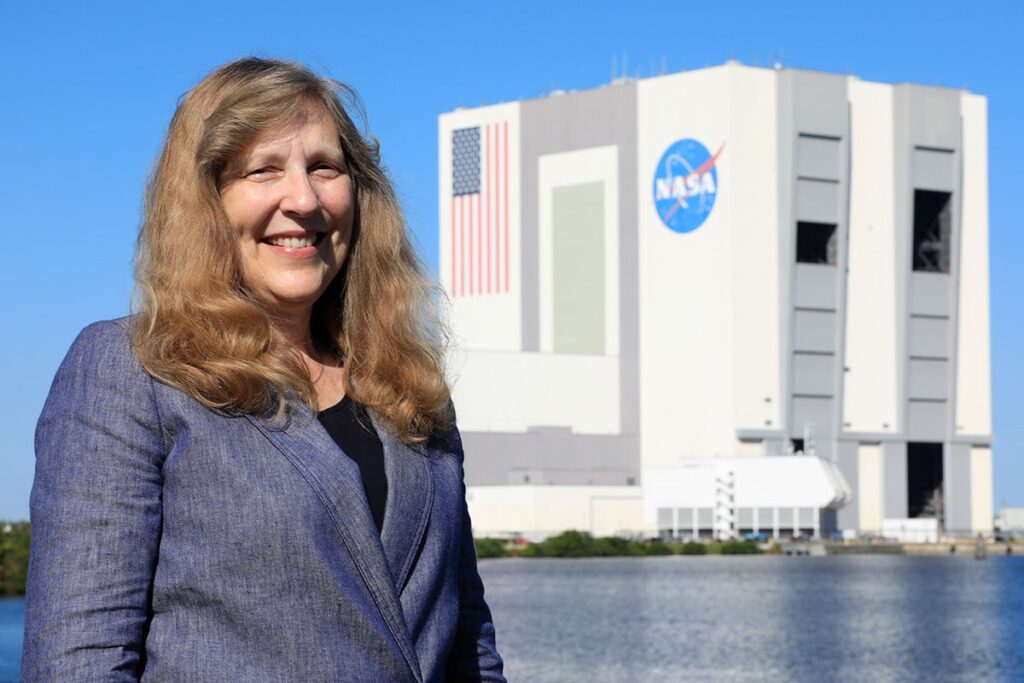
Industrial engineering graduate Teresa Kinney ’11MS is firmly entrenched in the Deep Space Logistics (DSL) Project at Kennedy Space Center, serving as the daily focal point for Gateway logistics.
Kinney and her team are responsible for coordinating the transport of cargo and essential supplies — including food, water and oxygen equipment — as well as replacement parts, personal items and specialized payloads for the future space station.
On any other night in 2027, the workday might have followed Teresa Kinney ’11MS home to Merritt Island, just a few miles from Kennedy Space Center. There, the UCF alumna could stand in her backyard, look toward the stars and imagine the fruits of her labor streaking across the Florida sky.
But if all goes as planned, Kinney won’t be envisioning the moment from a distance. As a chief engineer for NASA’s Gateway—the ambitious mission to establish a space station in lunar orbit—she will be inside Mission Control, monitoring the thunderous ascent of a SpaceX Falcon Heavy as it carries her work toward the moon.
Leading up to launch, Kinney is firmly entrenched in the Deep Space Logistics (DSL) project at KSC, serving as the daily focal point for Gateway logistics.
As the first female chief engineer in the history of KSC, Kinney performs technical evaluations and provides critical recommendations to DSL management and the engineering director at KSC and the Gateway Program’s chief engineer at Johnson Space Center in Houston. Her work ensures the safe, reliable delivery of equipment, commodities and payloads to the Gateway lunar space station via the SpaceX Falcon Heavy, which is a vital step toward sustaining human missions to the moon, Mars and beyond.
“My main role is to make sure Deep Space Logistics and the Gateway [Program] are successful in executing the logistics delivery part of the mission from a technical perspective,” says Kinney. “I make sure technically that the design is worthy of moving forward to the next phase, that we’re looking at all the right thermal, dynamic and radiation environments and making sure the integration of hardware, including electronics and other parts, are coming together the proper way. The chief engineer is the final technical authority for the project.”
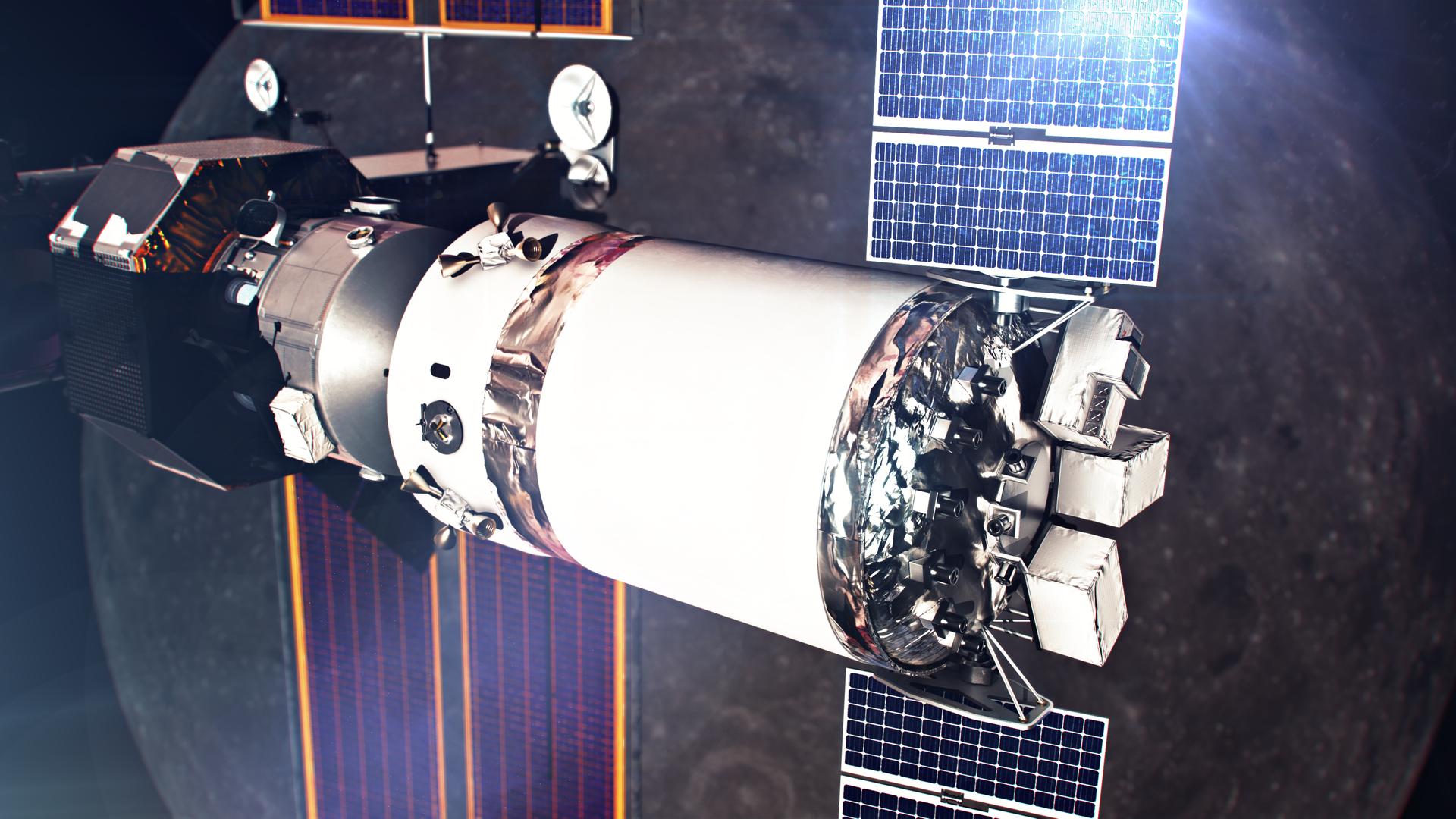 NASA has awarded the first Gateway Logistics Services contract to SpaceX to deliver cargo, experiments and other supplies to Gateway for the Artemis IV mission in September 2028, the first time that crew will travel to Gateway. (Credit: Alberto Bertolin, Bradley Reynolds)
Gateway to Deep Space
With the capability of carrying 140,600 pounds of payload to low Earth orbits, the SpaceX rocket will initially transport two foundational components for Gateway to become operational.
One is a solar electric propulsion system that will provide power, high-speed communications, altitude control and the capability to move the space station to different lunar orbits.
Another module will serve as Gateway’s command and control hub, which will include pressurized living quarters for astronauts visiting the space station as well as docking ports for vehicles, lunar landers and cargo spacecraft.
Subsequent missions to Gateway will deliver more modules and components, including the Deep Space Logistics spacecraft. This milestone will amplify the role of Kinney’s team, responsible for coordinating the transport of cargo and essential supplies — including food, water and oxygen equipment — as well as replacement parts, personal items and specialized payloads like the extravehicular robotics arm.
“We are the means by which cargo and commodities will be transported to the Gateway, which will essentially function as a lunar space station,” Kinney says. “Reliable delivery to and from the Gateway is essential. While some visiting vehicles will bring additional capabilities and crew, our role is to provide the full suite of supporting materials and resources required for sustained operations.”
When she says full suite of supporting materials to the Gateway, she’s not kidding.
The logistics of transporting everything from a robotic arm and spare parts to shaving supplies and freeze-dried vegetables must be highly choreographed. It’s a concerted type of effort Kinney first learned at 12, when she helped her dad install air conditioning in the family’s Chevrolet station wagon.
“We were living in Alabama and were going to Disney World but couldn’t make the drive to Florida without air conditioning,” Kinney says. “I was small enough that my dad slid me up under the dashboard and started handing me parts, asking me to connect things. At some point I realized, ‘I can do this.’ It was the first time I had ever completed a mechanical task entirely on my own.”
Career Takes Off
The hands‑on auto repair experience ignited an interest that would shape her future career, centered on what she enjoys most: putting things together.
Before landing a permanent job with NASA at Kennedy Space Center in 2005, Kinney earned a mechanical engineering degree from the University of Alabama in Huntsville and gained experience for two decades as a contractor supporting the space shuttle rocket booster Spacelab and International Space Station (ISS) programs at the Marshall Space Flight Center.
As a structural dynamitist at NASA, Kinney embraced the massive challenges of loads analysis and modal testing of large space structures as well as the freedom to express ideas and uncover fresh possibilities.
“I never had any roadblocks in front of me,” says Kinney. “They were like, ‘Here’s the work. Here’s your part of it, Teresa. If you have problems, come and talk to us.’ No one ever treated me in a way that wasn’t wonderful and supportive.”
UCF Landing
Kinney recognized if she were ever to lead an interdisciplinary team, she needed more training beyond structural dynamics, acoustics and load analysis. Nearly 30% of Kennedy Space Center employees are UCF alumni, so she knew exactly where to turn to.
“UCF has a great reputation and the proximity, but it took me years to say, ‘OK, start doing a master’s,’ ” says Kinney, who attended most classes at KSC through a special program while working full time, often putting in 60-70-hour weeks to earn a master’s in industrial engineering.
“You never know what opportunities might be waiting in front of you.”
Kinney applies that same dedication toward everything she does, whether she’s building bookcases with her husband, a retired NASA engineer whom she worked with at the Kennedy Space Center, or encouraging youth to pursue careers in space exploration. She offers the same advice she gave her daughter, Julia Kinney ’19, who works at a cancer center, and son, Jackson, an aerospace engineer who followed in his mother’s footsteps to work at the Marshall Space Flight Center.
“Don’t be intimidated,” Kinney says. “Don’t see things as too hard — see them as challenges. You never know what opportunities might be waiting in front of you.”