
Hey everyone,
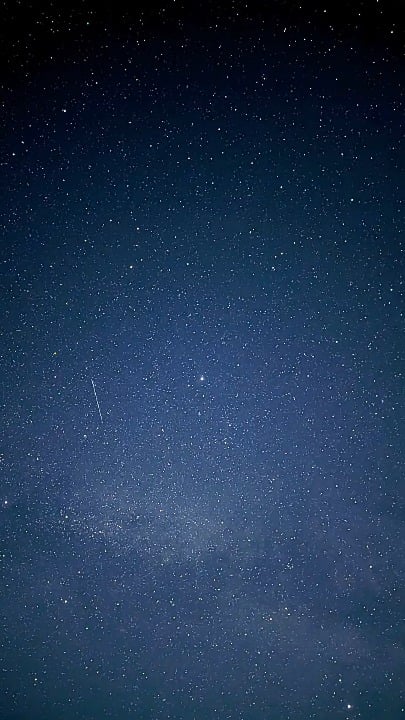
Just wanted to share a fascinating 4-minute computational time-lapse exposure captured with a Google Pixel 9a in Astrophotography Mode. The footage was taken from a dark-sky pocket in Lower Saxony, Germany (near Stoetze/Nievelitz), and subsequently slowed down in post-processing to analyze the orbital mechanics at play.
The results serve as a textbook visual comparison between künstliche orbital infrastructure and sporadic hyper-velocity atmospheric entries.
Here is the technical and astronomical breakdown of the sequence:
**Technical Profile: PXL_20260524_230838541**
* **Device:** Google Pixel 9a
* **Aperture/Mode:** Native Astrophotography Mode (Automated 15\text{-second} sub-exposures stacked internally over a 4\text{-minute} total integration window).
* **Location:** Stoetze / Nievelitz, Lower Saxony, Germany (Transition zone to the Wendland region—one of Germany's lowest light-pollution areas, bordering Bortle 3/4).
* **Epoch:** May 24, 2026, at 23:08 CEST.
### 🔭 **Deep Sky Targets & Frame Orientation**
* **Framing:** Pointed directly at the Zenith.
* **Target Constellations:** **Cygnus (The Swan)** and **Lyra (The Lyre)**.
* **Anchor Star:** **Vega (\alpha Lyrae)** shines prominently as the brilliant blue-white Type-A main-sequence star in the upper center frame (V_{\text{mag}} = 0.03).
* **Galactic Structure:** The dense background structure is the local spiral arm segment of the **Milky Way**. The composition cleanly resolves the **Cygnus Rift (Great Rift)**—the massive, cold interstellar dust lane blocking the light of distant background stars along the galactic disk.
### ☄️ **Orbital Intercept Analysis (Meteors vs. Hardware)**
**1. The Highlight: Sporadic Fireball / Bolide (~00:03 – 00:04)**
* **Visual Profile:** A classic aerodynamic ablation curve. It enters the frame from the left as a thin ionization trail, rapidly flares into a brilliant diamond-shaped plasma envelope due to extreme atmospheric compression, and terminates in a sudden vaporization blackout.
* **Physics:** Given the date, this is a **sporadic meteor** rather than a shower remnant. The physical progenitor was likely no larger than a grain of sand, accelerating to an entry velocity between 30\text{ and }70\text{ km/s} (100,000+\text{ km/h}) at an altitude of roughly 80\text{–}100\text{ km}.
**2. LEO Satellite Network Crossing (~00:01 – 00:03)**
* **Visual Profile:** In stark contrast to the meteor, these tracks exhibit perfectly uniform linear trajectory and unchanging magnitude.
* **Dynamics:** You can clearly see a "crossing junction" of distinct Low Earth Orbit (LEO) orbital planes. The parallel lines moving from the lower right are a freshly deployed **Starlink train** (likely from the *Starlink 10-47* launch earlier that day), maintaining identical inclination but separated chronologically, which the phone translates into parallel lines due to Earth's rotation between sub-exposures.
### 🛠️ **Sensor & Processing Artifacts**
* **Stellar Alignment:** The on-board computational stacking algorithm completely negates field rotation over the 4-minute window, locking the stars into pinpoints while allowing orbital objects to form continuous vectors.
* **Thermal Hot Pixels:** Microscopic RGB color-flashing pixels are visible upon close inspection. This is standard thermal noise generated by the small smartphone sensor during continuous long exposures without a dark-frame subtraction pass.
* **Horizon Flutter:** The very bottom edge of the frame features a subtle "wobble" in the tree silhouettes, which is a structural artifact of the software's alignment matrix favoring the celestial coordinate system over the terrestrial horizon.
*Clear skies! Feel free to ask about the post-processing or the location if you're planning a Bortle-hunting trip to Northern Germany.*
by Obvious_Factor7103