
SITAEL announces a growth plan targeting €200 million in revenues by 2031, currently supported by over €150 million in backlog and nine launches planned by 2030.
The company confirms its role as prime contractor for ESA’s Scout HiBiDiS mission, strengthening its position in European space infrastructure.
MoU signed with Eycore: new collaborations in Earth observation and advanced satellite services.
SITAEL, the Italian private space company and part of Angel Holding, presented its growth strategy at SmallSat Europe Amsterdam, built on ten years of investment in satellite platforms, electric propulsion and production infrastructure. The plan fits within Europe’s new space cycle, in which secure communications, Earth observation, defence and technological sovereignty require robust industrial capabilities.
“Europe is entering a new space cycle. SITAEL is ready to industrialise it,” said Chiara Pertosa, CEO of SITAEL. “For years, we invested ahead of the market. Today, the market is moving towards the capabilities we have built: facilities, platforms, propulsion, missions, customers and a clear growth trajectory.”
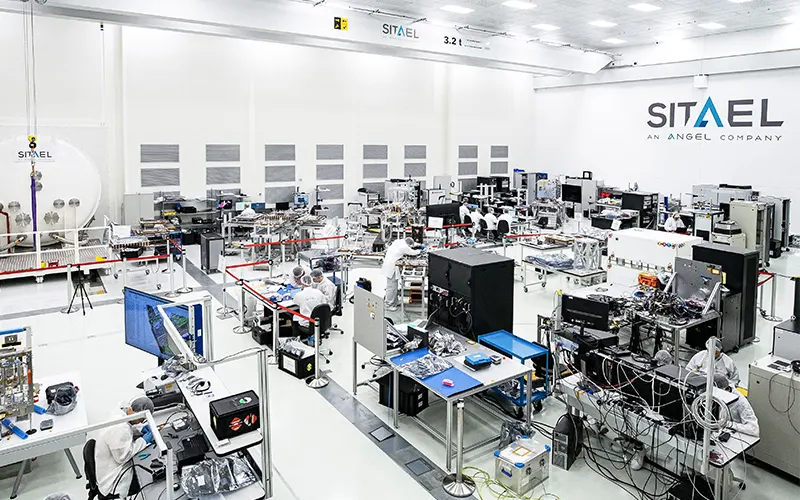
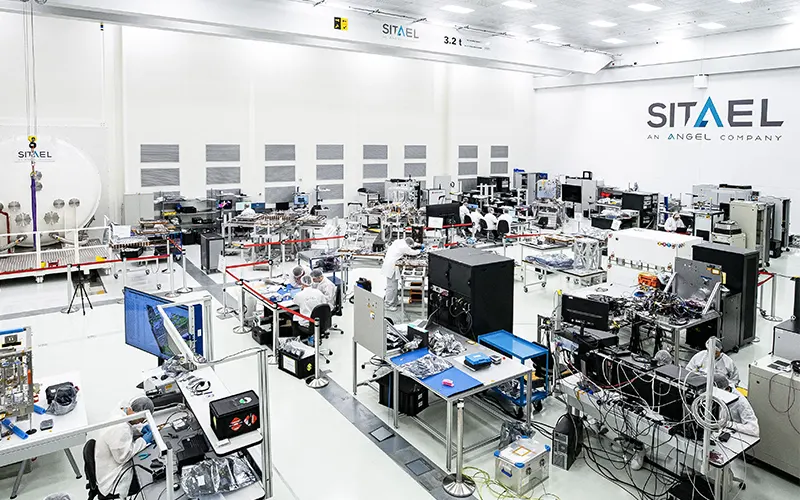
SITAEL operates through two industrial hubs in Italy: Mola di Bari, with a state-of-the-art clean room and five satellites under construction simultaneously; and Pisa, where a production line for Hall-effect electric propulsion was inaugurated in July 2025.
The combination of proprietary satellite platforms and electric propulsion sets SITAEL apart in the fields of constellations, orbital management, space sustainability and Very Low Earth Orbit missions. The company develops solutions based on the NextGen and EMPYREUM platforms and has launched with ESA the concept for a propellantless RAM-EP thruster for very low orbits.
To date, SITAEL has completed 29 space missions and employs around 280 people, with a net workforce growth of at least 10% per year. The company has eight satellites under construction, two platforms under development, thrusters undergoing qualification and a backlog exceeding €150 million.
The plan targets revenue growth from the current level of approximately €60 million to around €200 million by 2031, with EBITDA expected to rise from 12% towards 25%. The pipeline includes nine launches between 2026/2027 and 2030: PLATINO 1, EAGLE-1, five IRIDE satellites, PLATINO 2 and ESA’s Scout HiBiDiS mission.
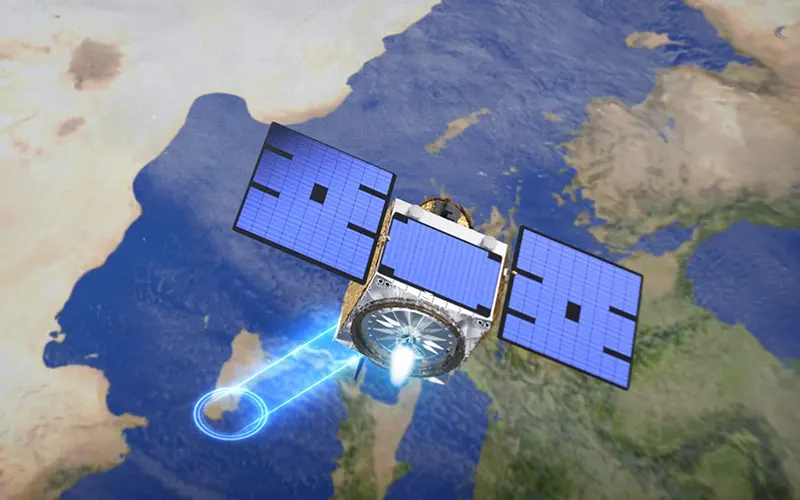
HiBiDiS, expected to launch in 2030, confirms SITAEL as prime contractor for a complete ESA mission and strengthens the role of EMPYREUM, the platform developed by the Italian company for high-performance missions. Dedicated to the study of biodiversity, the mission will contribute to the development of advanced tools for monitoring ecosystem sustainability and resilience, with a particular focus on forest environments. The mission will be led by SITAEL together with leading partners, including AMOS for the hyperspectral instrument, VITO and the University of Zurich for data processing and the scientific case.
“HiBiDiS is more than a new contract,” added Pertosa. “It confirms our evolution towards becoming a European mission company, capable of combining platform, payload, integration, data and impact.”
Arnaud Dartevelle, Managing Director of AMOS, said: “HiBiDiS is the kind of mission AMOS was built for: ambitious science, an uncompromising schedule, and a first-class European team led by SITAEL. With our hyperspectral instrument at its core, this Scout mission will open a new window on Earth’s biodiversity, capturing what no satellite has ever been able to see.”
Iskander Benhadj, project manager Remote Sensing at VITO said: “Forests are changing faster than ever, yet much of their complexity remains hidden. With ESA’s HiBiDiS Scout mission, VITO is helping turn multi-angular hyperspectral observations into reliable biodiversity intelligence, giving the scientific community an unprecedented view of both forest understorey and overstorey ecosystems from space.”
Maria J. Santos, professor of earth system science in the Department of Geography at the University of Zurich, said: “Remote sensing satellites have become a major tool for measuring and understanding biodiversity-mediated processes on a large scale. Yet, current spaceborne observations are dominated by the top of the canopy. What if we could observe what the forest understory? This is the goal of the recently approved new European Space Agency SCOUT mission HiBiDiS.”
SITAEL also confirms its positioning in European programmes and its intention to take part in competitions for ERS – European Resilience from Space, IRIS² and future European governmental Earth observation architectures.
In parallel, SITAEL is strengthening its internationalisation path through the MoU signed with Eycore, a Polish SAR service provider that recently launched its first synthetic aperture radar satellites. The agreement aims to explore collaborations in high-potential areas, starting with Earth observation, SAR applications and advanced satellite services.
“Ours has been sustainable growth. What we have built is the result of many sacrifices and has laid solid foundations for what we intend to achieve in the near future,” concluded Pertosa.
This post was sponsored by:

SITAEL is a 100% Italian space company, part of Angel Holding, specializing in multi-domain innovative missions and having contributed to over 30 international space missions in collaboration with leading institutions and partners across scientific, Earth observation, and telecommunications programs. The company develops and manufactures next-generation satellites, electric propulsion systems, and advanced electronic subsystems for space applications.
SITAEL operates across key sites in Italy, including Mola di Bari (headquarters), Pisa, Forlì, Torino, Milano, and Roma, integrating design, engineering, production, and testing within a cohesive industrial ecosystem.
Keep European Spaceflight Independent
Your donation will help European Spaceflight to continue digging into the stories others miss. Every euro keeps our reporting alive.