
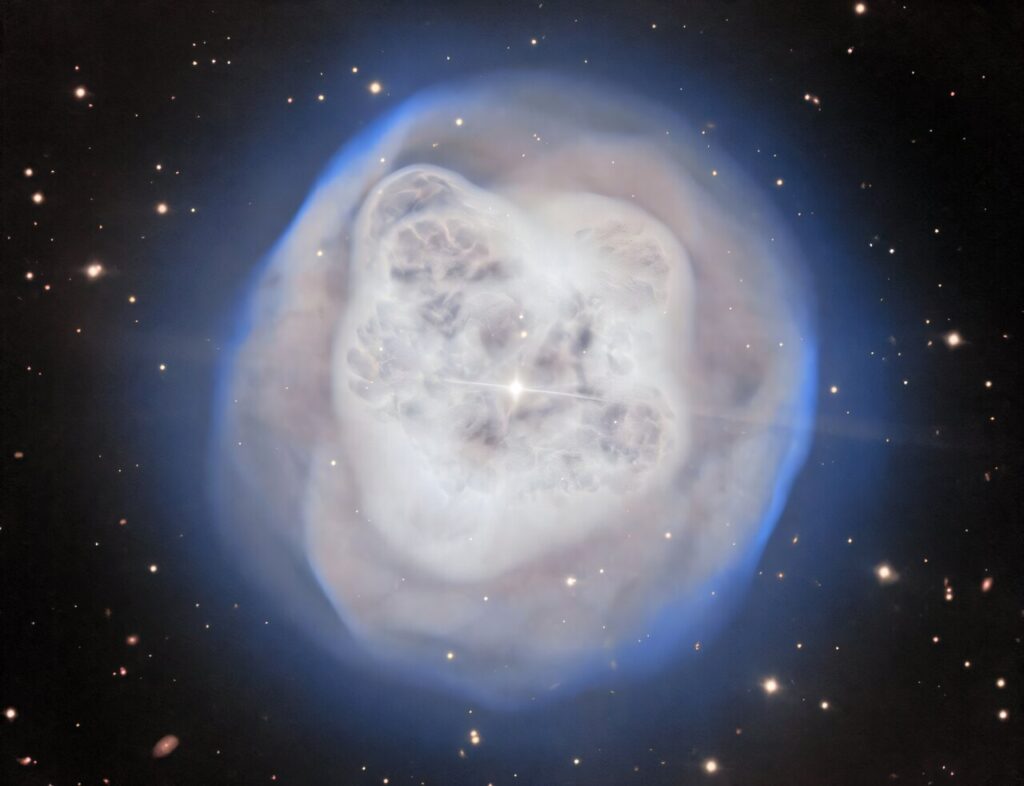
The James Webb Space Telescope has captured a stunning image of the Crystal Ball Nebula (NGC 1514). Thanks to the telescope’s infrared spectroscopy, features of this nebula have been discovered that astronomers had not even suspected existed before.
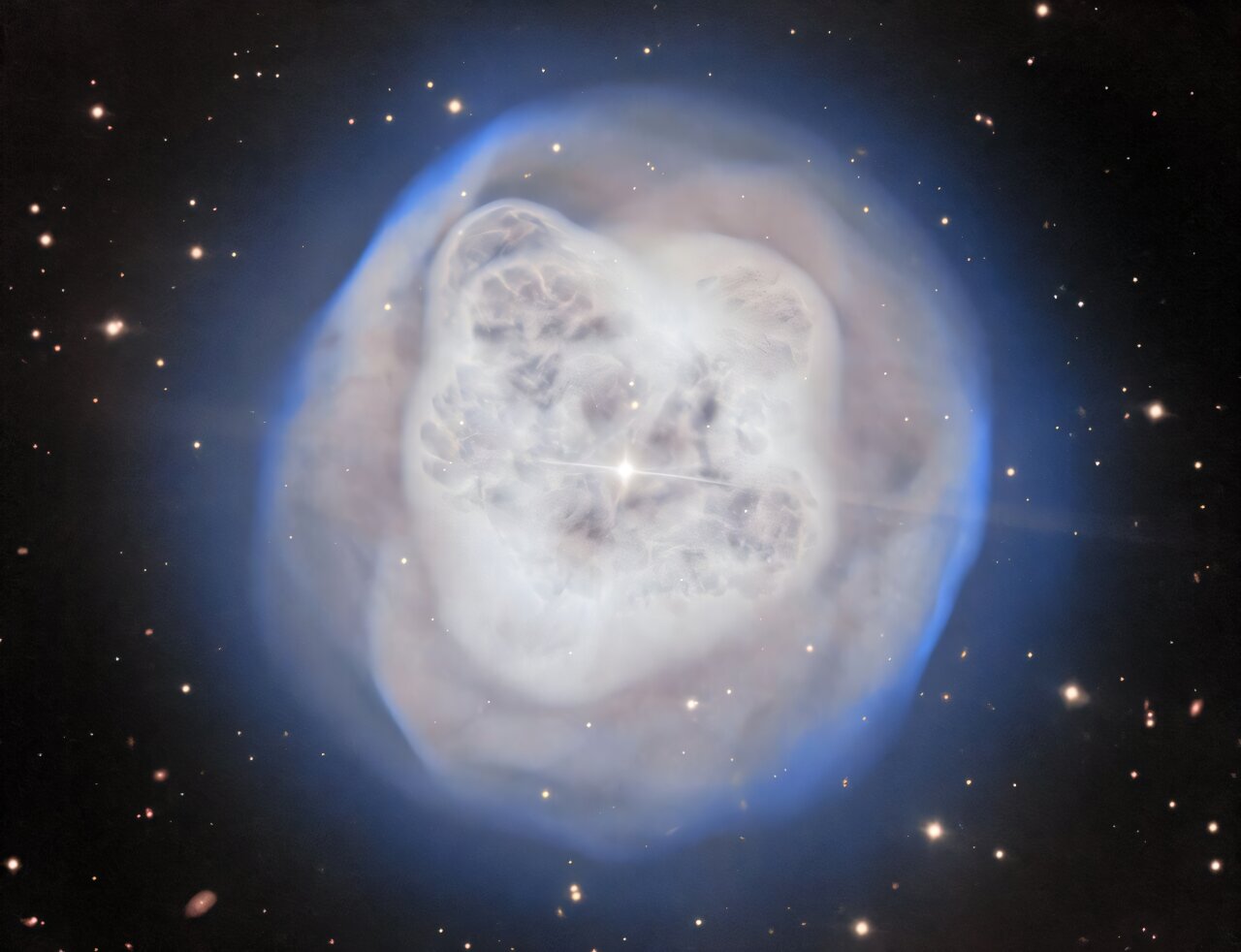 Crystal Ball Nebula. Source: phys.org
About the planetary nebula NGC 1514
Planetary nebulae, such as the Crystal Ball Nebula (NGC 1514), are like obituaries for stars. While crystal balls are supposed to reveal the future, the Crystal Ball Nebula tells us more about the past. It shows how a binary star system came to an end. And since NGC 1514 is 1,500 light-years away, we are seeing it as it appeared 1,500 years ago.
Planetary nebulae have nothing to do with planets. They simply looked like planets when viewed through early telescopes, and the astronomer William Herschel, who discovered the Crystal Ball Nebula, was the one who coined the term.
Planetary nebulae are exclusively stellar in origin. They form when a low- or medium-mass star ejects its outer layers of gas at the end of its life through the process of nuclear fusion. The ejected gas forms a more or less spherical shell. But over time, the structure changes due to turbulence and uneven gas outflow. This is exactly what happened to the Crystal Ball Nebula. It is bumpy and lobed, with thread-like loops and voids of gas and dust.
What did the James Webb Space Telescope see?
Gemini North has produced an excellent image of the Crystal Ball Nebula, but so have other telescopes, including the James Webb Space Telescope. Since the James Webb Space Telescope is an infrared telescope, it has revealed aspects of the nebula that are invisible to Gemini North.
The James Webb Space Telescope reveals that the nebula is surrounded by a pair of rings. These likely formed during an early phase of mass loss by the central binary system. Later, these rings were shaped by asymmetric, high-speed winds from the binary pair. A 2025 study concluded that the rings likely consist of dust rather than gas.
One of the stars in the central binary pair is somewhat unusual. It is called a hot sub-luminous O-type star. These are O-class stars, which are the hottest type of star. But they are also sub-luminous, which means that for such a hot star, they are dim. This is because they are so tiny and occupy about as much space as Earth’s orbit around the Sun.
An amazing O-type star in the NGC 1514 nebula
Sub-luminous O-type stars are, in essence, bare stellar cores composed of helium. They have typically lost most of their mass to a more massive stellar companion, as is the case here. The star in NGC 1514 has lost most of its mass, is nearing the end of its helium fusion process, and is cooling down and transforming into a white dwarf.
Although the subluminous star used to be responsible for most of the nebula’s formation, its companion star is now doing most of the work in NGC 1514. This is a massive A0III-type star that has exhausted most of the hydrogen in its core and has left the main sequence. Its energy illuminates the nebula.
A binary star forms a nebula
The asymmetry of NGC 1514 is explained by a binary star system. The stars orbit each other every nine years, which is the longest orbital period of any binary pair in a planetary nebula. As they rotate, their powerful winds form a striking nebula and create shells, filaments, and clumps that are visible in the image taken by Gemini North.
Planetary nebulae do not last long, typically between about 10,000 and 25,000 years. In astronomical terms, that is not very long. Over time, the gas will disperse and become part of the interstellar medium, just like a child blowing on a dandelion seed into the wind.
According to phys.org