
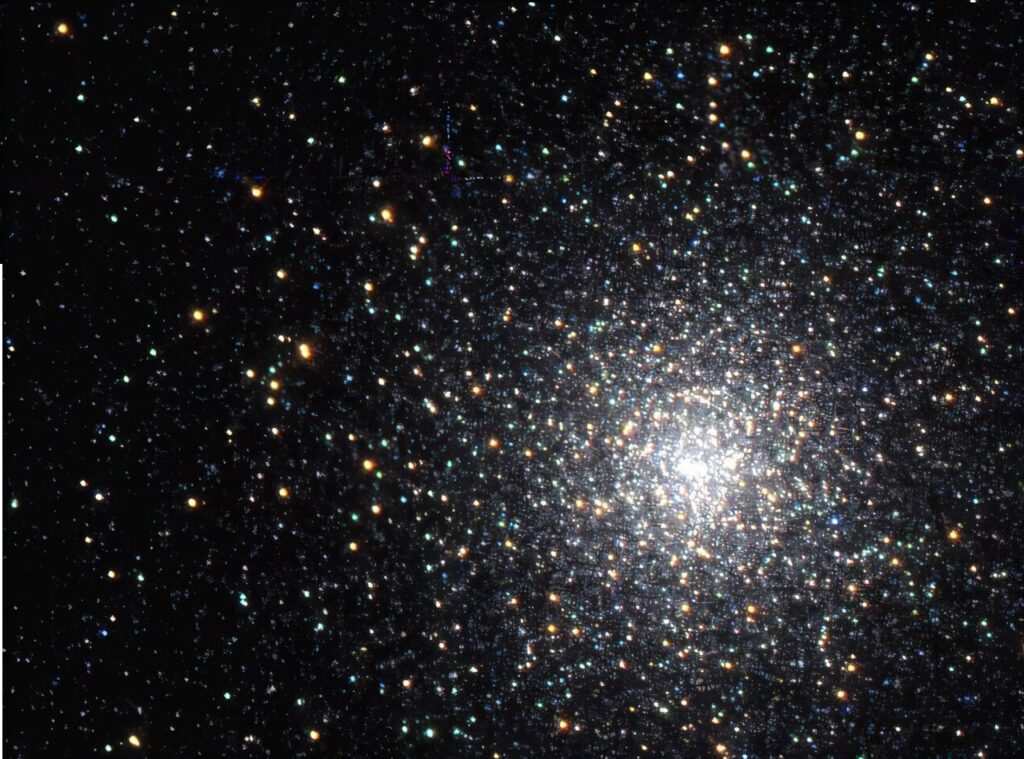
The James Webb and Hubble space telescopes conducted a large-scale survey of nearly 9,000 young star clusters in four neighboring galaxies. The results of this study pose a real challenge to classical astronomical models: it turns out that the most massive star clusters destroy their gas and dust clouds in 5 million years, which is significantly faster than their smaller neighbors. This discovery could rewrite the history of galaxy formation and the reionization of the early universe.
Infrared penetration through a dust curtain
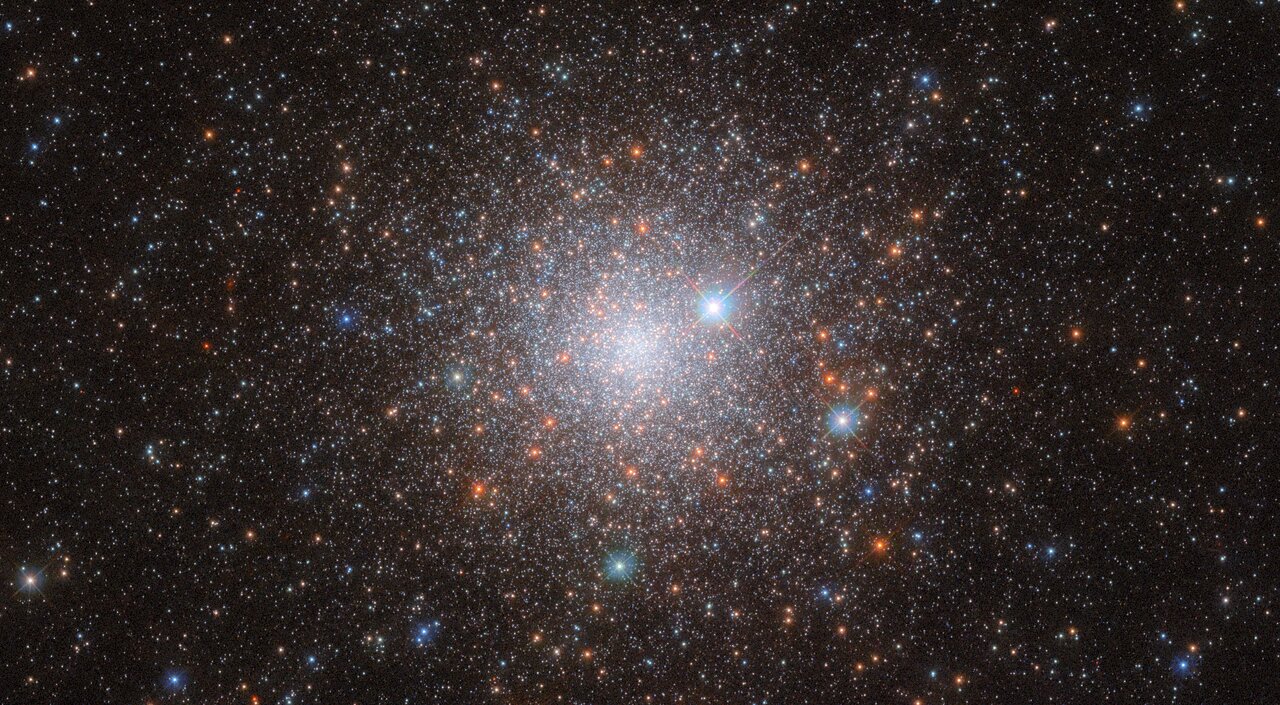 Globular cluster NGC 1786. Source: ESA/Hubble & NASA, M. Monelli
Star-forming regions are usually hidden from optical telescopes by a thick layer of dust and gas. However, thanks to the combined efforts of two powerful observatories, the situation has changed. James Webb, with its unprecedented infrared vision, was able to pierce through dense gas clouds, while Hubble supplemented the overall picture with unique data in the visible and ultraviolet spectra.
Together, these instruments have enabled astronomers to study thousands of clusters at various stages of formation in the galaxies Messier 51, Messier 83, NGC 628, and NGC 4449. These objects are at an ideal distance: close enough to examine individual systems in detail, but far enough to understand the large-scale processes that are completely inaccessible to observations from within our Milky Way.
Paradox of the star nursery
Data from space telescopes have revealed a clear, albeit completely unexpected, pattern. Intuitively, it seems that larger clusters located in a very dense environment should remain shrouded in gas for much longer. However, observations have proven the opposite: these giant stellar families cleared their surroundings completely in about 5 million years. In contrast, smaller and lighter clusters took between 7 and 8 million years to shed their gaseous cocoon.
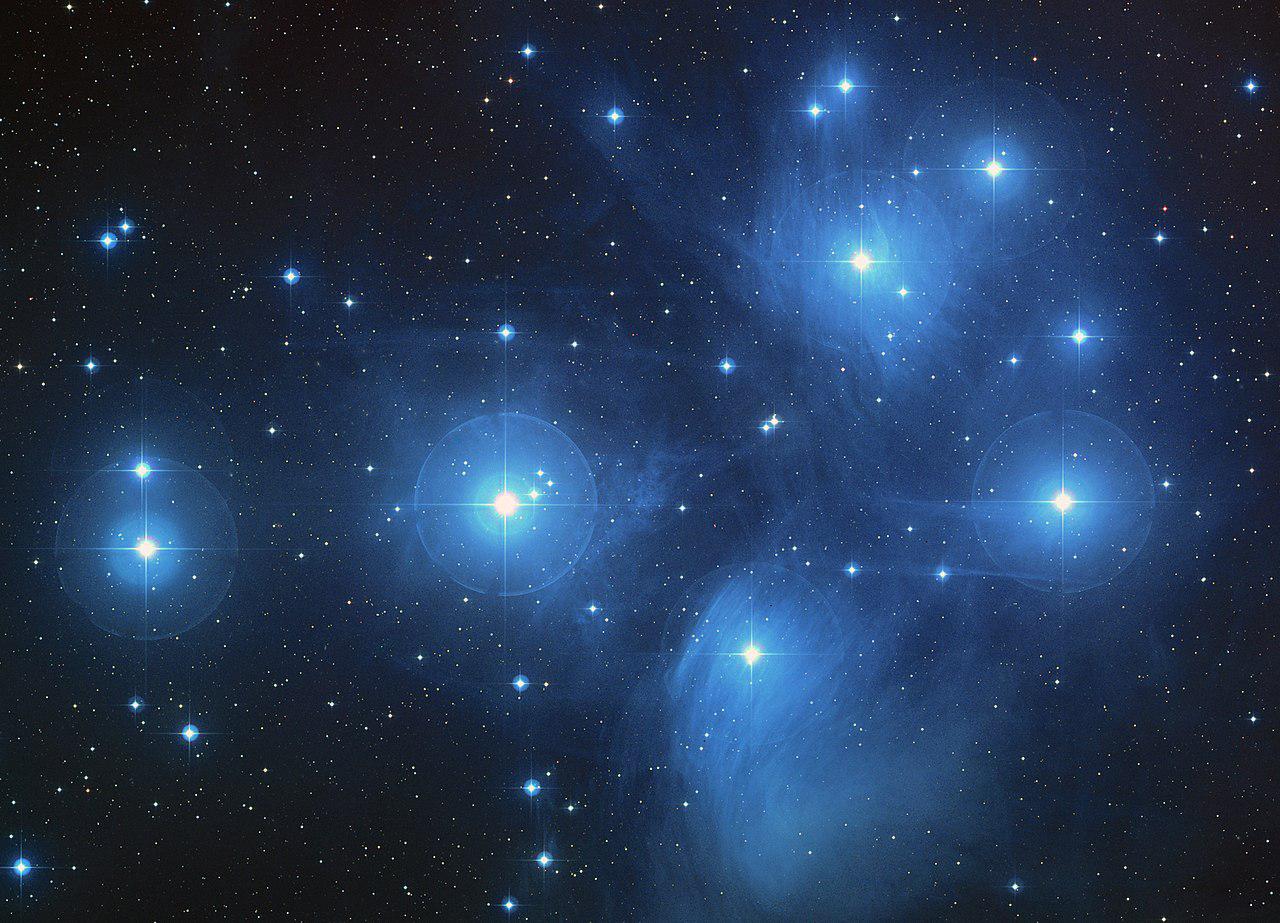 The Pleiades star cluster. Source: NASA, ESA, AURA/Caltech, Palomar Observatory
The reason for this cosmic rush is quite simple: large clusters contain supermassive stars. These stars emit extremely aggressive ultraviolet radiation, generate ferocious stellar winds, and their short lives end in spectacular supernova explosions. All this colossal energy literally tears the parent cloud apart from the inside much more effectively than lower-mass stars are capable of doing, as they disperse the gas very slowly.
The price of two million years
Although a couple of million years may seem like a mere blink of an eye on the vast scale of the cosmos, it is a critical period in the life cycle of a massive star. The sooner the cluster is stripped of its gas, the faster its powerful ionizing radiation reaches the open space of the galaxy.
This fact is key to understanding the reionization era—a period in the early Universe when neutral hydrogen was broken down into protons and electrons by intense radiation. The new discovery supports the theory that radiation from early galaxies filled with massive young stars may have been the primary driving force of this era. If clusters in the early universe cleared out in 5 million years rather than 8 million, their radiation escaped outward even before the inevitable demise of the giant stars.
A challenge for simulations and planet formation
New, unprecedented data impose strict constraints on computer models of galaxy formation. Previously, it was extremely difficult for computer programs to accurately simulate what is known as “stellar feedback”—the process by which young stars influence the remaining gas and regulate further star formation. Astrophysicists now have an accurate cosmic “clock,” since even the slightest errors in the time scale can significantly skew estimates of the rate at which new stars are formed over billions of years.
This discovery also has direct implications for the formation of planets. Young stars are often surrounded by protoplanetary disks, and the early disruption of a gas cloud instantly exposes these vulnerable disks to the harsh ultraviolet radiation of neighboring giant stars. This could significantly shorten the time available for the formation of fully-fledged planets in dense star clusters.
What’s next?
Scientists now plan to expand the scope of their observations, focusing on dwarf galaxies. Their low metallicity and weaker gravity closely resemble the conditions of the early Universe. The unique data from the James Webb Space Telescope once again convincingly demonstrate that a deep understanding of the very first stages of star clusters is the key to unlocking the greatest mysteries of our cosmos.
We previously explained whether dark star clusters are extreme dwarf galaxies.
According to spacedaily.com