
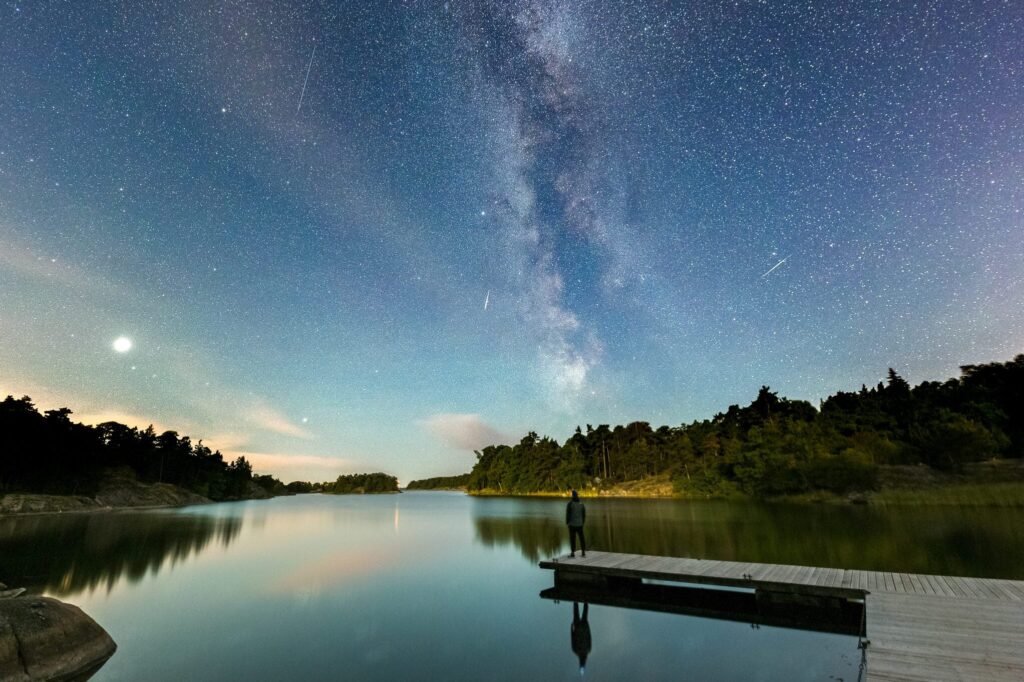
For many of us, summer brings to mind time spent outside with family and friends, from swimming and snorkeling to hiking and biking. But come evening, the sky begins its own performance, filled with streaking meteors, glowing planets and unforgettable astronomical events that turn an ordinary evening into something extraordinary. Summer is particularly rewarding for skywatchers in the United States, as the season brings warm weather, easier late-night outings and some of the year’s most anticipated celestial displays.
My first real experience with a summer celestial event came in 2020, watching the Perseid meteor shower at a campground in rural Nebraska. Far from city lights, I set the alarm on my phone and rolled out of my tent in the middle of the night to watch meteors flash overhead every few minutes. I had traveled there specifically to witness the meteor shower because I knew it would be quiet, uncrowded and dark. I’d never seen anything like it, and to this day, it remains one of my most treasured travel experiences.
Looking for your own summer celestial adventures? I talked to Lucas Snyder, a planetarium specialist at the Flandrau Science Center & Planetarium in Tucson, Arizona, and consulted astronomical calendars from NASA and others to find out when the best celestial events will occur this summer. And you’re in luck: Snyder says many of this summer’s astronomical events will be visible nationwide, though some places offer a better chance to catch them than others.
Read on for the must-see astro events this summer, along with ideas for where to find them and what to know in advance.
Get Reader’s Digest’s Read Up newsletter for more astronomy, cleaning, humor, travel, tech and fun facts all week long.
What are the must-see astronomical events of summer 2026?
The fun planetary happenings actually kick off before the summer solstice on June 21, which is the year’s longest day and marks the official beginning of astronomical summer. The solstice also produces the shortest night of the year, which skywatchers will notice immediately. Here’s what to look out for and when.
June
 VW Pics/Getty Images
Planetary conjunctions
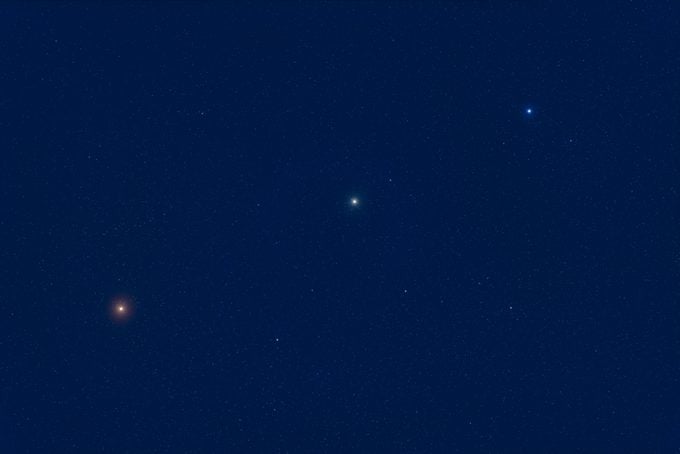
All of Earth’s neighboring planets will be visible at some point this summer, but an extra-special arrangement will occur between June 6 and 10, when Venus, Jupiter and Mercury will be above the western horizon. To see the (very bright) Venus and Jupiter only a pinky finger apart, with Mercury in line but a bit dimmer, look outside on June 8 and 9. This trio of planets will be spaced out across the sky until around July, and come June 17, a crescent moon will also join the cluster.
How to see it: Look out above the western horizon after sunset (no telescope necessary). You can see the conjunction across the country, but an especially good option is Bend, Oregon, at the University of Oregon’s free Pine Mountain Observatory. The high elevation, dry air and low chance of rain and clouds increase your chances of a great viewing. To combine astro events with food and fun, wander into Bend’s Worthy Brewing, which even has its own observatory and 16-inch telescope.
Strawberry Moon
June’s full moon, known as the Strawberry Moon, rises low along the horizon on June 29. The name comes from Native American seasonal berry-harvest traditions rather than color, though strawberry moons tend to appear larger and warmer-toned than expected. Because this moon follows one of the year’s lowest moon paths, photographers often capture striking images of it rising behind landscapes and landmarks.
How to see it: Look toward the southeastern horizon at sunset to catch the Strawberry Moon climbing into the sky. Weather permitting, it will be visible across the U.S. and is best seen at moonrise.
The Milky Way
Though you can see the Milky Way throughout the year, summer is peak season in the Northern Hemisphere for spotting its bright galactic core. Light pollution keeps many of us from seeing this dense mass of stars, but if you can get under dark skies from late June through August, you’re in for a treat. The galactic center becomes visible, arcing across the southern sky after midnight under dark conditions.
How to see it: Head away from cities and give your eyes 20 to 30 minutes to adjust, then look toward the south. One of the best places to catch the core will be around Tucson, Arizona, particularly at Mount Lemmon and the Kitt Peak National Observatory. Take advantage of the powerful telescopes at the observatory, or for an experience right in Tucson, stop by Sky Bar, an astronomy-themed, solar-powered cafe and bar that sets up telescopes on its patio and has local astronomers on hand in the evening.
July
 DaveBolton/Getty Images
Predawn planetary parade
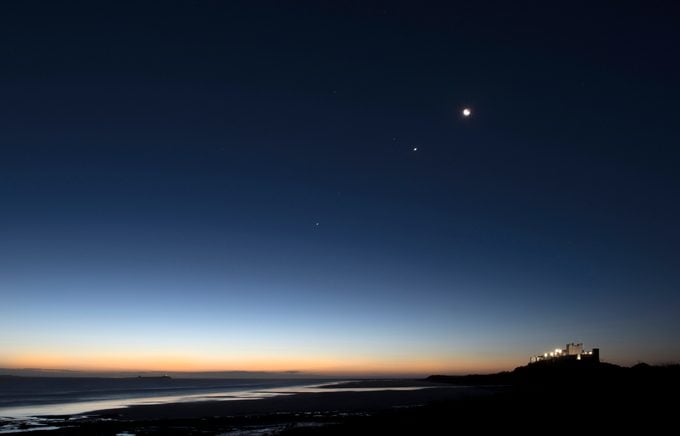
Throughout July, early risers should keep an eye out for a loose planetary grouping featuring bright planets along the ecliptic (the path the sun, moon and planets take in the sky) before dawn. These summer mornings create excellent opportunities to see multiple worlds in a single glance. Venus is often the standout, shining so brightly it’s visible even against the morning twilight.
How to see it: Find the ecliptic by imagining the sun’s path through the sky during the daytime. (If you’re not sure, do a preview the day before.) Before sunrise, the planets should be visible near this line across much of the U.S., and while binoculars can enhance the view, a telescope isn’t required.
Delta Aquariid meteor shower
Active from mid-July to mid-August and predicted to peak from July 28 to 30, the Delta Aquariid meteor shower is frequently overshadowed by August’s Perseids. But patient observers can still catch dozens of Aquariid meteors per hour under ideal conditions. According to NASA, moonlight can make the Aquariids tough to see, so your best bet is a moonless night away from city lights.
How to see it: The shower favors southern U.S. latitudes, making Arizona, Texas and parts of the Southeast particularly rewarding viewing spots. Another great place to catch the Aquariids is in Nebraska’s Sandhills region (near the city of Valentine), which will host its annual 2026 Nebraska Star Party from July 12 to 17. The much-anticipated party boasts excellent viewing conditions and coincides with both the meteor show and peak Milky Way visibility.
Saturn rising
Visible nationwide by midsummer, Saturn becomes increasingly prominent in late-night and predawn skies. Through even a modest telescope, its rings can create one of those unforgettable “wow” moments for first-time observers.
How to see it: Look to the east-southeast between midnight and dawn. Saturn can be seen by the naked eye, but you will see its rings only through a telescope. Public telescope nights at observatories across the country (and even in dense metro areas like New York City, where the Amateur Astronomers Association regularly hosts volunteer-led viewing events across the city) can make this especially accessible for travelers.
August
 Don Grall/Getty Images
Perseid meteor shower
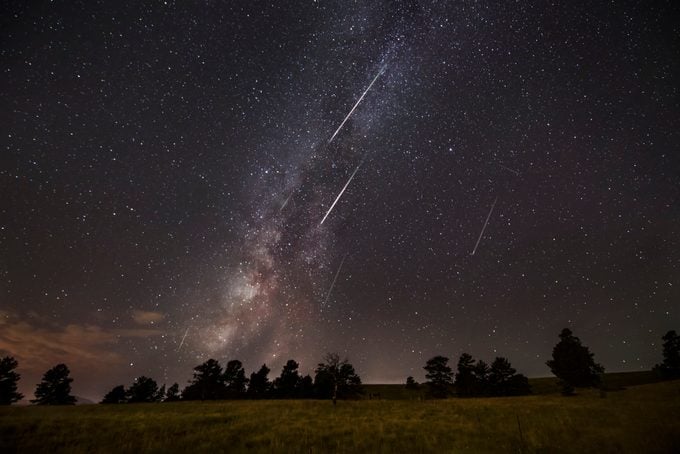
The Perseids remain summer’s headliner and one of the year’s most beloved celestial events. Earth passes through debris left behind by Comet Swift-Tuttle, producing bright meteors and occasional fireballs. Under dark skies, viewers may see dozens of meteors per hour.
This is where that Nebraska campground memory comes rushing back for me—the quiet anticipation between meteor streaks and the collective excitement whenever a particularly bright one crossed overhead. Peak viewing is expected around August 11 to 13, and this stunning astronomical event will be visible across the U.S.
How to see it: For exceptional viewing, consider somewhere with very low light pollution, like rural Nebraska or California’s Channel Islands National Park, which is one of the darkest national parks in the country. As this is a major event, there will be countless viewing parties in the U.S. (such as the Annual Perseid Meteor Shower and Stargaze in Indiana Dunes State Park), so see what’s available in your area if you aren’t able to travel too far.
Asteroid viewing opportunities
Summer skies often bring favorable positioning for the brighter asteroids, such as Vesta, the second-largest asteroid in the solar system. These rocky worlds typically appear as star-like points of light, and astronomy apps can help pinpoint their time and location.
How to see it: Asteroid viewing rewards patience and a little preparation, and it’s best done with binoculars or a telescope. You can see asteroids throughout August, and spotting one for the first time feels surprisingly satisfying—like discovering a secret moving among the stars.
Partial lunar eclipse
Summer closes with one of the season’s most memorable astronomical events: a partial lunar eclipse. During the event, which happens on the evening of August 27 to 28, Earth’s shadow gradually moves across the moon, darkening a large portion of its surface.
How to see it: Just look up! Unlike solar eclipses, lunar eclipses are safe to watch without special equipment, and this one will be visible across North America.
What are some stargazing tips for viewing astronomical events?
Summer’s biggest celestial displays don’t necessarily require advanced equipment, but a little preparation can dramatically improve your experience. Finding a dark sky and allowing your eyes to adjust are key. According to Snyder, Venus and the lunar eclipse are bright enough that light pollution won’t make a big difference in terms of visibility, but dark skies are very important to creating a good viewing experience for other events.
Here are some tips for peak dark sky and astro event viewing:
Get away from cities: Rural areas, national parks and open landscapes dramatically improve visibility. Snyder says the Sonoran Desert near Tucson (aka the Astronomy Capital of the World) has clear skies around 300 nights per year, and Pima County has restrictions to minimize light pollution created by the city and its suburbs.
Check light pollution maps before heading out: Dark-sky resources can reveal unexpectedly good locations. Use DarkSky to locate certified dark-sky destinations.
Bring binoculars: Many celestial objects look fantastic through simple 10×50 binoculars.
Download sky-identification apps: Apps like Sky Guide and Star Walk 2 can identify constellations and planets in real time.
Arrive before sunset: Set up chairs, blankets and gear while it’s still light outside.
Allow your eyes 20 to 30 minutes to adjust: Your eyes need time to adjust between daytime mode and nighttime mode.
Use red flashlights instead of white light: If you don’t have a red light, cover your white-light source with red cellophane.
Pack layers and snacks: Summer nights can still cool quickly in mountain or desert environments.
Look broadly rather than staring at one spot: Meteors can appear anywhere.
Because summer’s best celestial events unfold over weeks rather than minutes, the real magic often comes from simply being outside long enough to see what happens next.
About the expert
Lucas Snyder is a planetarium specialist at the University of Arizona’s Flandrau Science Center & Planetarium. He graduated from Ball State University with a master’s degree in physics and has worked at the planetarium for 18 years.
Why trust us
At Reader’s Digest, we’re committed to producing high-quality content by writers with expertise and experience in their field in consultation with relevant, qualified experts. We rely on reputable primary sources, including government and professional organizations and academic institutions as well as our writers’ personal experiences where appropriate. For this piece on summer astronomical events, Cassandra Brooklyn tapped her experience as a travel writer and guidebook author to ensure that all information is accurate and offers the best possible advice to readers. We verify all facts and data, back them with credible sourcing and revisit them over time to ensure they remain accurate and up to date. Read more about our team, our contributors and our editorial policies.
Sources: