
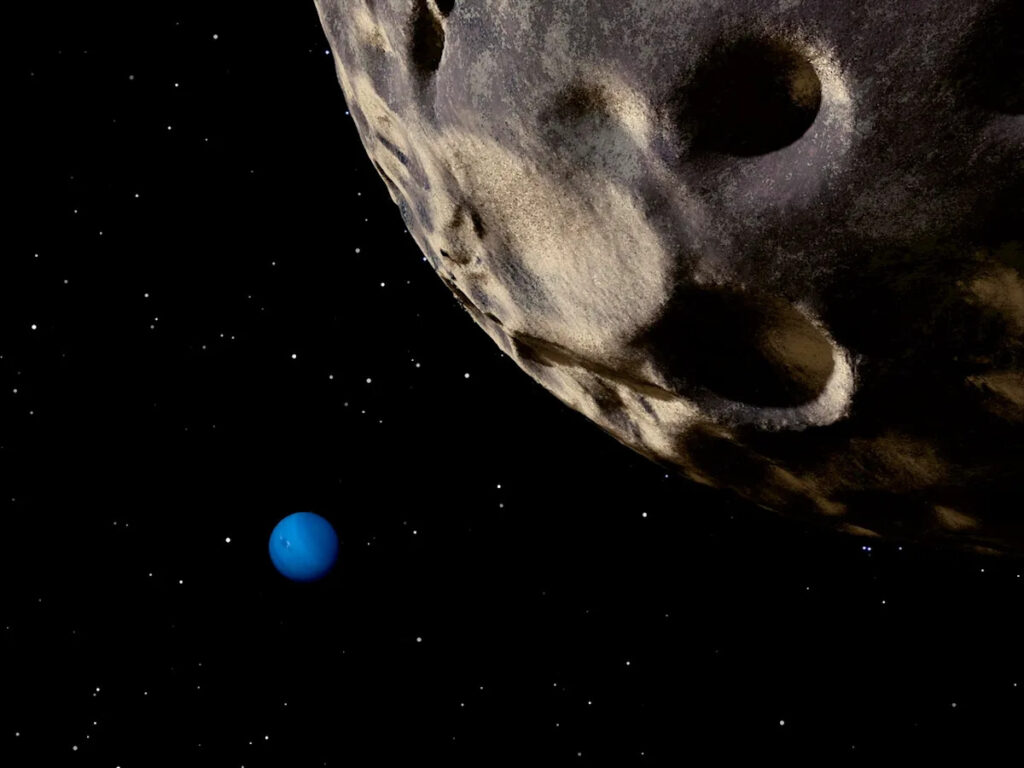
A moon located in our solar system might have been the only one to survive a “moonpocalypse” that occurred long, long ago.
ScienceNews reports that Nereid might have been one of the planet’s original moons that wasn’t destroyed when Triton — the largest of the current 16 moons that surround the Neptune — was drawn into orbit, an idea that comes courtesy of new findings published in Science Advances..
Nereid is then thought to have had a “chaotic encounter” with another celestial body that ended up ejecting or pulverizing all of its sibling moons while leaving Nereid the sole survivor.
This runs counter to the long-held idea that Nereid was pulled into Neptune’s orbit from the Kuiper Belt, ScienceNews adds, which NASA explains “is a doughnut-shaped region of ice objects beyond the orbit of Neptune” that’s “home to Pluto and most of the known dwarf planets and some comets.”
According to AccuWeather, Nereid has long been viewed as a bit of an oddball of astronomers due to its extreme orbit; the moon takes roughly 360 Earth days to complete a single trip around Neptune.
The idea that Nereid was thrown into its odd orbit after colliding with another large object might also make it the “last remaining signature of the original satellite system,” planetary scientist Matthew Belyakov of Caltech told ScienceNews.
Plus, Phys.org points out that Nereid’s composition differs from other moons that were once pulled in from the Kuiper Belt, mostly in that it has way too much ice. This indicates that it might have been part of Neptune’s system all along.
“We don’t have all that much evidence left around Neptune — the system doesn’t have many moons left,” Belyakov told Phys.org via email. However, these new findings “strongly rule out” that Nereid was pulled into Neptune’s system thanks to gravity.
More Life & Culture news
Read the original article on pennlive.com. Add pennlive.com as a Preferred Source by clicking here.