
Here’s what you’ll learn when you read this story:
Gamma Cassiopeiae, the central star of the W-shaped Cassiopeiae constellation, has long stumped astronomers because of its immense X-ray emissions.
A new study discovered that these emissions are caused by a white dwarf companion that’s feeding on the star’s ejected disc material.
Scientists hope this new discovery will help explain other mysteries, including why we don’t see more of these binary pairs.
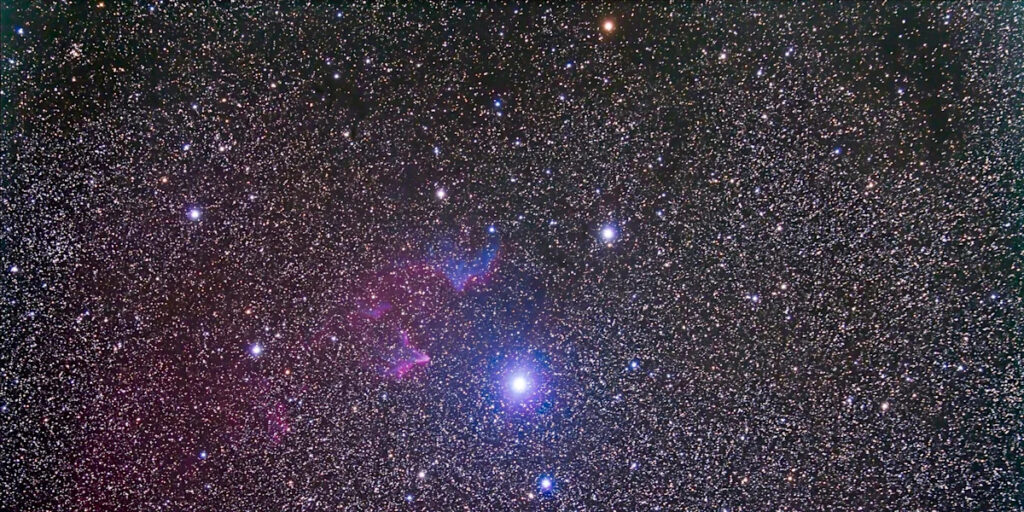
In 1866, Italian astronomer Angelo Secchi noticed something strange in one of the five stars that makes up the W-shaped Cassiopeia constellation—the central star known simply as “Gamma.” Where the star’s hydrogen emissions should have been bright, they were instead dark. This feature was so unusual—and Secchi would know, since he studied the spectra of some 4,000 stars during his lifetime—that he created an entirely new stellar classification, the Be star, to mark both its temperature (B) and its hydrogen emission lines (e).
Over the decades, astronomers found that Be stars rotate at breakneck speeds, between roughly 70 to 80 percent of the velocity that’s required to essentially rip a star apart. That ultrafast rotation also flings gas off the stars’ equators. In the mid-20th century—during one of the star’s more variable eras, when it brightened visually yet its surface temperatures plummeted—Soviet scientists were the first to model the star’s disc as individual gas blobs rather than a smooth envelope. But much of this foundational work, by researchers like A.A. Boyarchuk and V.G. Gorbatskii, was published only in Russian and remained largely unknown to Western astronomers. A new review paper, authored by scientists at Russia’s Pulkovo Observatory and St. Petersburg University and published in the journal Galaxies, is the first to bring these Soviet-era studies to an English-speaking audience.
Around 20 percent of B-type stars are actually Be stars, and their spectra are variable, meaning they change with time. Although Secchi first noticed Gamma Cas’s strangeness compared with other stars, Soviet astronomers took the first step to explain it, and modern astronomers continued to be obsessed with this otherwise unassuming star, which is the 63rd brightest in the night sky.
It wouldn’t be until a full century later after Secchi’s first observations that scientists fully grasped the depths of the weirdness of Gamma Cas. In 1976, astronomers using X-ray satellite observatories discovered that Gamma Cas was pumping out high-energy X-rays at a rate hundreds of times greater than what’s typical for Be stars. The plasma producing these X-rays reached a scorching 150 million degrees Celsius.
Soon, theories suggested that Gamma Cas must have another stellar companion, possibly a neutron star or white dwarf, that was gobbling up the star’s disc material. Now, a new study published in the journal Astronomy & Astrophysics discovered, with the help of JAXA’s X-Ray Imaging and Spectroscopy Mission (XRISM) space telescope, that the curious X-ray emissions are linked to the orbital motion of a companion white dwarf.
“There has been an intense effort to solve the mystery of gamma-Cas across many research groups for many decades,” University of Liège’s Yaël Nazé, lead author of the study, said in a European Space Agency (ESA) press statement. “And now, thanks to the high-precision observations of XRISM, we have finally done it.”
Of course, all great discoveries typically inspire more and more questions, and the discovery of Gamma Cas’s white dwarf companion is no different. Scientists expect this arrangement, especially among low-mass stars, to be plentiful throughout the universe, but data suggests they’re a rarer arrangement that initially predicted and actually tend to occur among high-mass Be stars.
“We think the key is in understanding how exactly the interactions take place between the two stars,” Yaël said in a press statement. “Now that we know the true nature of gamma-Cas, we can create models specifically for this class of stellar systems, and update our understanding of binary evolution accordingly.”
For more than 150 years, this strange star has only been a source of unending questions. But now, with the discovery of its binary nature, maybe the central star of the constellation Cassiopeia is finally starting to provide some answers.
You Might Also Like