
When the James Webb Space Telescope (JWST) launched into space in late 2021, astronomers had very specific hopes for it. It was expected that this, the most expensive space instrument in human history, would be able to peer into the deepest past and see the very first galaxies—faint, tiny, and chemically simple objects from the early universe.
 If the “impossibility of early galaxies” paradox holds true, then the age of the Universe is probably 26 billion years. Featured image: Unsplash
However, the reality turned out to be quite different. Instead of barely visible specks, the telescope detected enormous, brightly shining star systems that, according to current laws of physics, simply should not yet exist. After years of continuous observation, these anomalies have become increasingly difficult to explain within the framework of the accepted theory of the origin of the Universe. A question that once seemed unthinkable is gradually gaining traction in the scientific community: what if our Universe is much older than we’ve traditionally believed?
Illegal galaxies on the cosmic map
Today, the record holder among the most distant galaxies known to us is the object MoM-z14, discovered by the James Webb Space Telescope in 2025. The light from it dates back to a time when only about 280 million years had passed since the Big Bang. By cosmic standards, this is almost nothing—just 2% of the officially recognized age of the Universe.
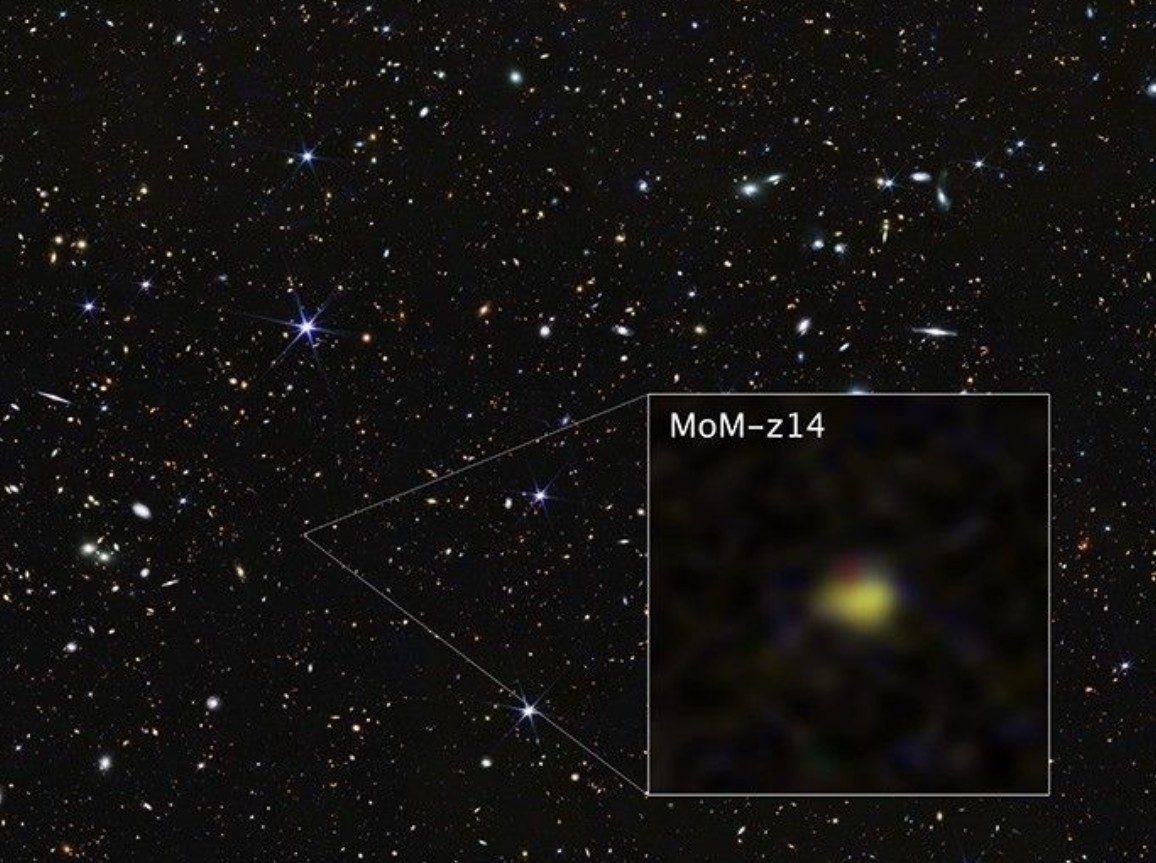 The galaxy designated MoM-z14 is currently the most distant galaxy ever discovered. It was detected using the James Webb Space Telescope’s NIRCam (Near-Infrared Camera) and confirmed spectroscopically using its NIRSpec (Near-Infrared Spectrograph). Source: NASA
Its predecessor, JADES-GS-z14-0, which existed 300 million years after the Big Bang, is even more impressive. This galaxy not only has a mass hundreds of millions of times greater than the Sun’s, but it also shines five times brighter than previous record-holders. According to astronomer George Rieke of the University of Arizona, none of the scientists had even imagined that such bright and large structures could exist at such early stages. According to standard models, they should have only been beginning their slow formation at that time.
Chemical puzzle
But the most puzzling mystery turned out to be astrochemistry. In early 2025, researchers discovered significant reserves of oxygen in the galaxy JADES-GS-z14-0. This discovery literally sent shockwaves through the field of astrophysics.
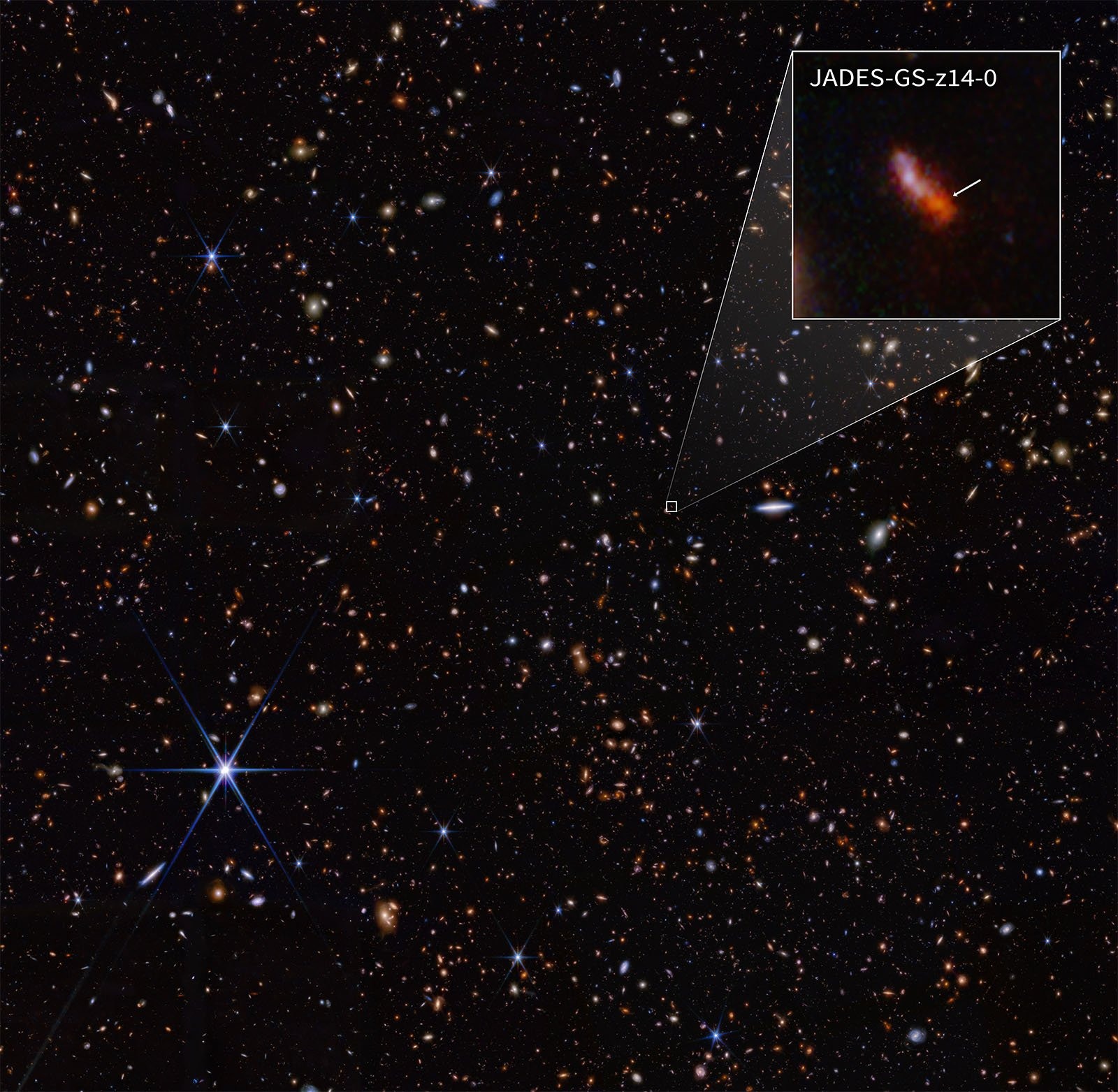 JADES-GS-z14-0 has a redshift of 14.32 (+0.08/-0.20). Photo: NASA
The problem is that, following the Big Bang, only hydrogen and helium existed in the Universe. All heavier elements, including oxygen, are produced exclusively in the cores of stars and are ejected into space only after the stars’ deaths in supernova explosions. To produce that much oxygen in less than 300 million years, the Universe would have had to undergo a veritable evolutionary sprint. The first generation of stars had to be created quickly, allowed to live out their lives and explode, and then a new generation of stars had to form from their remnants. And all of this had to happen in a time span during which a large tree barely has time to grow on Earth. Scientists have dubbed this paradox the “impossibly early galaxy problem.”
The old Universe
Faced with these paradoxes, most scientists simply attempt to refine existing models, assuming that galaxy formation in the early universe was significantly more efficient. The age of the universe itself, however, remains unchanged—approximately 13.8 billion years.
However, some go much further. In 2023, physicist Rajendra Gupta published an incredible hypothesis in the prestigious journal Monthly Notices of the Royal Astronomical Society. He combined two unconventional concepts: the “tired light” theory and the idea that fundamental physical constants change over time.
Gupta’s calculations caused a sensation—he estimated the age of the universe to be 26.7 billion years! In this new paradigm, the galaxy JADES-GS-z14-0 did not exist when the universe was 300 million years old, but rather when it was already nearly 4 billion years old. Under such conditions, the existence of massive and chemically mature star clusters seems entirely logical—they had already had enough time to form.
Is a scientific revolution on the horizon?
Despite its publication in a peer-reviewed journal, Gupta’s theory remains a minority view. The standard Lambda-CDM model successfully explains a wide range of other phenomena, from the cosmic microwave background to the distribution of matter. To abandon it, scientists would have to find new explanations for all of these processes.
 Night sky. Photo: Unsplash
At the same time, Gupta’s article is not the only one. Other serious scientific papers attempt to solve the problem of early galaxies by revising the cosmic timeline. When unconventional questions begin to emerge from all sides, they cease to be marginal and become the cutting edge of science.
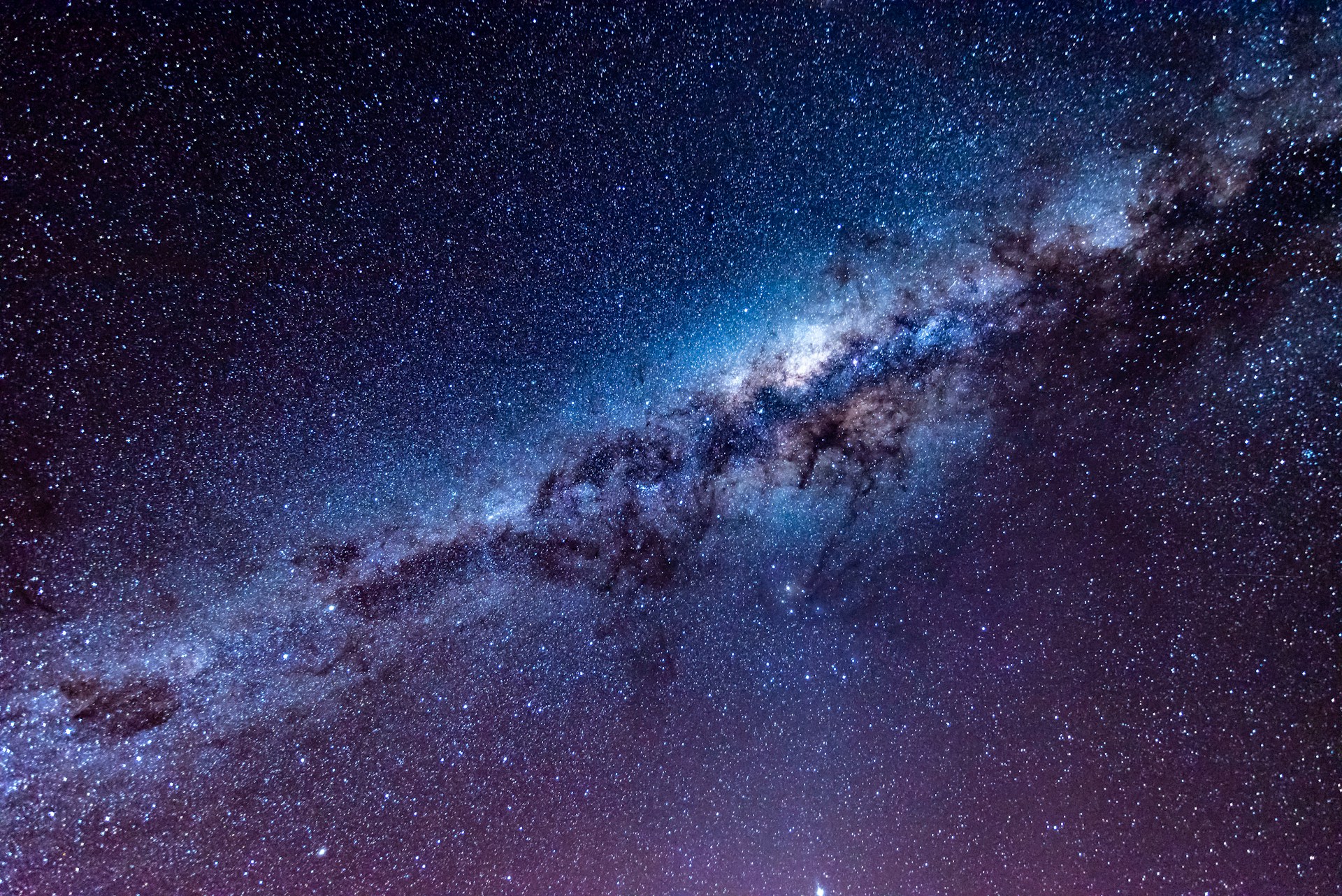 The universe may be twice as old as previously thought. Photo: Unsplash
The James Webb Space Telescope continues its observations, and the number of anomalies detected grows every year. If this trend continues, scientists will face a difficult choice: either fundamentally rewrite the theory of galactic evolution or opt to overhaul the entire cosmological paradigm. And although mainstream science still firmly adheres to the figure of 13.8 billion years, the gap between certainty and doubt has widened significantly in recent years.
We previously reported on a journey to the beginning of the universe.
According to spacedaily.com