
Artificial intelligence has learned to predict hazards in fusion reactors. Researchers have integrated machine learning algorithms directly into tokamak control systems to prevent sudden plasma collapses before they have a chance to occur.
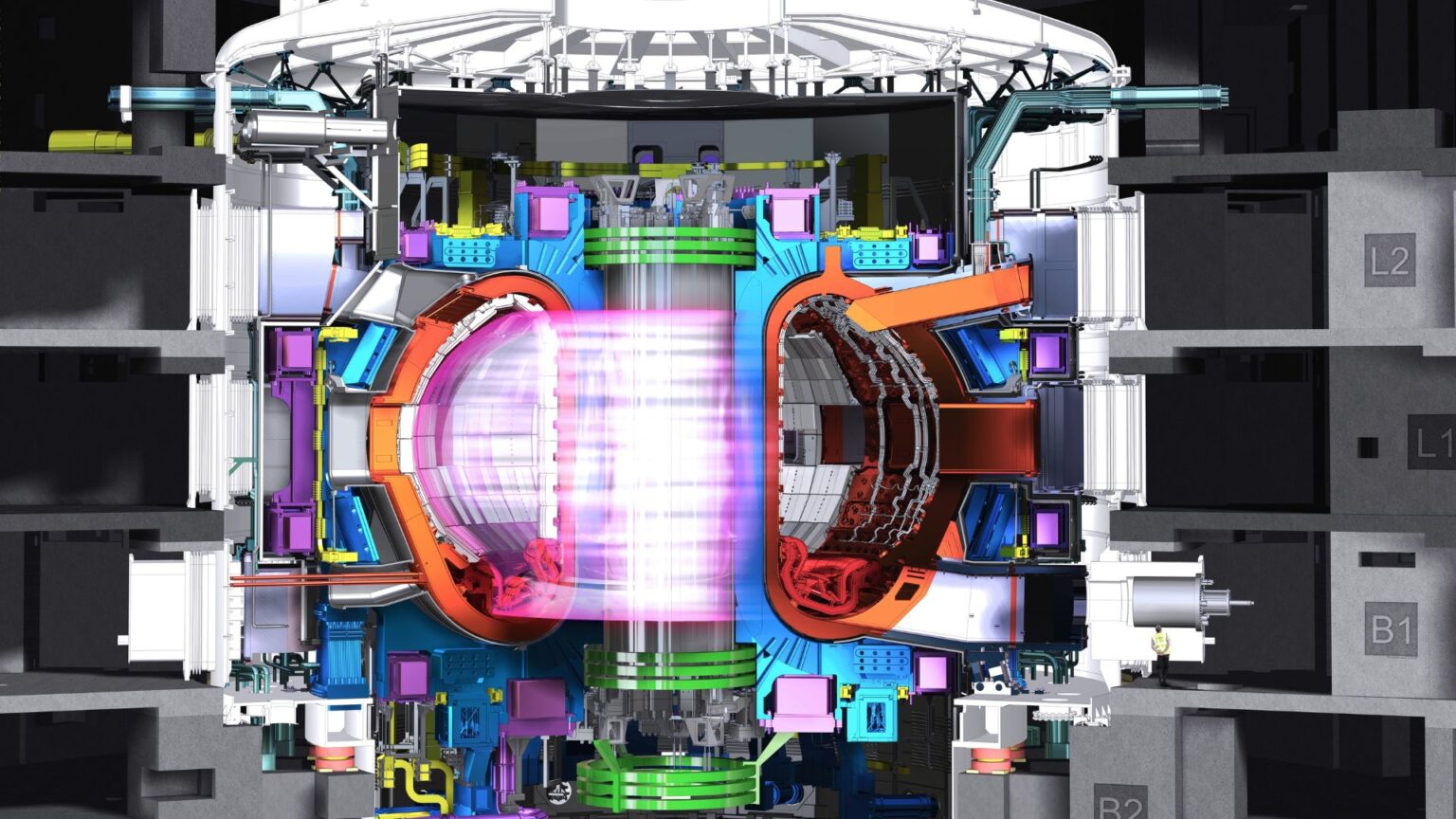 3D visualization of a tokamak—a device that uses magnetic forces to confine superheated plasma inside a chamber. Source: interestingengineering.com
Main threat to the reactor
A tokamak is a toroidal-shaped device (resembling a doughnut) in which powerful magnetic fields confine plasma heated to hundreds of millions of degrees. The main threat to its operation is so-called tearing modes. These are slowly growing instabilities that arise at specific points along the plasma string and alter the configuration of the magnetic field lines.
When this instability gets out of control, a magnetic “bubble” forms inside the plasma. It slows down the rotation of the plasma filament, and eventually the plasma comes into contact with the reactor wall—the fusion process is interrupted.
Why physical models fall short
Traditional models poorly describe these events because the instabilities are nonlinear and chaotic in nature. Minor disturbances in one part of the plasma can trigger a tearing mode in another.
Researchers Cristina Rea of the Massachusetts Institute of Technology (MIT) and Stuart Benjamin of the Princeton Plasma Physics Laboratory (PPPL) processed large datasets from previous tokamak runs and trained algorithms to recognize signs of impending instability even before standard diagnostic systems detect it.
Real-time control
Active plasma controllers have been developed based on these algorithms. They continuously receive data from the reactor and assess plasma stability at any given moment. If the system detects a risk of a tearing mode developing, the controller automatically adjusts the magnetic configuration—suppressing the instability or preventing the conditions under which it arises.
This development is important for the International Tokamak Physics Activity (ITPA), which is currently designing a disruption mitigation system for the ITER project.
Why is this becoming more important?
As plasma pressure increases in new experiments, tearing modes occur more frequently and develop more intensely. Higher pressure is necessary for efficient energy production, but at the same time, it makes it more difficult to maintain the plasma in a stable state.
“Tearing modes remain extremely difficult to predict using physical models, but their stochastic complexity appeals to scientists equipped with machine learning methods,” Benjamin noted. Integrating AI into the core of the tokamak control system makes it possible to maintain the parameters necessary for a sustained fusion reaction.
According to interestingengineering.com