
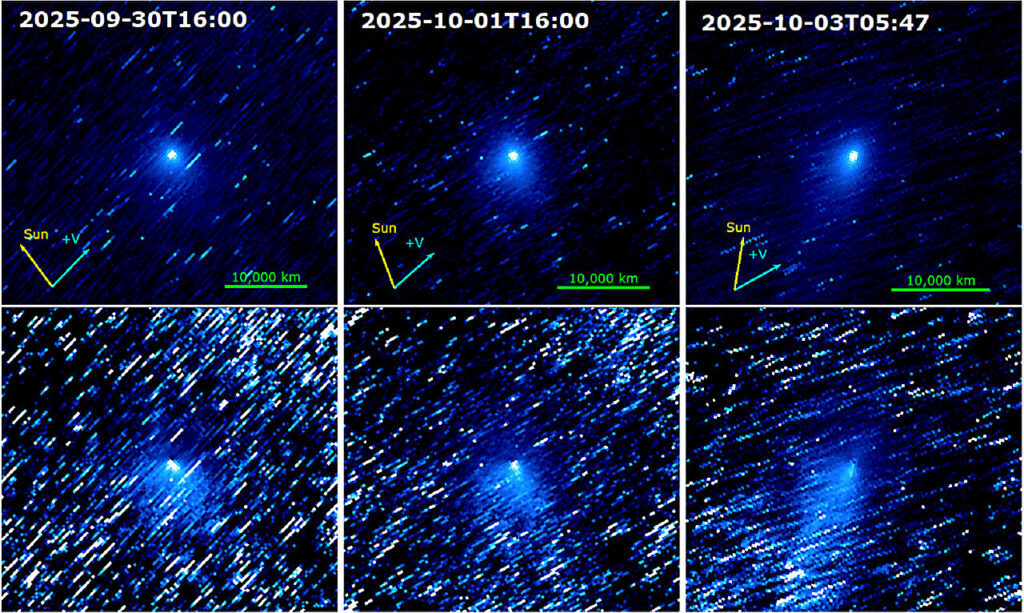
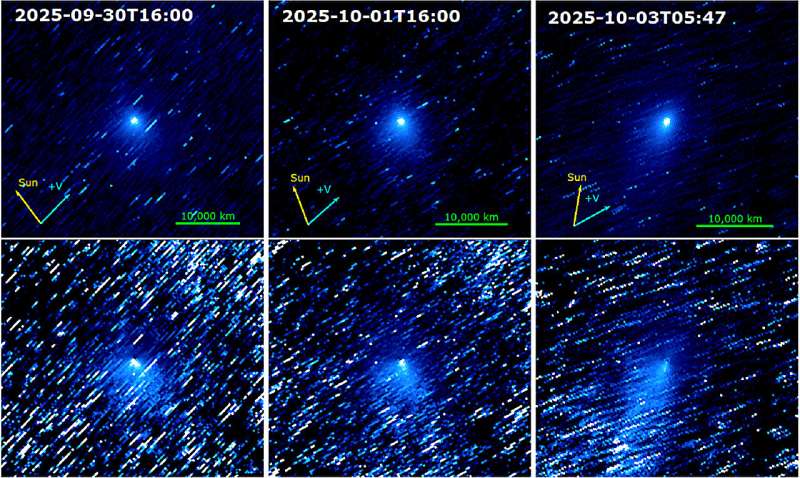
Stacked images of 3I/ATLAS acquired by HiRIC CMOS camera on board the Tianwen-1 spacecraft (upper row) and the corresponding 1/ρ divided images (lower row) from the three epochs. All images are displayed north up and east to the left. The stacked images are displayed with logarithmic brightness stretch, and the enhanced images are displayed with a linear brightness stretch. The arrows in the upper panels mark the projected directions of the sun and the heliocentric velocity vector. The scale bars are 10,000 km. The bright star trails are visible in each stack due to the apparent movement of 3I in the sky background during each 30 s observation epoch. Credit: Xin 鑫 Ren 任 et al, Interstellar Object 3I/ATLAS Observed from Mars by China’s Tianwen-1 Spacecraft, The Astrophysical Journal Letters (2026). DOI: 10.3847/2041-8213/ae61b3
Last fall, a Chinese spacecraft orbiting Mars captured images of a comet from another star system, offering scientists a fresh vantage on a rare visitor.
In July 2025, telescopes spotted 3I/ATLAS—only the third interstellar object ever seen in our solar system. It behaved exactly like a comet, with a bright coma of dust and gas. Even NASA’s Webb Space Telescope found its chemistry unusual: 3I/ATLAS had a much higher CO₂-to-water ratio than nearly any solar system comet. Chinese space scientists seized a rare opportunity: they turned Mars-orbiting Tianwen-1’s camera toward the comet as it flew by.
In doing so, they achieved a milestone—in their words, “These observations constitute the first imaging of this object from a vantage point significantly out of its orbital plane, providing a unique constraint on dust dynamics.”
Remarkably, the researchers note this was indeed China’s first deep-space astronomy from orbit. The two sets of images (just days apart) highlight how the coma’s shape changed as the geometry shifted.
These findings are published in The Astrophysical Journal Letters.
A Martian view of an alien comet
Unlike nearly all previous observations (made from Earth or Earth orbit), Tianwen-1 saw the comet from well out of its orbital plane. This unique perspective was crucial for understanding the comet’s behavior.
The HiRIC camera is actually a 512×512-pixel CMOS imager (∼1.94″/pixel) designed for snapping Mars, not faint comets. The team trained it carefully on 3I/ATLAS for 30-second exposures, capturing 57 frames over three epochs (Sept. 30, Oct. 1, Oct. 3). These observations spanned only a few days, but with the comet racing at ~86 km/s relative to Mars, each image showed the coma and tail in a new configuration.
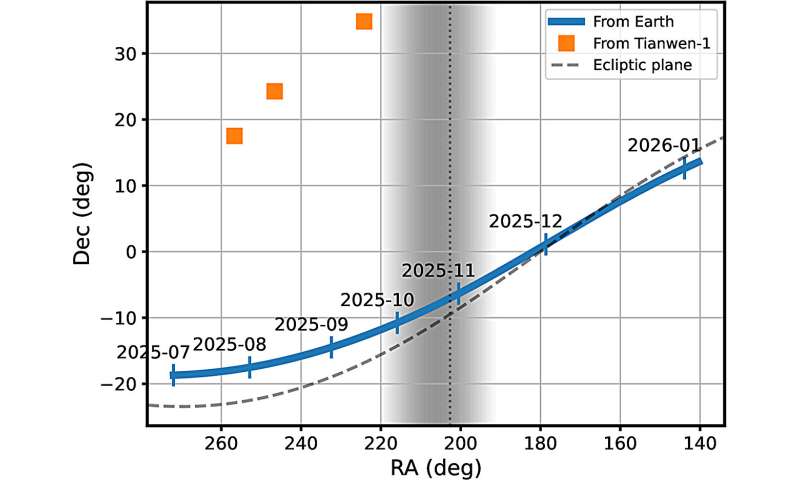
The sky coordinate of 3I from Earth between 2025 July 1 and early 2026 January (blue line) and from Mars during the three epochs of Tianwen-1 observations (filled orange squares). The thin dashed curve marks the ecliptic plane. The vertical dotted line marks the R.A. of 3I from Earth at perihelion, and the shaded area marks the range of R.A. with solar elongation <45°. While no ground-based optical observations are possible near perihelion and solar conjunction, monitoring can still be continued with space-based facilities. Credit: Xin 鑫 Ren 任 et al, Interstellar Object 3I/ATLAS Observed from Mars by China’s Tianwen-1 Spacecraft, The Astrophysical Journal Letters (2026). DOI: 10.3847/2041-8213/ae61b3
From this Martian vantage point, astronomers could see aspects of the comet that Earth telescopes never could.
As described in their paper, “This is China’s first deep-space observation of an astronomical object,” and it gave unique insight into the dust around 3I/ATLAS. (For example, the comet’s nucleus had been estimated at 1.3±0.2 km across from Hubble data, with a ~16-hour spin. Slow dust seen from Earth implied large grains; now Mars sees those grains directly.)
Dust grains as big as sand
The key finding: 3I/ATLAS’s dust cloud was filled with unusually large particles. By comparing the images to standard dust models, the researchers found the coma is dominated by grains hundreds of micrometers in size (solar-pressure parameter β≈10⁻³–10⁻²). In other words, most grains are on the order of a tenth to a millimeter across—about the size of coarse sand.
These hefty bits moved very slowly once released: the extent of the sunward coma implies ejection speeds of only 3–10 m/s. For comparison, previous analyses had estimated about 5 m/s and a mix of tens-to-hundreds-of-micron grains.
Despite these changes, the coma’s overall brightness profile remained steady across the epochs. Near the nucleus, it falls off roughly as 1/ρ (ρ = distance), steepening to about 1/ρ1.5 farther out. This is exactly what one expects if large dust is steadily streaming away under sunlight.
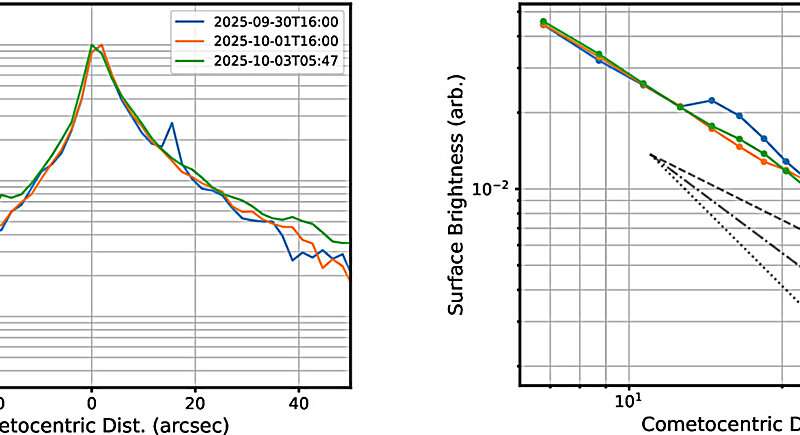
(Left) Surface brightness scan of the coma along the sunward–antisunward direction, normalized to the peak brightness. Left is the sunward direction, and right is the antisunward direction. The profile is averaged over a ∼10″ wide strip. An obvious asymmetry is shown between the sunward (left) and antisunward (right) direction, consistent with the effect of SRP. (Right) Azimuthally averaged surface brightness profile with respect to cometocentric distance, derived from the photometry measured in a series of concentric annulus apertures centered on the centroid of the comet. Also shown are the lines representing exponential slopes of −1 and −2. Credit: Xin 鑫 Ren 任 et al, Interstellar Object 3I/ATLAS Observed from Mars by China’s Tianwen-1 Spacecraft, The Astrophysical Journal Letters (2026). DOI: 10.3847/2041-8213/ae61b3
Using calibrated photometry, the team estimated a dust mass-loss rate of order 10³ kg/s—about a ton of material every second. That’s much higher than earlier ground-based estimates of tens of kg/s, indicating the comet was shedding far more dust than first thought (with most in these big grains).
Where are the jets?
Astronomers had briefly reported narrow dust jets in 3I/ATLAS’s coma (likely linked to its spin). Intriguingly, the Tianwen-1 images showed no such jets. In the Mars data, the comet’s cloud was smooth and fan-shaped, without discrete streaks of dust. The authors explicitly write that they “searched for jet structures … but found none.”
They even express doubt about some Hubble jet claims: if those jets were real, they argue, they should have appeared in their data (from a very different angle)—but they did not.
Cosmic clues and next steps
All of these observations lead to some clues regarding the formation of 3I/ATLAS. This interstellar body and its predecessor, 2I/Borisov, share massive grains and unusual volatiles. This is an indication that both formed in very cold environments outside their star systems, allowing for the preservation of volatiles such as carbon dioxide.
There’s also a practical takeaway: modern spacecraft can double as telescopes. As the authors conclude, “the success demonstrated the capability and flexibility of the Tianwen-1 orbiter spacecraft, and set an example for exploiting operating spacecraft in deep space to perform target-of-opportunity astronomical observations.”
Tianwen-1 was launched to orbit Mars, but this study shows it can also chase comets. In the future, orbiters or planetary probes might routinely be redirected to snap otherwise-missed sights.
The next interstellar traveler could potentially also be observed not only on planet Earth but also through the eyes of another planet. Every new perspective holds new surprises as we keep pursuing our quest for these cosmic travelers.
Publication details
Xin 鑫 Ren 任 et al, Interstellar Object 3I/ATLAS Observed from Mars by China’s Tianwen-1 Spacecraft, The Astrophysical Journal Letters (2026). DOI: 10.3847/2041-8213/ae61b3
© 2026 Science X Network
0 share
Send feedback to editors
Add as preferred source
Citation:
Seen from Mars, an interstellar visitor looks completely different and changes what astronomers thought they knew (2026, May 19)
retrieved 19 May 2026
from https://sciencex.com/news/2026-05-mars-interstellar-visitor-astronomers-thought.html
This document is subject to copyright. Apart from any fair dealing for the purpose of private study or research, no
part may be reproduced without the written permission. The content is provided for information purposes only.