
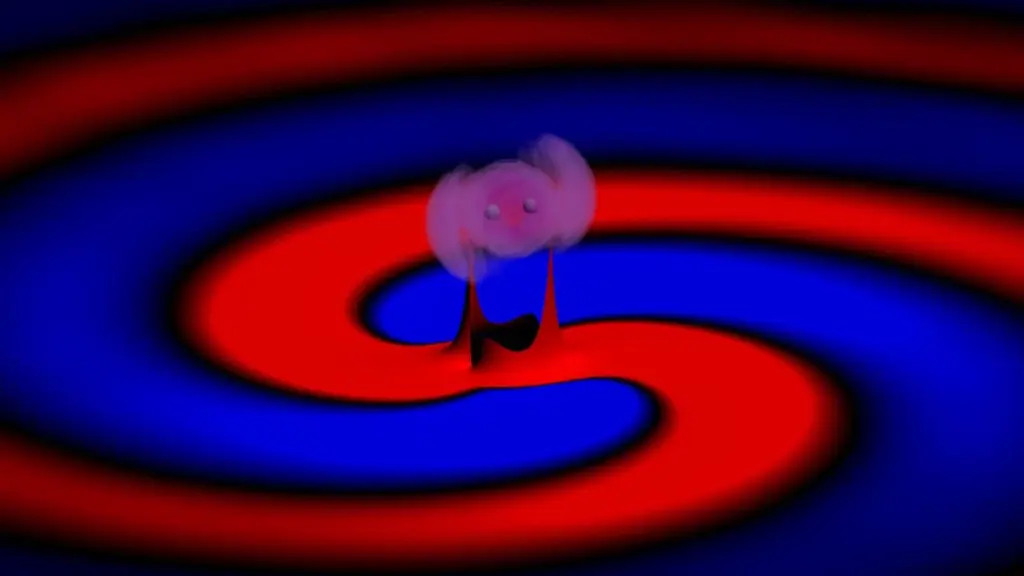
Physicists have discovered that data on gravitational waves may contain clues to dark matter. One of the signals detected back in 2019 turned out to be different from the others. This is not a definitive discovery, but it is potentially a new way to search for the invisible component of the Universe, whose presence has so far only been detected through gravity.
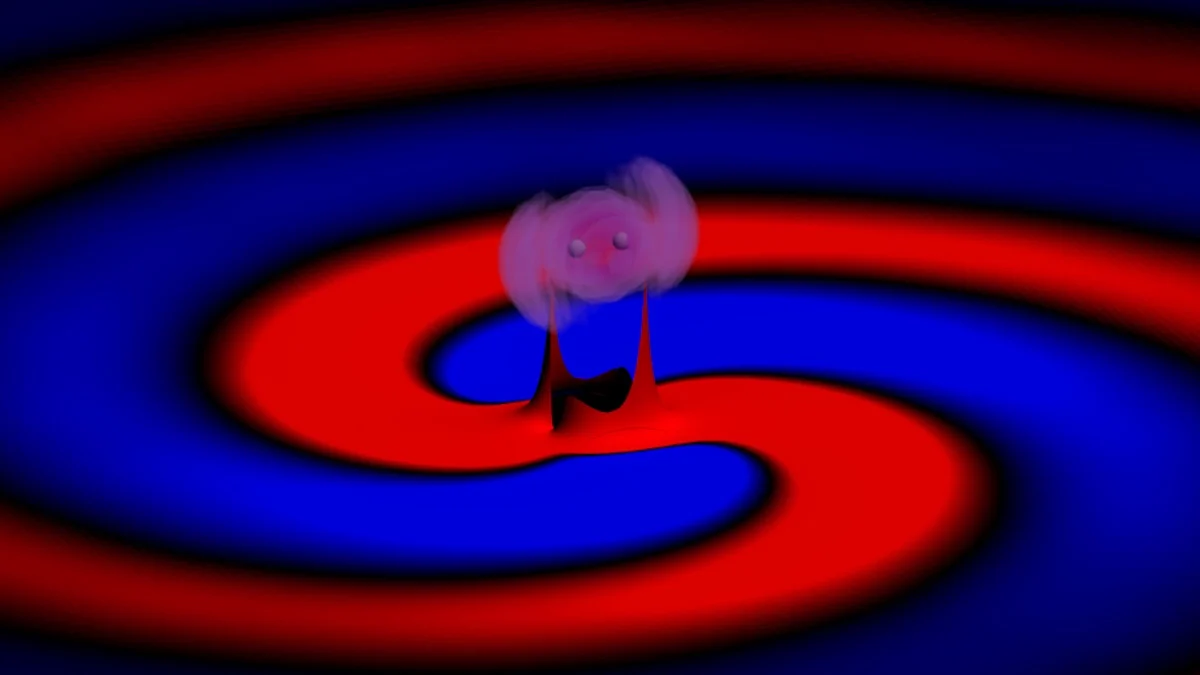 Illustration of gravitational waves (red and blue) from the merger of two black holes within a dark matter cloud. Source: mit.edu
What are gravitational waves?
Gravitational waves are ripples in the very fabric of spacetime. They arise during extremely powerful events: collisions between black holes, mergers of neutron stars, and supernova explosions.
They were first directly detected in 2015, and since then, detectors have recorded hundreds of such events. Each signal carries an “imprint” of the objects that generated it: their masses, orbits, and velocities.
Dark matter and black holes
Dark matter interacts with its surroundings solely through gravity, so it cannot be observed directly. However, one theoretical model describes it as clouds of ultralight particles capable of behaving like waves in the vicinity of massive objects.
Physicists from the Massachusetts Institute of Technology (MIT) and several European institutions have suggested that if two black holes merge inside a dense cloud of dark matter, this alters their orbit and the shape of the gravitational waves.
A rotating black hole can transfer its rotational energy to the surrounding dark matter field through a process known as superradiation. As a result, the cloud becomes dense enough to significantly affect the orbital dynamics of the binary system.
3D visualization of a binary black hole system orbiting within a dark matter cloud (scalar field). The plane shows gravitational waves propagating through space. At the top is a comparison of the signal shape with and without dark matter. Source: GRChombo
One signal out of twenty-eight
The researchers developed a model of what a gravitational signal from a merger in a dark matter environment would look like and compared it with actual data. To verify this, they selected the 28 clearest events from the LVK network database, which includes three gravitational-wave observatories: LIGO in the U.S., Virgo in Italy, and KAGRA in Japan.
Twenty-seven signals were consistent with standard vacuum mergers. But one, GW190728, detected on July 28, 2019, showed a statistical match with the dark matter model. It originated from the merger of two black holes with a combined mass of about 20 solar masses.
Not a discovery, but a new tool
Researchers emphasize that this is not a confirmed detection of dark matter. The statistical significance is not yet sufficient to support such a claim, and the results need to be verified by independent groups.
However, there is something else that matters. Without such models, signals from dark matter cloud mergers are simply classified as ordinary vacuum events, and no one revisits them. The new approach makes it possible to identify such cases as early as the initial data analysis stage.
According to sciencealert.com