
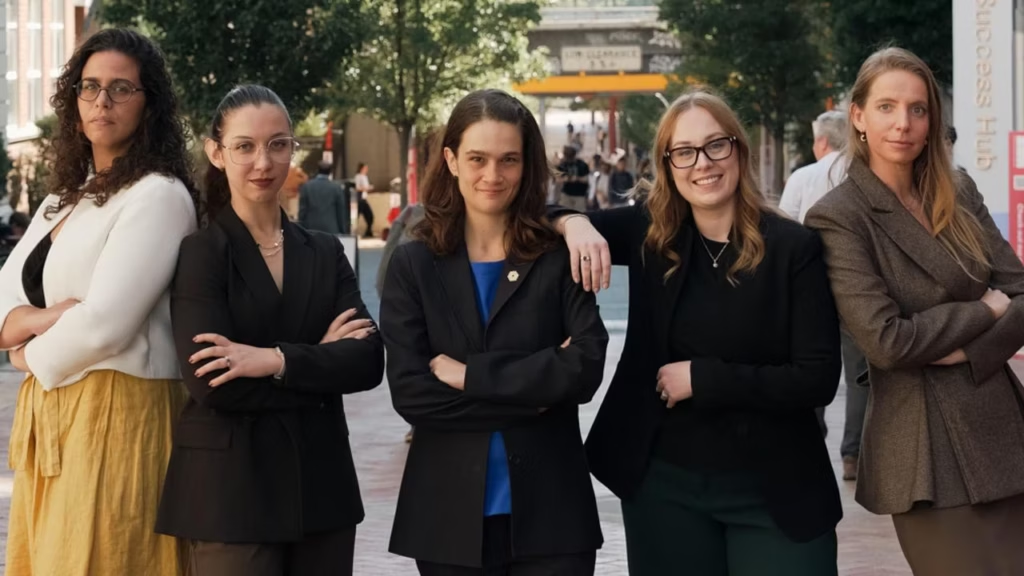
Swinburne University of Technology has appointed five scientists representing the next generation of astronomical research to come together like a group of superheroes to try to answer some of the biggest questions in – and about – the universe.
Meet the Astro Avengers, a group of astrophysicists at the Centre for Astrophysics and Supercomputing at Swinburne University of Technology dedicated to uncovering some of the greatest mysteries of the universe, from understanding how and why galaxies form and evolve, to the reasons behind massive explosions in the universe.
The Avengers are peering into the farthest reaches of the universe using the world’s best telescopes and developing new methods to understand the data using artificial intelligence.
Equally vital for the Avengers –Dr Kirsten Banks, Dr Sara Webb, Dr Rebecca Davies, Dr Rebecca Allen, and Dr Anais Möller – is their commitment to broadening participation in science, especially among individuals who traditionally lack access to scientific education and opportunities. The Astro Avengers are five female researchers on a mission to make STEM our super strength, while solving some mysteries of the universe along the way.
ENGINE ROOM OF THE FINAL FRONTIERS
The Centre for Astrophysics and Supercomputing (CAS) serves as a hub for advancement and development across astrophysics, Space Technology, artificial intelligence, and related fields.
CAS is one of Australia’s leading astronomy research centres, with a strong international reputation in observational astrophysics, computational modelling, and large-scale sky surveys. Established in the late 1990s, CAS has played a significant role in major global collaborations and the development of advanced supercomputing facilities, contributing to discoveries ranging from galaxy evolution to transient cosmic events.
THE ASTRO AVENGERS
To continue the superhero analogy, each of the Astro Avengers has a unique set of powers – or skills.
Deep inside the Centre, the two Rebeccas, Dr Allen, Co-Director of the Space Technology and Industry Institute and Dr Davies, an ARC DECRA Fellow, work to map how galaxies form and evolve over billions of years, tracing the universe’s development since its origin about 14 billion years ago with the Big Bang.
Dr Rebecca Davies researches the physical processes driving galaxy evolution over cosmic history, with a special interest in galaxy-scale outflows – cosmic winds that strip galaxies of the fuel needed to form new stars, while seeding the Universe with the elements needed for life.
And Dr Allen’s PhD in Astrophysics research focused on studying the structural properties and stellar populations of galaxies to determine their growth rates over time. She supports cutting-edge research in areas such as microgravity experimentation
and Earth observation to build climate change-resilient communities and support innovation in space technology.
Dr Sara Webb is the Course Director for Swinburne Astronomy Online, Microgravity Program Lead, and Program Mission Director for SHINE and the Swinburne Space Innovation Challenge. Dr Webb has discovered some of the most energetic, fast-flaring star populations ever, only possible through vast sky surveys. This links to Dr Anais Möller’s work in the fast-transient universe: supernovae, neutron-star mergers, and other fleeting, high-energy explosions that light up the cosmos without warning.
Meanwhile, Dr Kirsten Banks is a lecturer within Swinburne’s School of Science, Computing
and Emerging Technologies and her academic journey has fostered a passion for uncovering the
stories hidden in starlight and sharing them with others by engaging diverse audiences with the excitement of astrophysics
and gravitational wave research, using innovative approaches such as social media, public lectures, and multimedia storytelling.
Dr Anais Möller is an ARC DECRA Fellow who leads research in the areas of cosmology and transient astrophysics.
To do so, she studies multi-wavelength and messenger transients, including some of the most exotic explosions and collisions or mergers in the universe, involving supernovae, black holes, and neutron stars.
CLEAR SCIENCE
All together, their fundamental astrophysics becomes capability. Dr Allen and Dr Webb translate astronomical tools and insight into space technology and space station experiments, while Dr Banks leads vast online communication of science and astronomy to all audiences and learners.
Dr Möller enables real-time astronomy through the Fink broker, a scientific software data system which acts as an intermediary (or broker) between telescopes that detect events
and the researchers who want to study them.
Across it all is a shared mission: to communicate science clearly and inclusively, advancing knowledge at the frontier while inspiring the public into the unfolding story of the universe.