
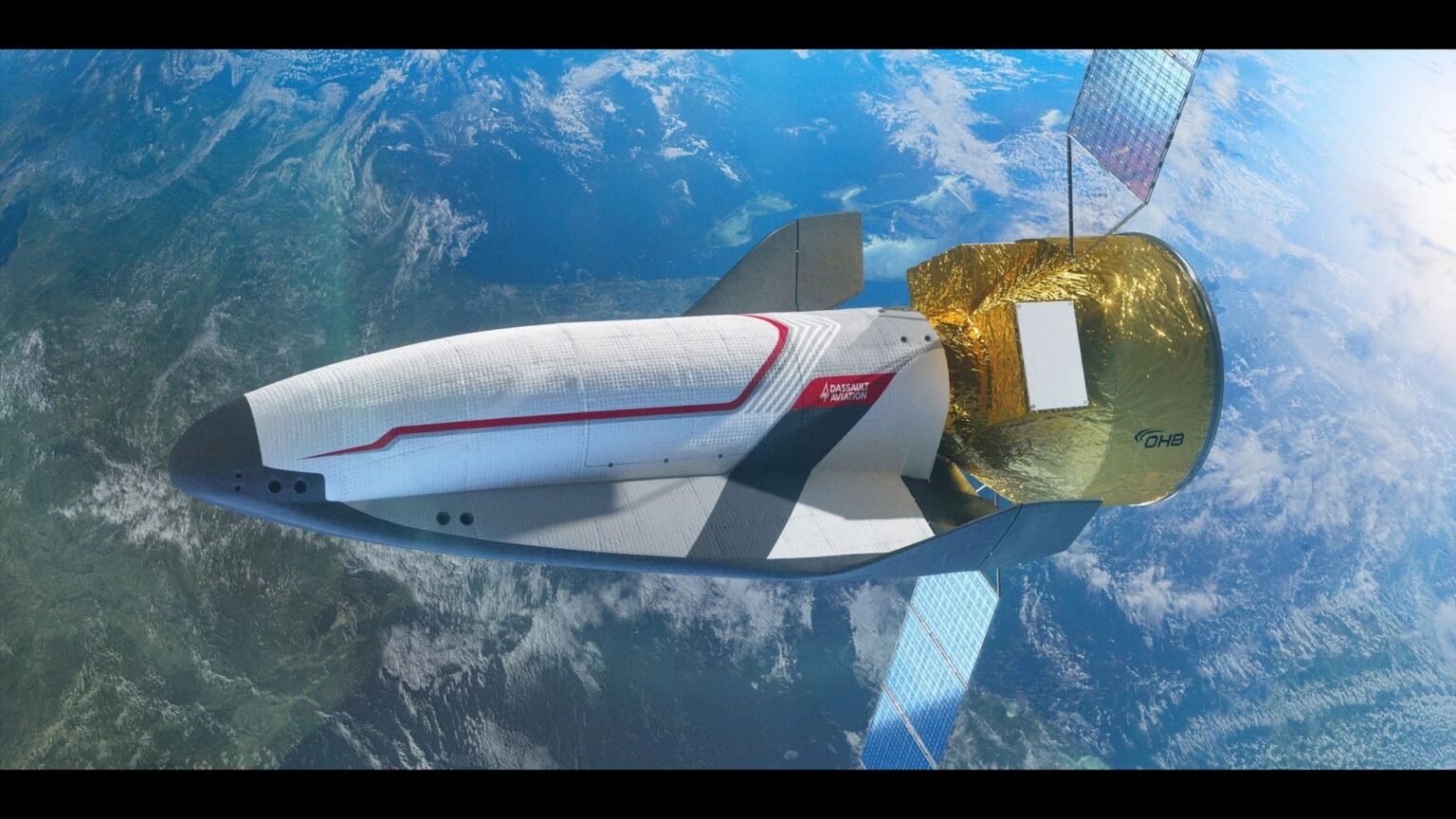
Dassault Aviation and OHB announced on 11th May that they are partnering to propose to the European Space Agency (ESA) a multipurpose reusable orbital transport spaceplane named VORTEX-S (Véhicule Orbital Réutilisable de Transport et d’Exploration). According to the press release discussions are also underway with other major European space companies to expand the team for the project.
It further states that Dassault Aviation will be the prime architect and system integrator of the spaceplane, whereas OHB will be the architect and integrator of the space plane`s service module.
The vertical launch horizontal landing spaceplane will be mated to a launch vehicle and will not be encapsulated in the launch vehicle fairings. Vortex-S will be capable of round-transport to space stations and of autonomous orbital free flyer missions. It is primarily aimed at providing European future in space mobility, given that the International Space Station (ISS) is scheduled for retirement in 2030.
Phased development
The program is aimed at an incremental four phased development. Starting from Vortex-D (demonstrator), Vortex – S (smart, free flyer), Vortex – C (heavy cargo), and Vortex – H (human-rated). Vortex-C and Vortex – H will be full scale spaceplanes.
The demonstrator version will be 4 m long, and will have a payload capacity of 2 tons with a payload volume of 8 cubic meters. The objectives of the Vortex-D will be aerodynamic design validation, hypersonic technologies validation (including flight controls), flight control laws validation and key systems qualifications. The spaceplane has rendezvous and docking capability with space stations (located in low Earth orbit) and can carry out soft atmospheric reentry (less than 2Gs), making it ideal for returning fragile payloads from space. Its suborbital flight is likely to take place in 2028. The demonstrator version will be supported by the French Defense Procurement Agency (DGA).
Vortex-S is designed to anticipate the need for larger variants, allowing more cargo to be transported, or carry astronaut crews onboard, to Low Earth Orbit based space stations. Vortex-C and H are expected to enter into service by the mid 2030s.
Mission sets
The space plane is meant to be a versatile dual-use platform for a wide range applications. These include serving as a flying test bed for in orbit manufacturing of alloys, composite materials, and fibers as well as research and production of space medicine.
Military applications of Vortex-S include in-orbit servicing and refueling missions, rendezvous with a cooperative or non-cooperative space objects, scheduled or unscheduled satellite intervention, de-orbit assistance, space surveillance and policing.
Currently only United States and China operate active, orbital space planes. These include X-37B (manufactured by Boeing) and Dream Chaser (manufactured by Sierra Space) from the United States and Shenlong (manufactured by China Aerospace Science Technology Corporation) from China.