
Scientists have discovered why some massive stars explode while others fade away quietly. It turns out that a star’s fate may depend on how neutrinos behave in the first moments after the core collapses. These particles are capable of changing their type—and this is precisely what determines whether the shock wave will gain enough energy to trigger an explosion.
 Illustration of neutrino oscillation inside the core of a supernova.
Chameleons of the Microworld
There are three types of neutrinos: electron, muon, and tau neutrinos. They can spontaneously oscillate from one flavor to another. This phenomenon is known as oscillation—and under extreme astrophysical conditions, it remains poorly understood.
The problem is that only certain flavors interact with the surrounding material strongly enough to heat it up. If the transition doesn’t occur at the right moment, the heating weakens and the explosion doesn’t happen.
Too fast for simulations
A team led by Ryuichiro Akaho at Waseda University in Tokyo focused on a specific type of oscillation known as “rapid flavor conversion.” This phenomenon occurs when dense streams of neutrinos collectively switch between types in an extremely short period of time.
The challenge is that the process takes place over distances of just a few centimeters and unfolds in nanoseconds. None of the current supernova simulations have sufficient resolution to directly reproduce this.
What determines the fate of a star
The researchers developed theoretical models for stars of various masses and incorporated a detailed account of rapid flavor oscillation into simulations that track the motion of neutrinos in all directions.
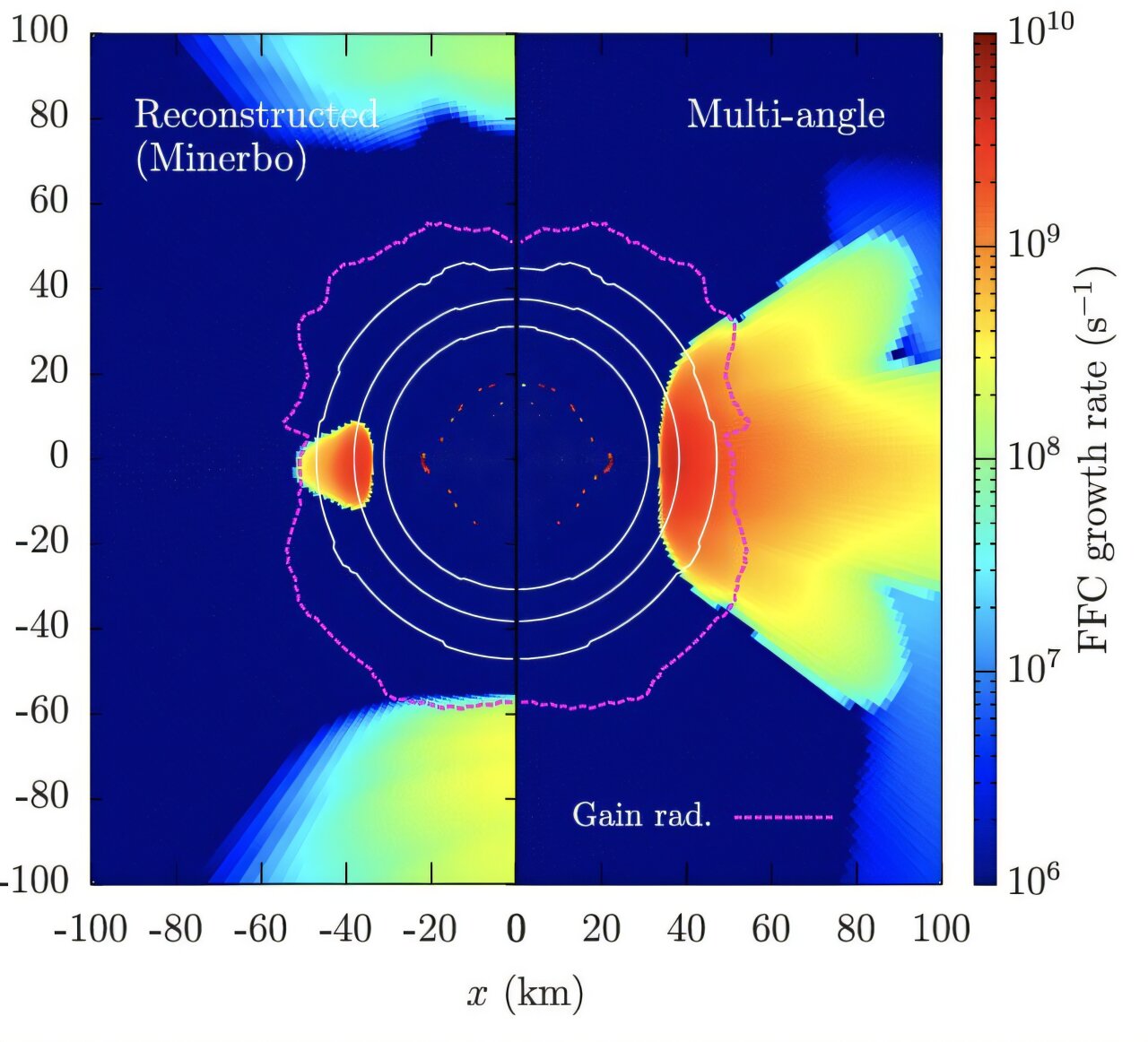 Computer simulation of the rapid transformation of the neutrino flavor following the collapse of a supernova core. Credit: Ryuichiro Akaho et al. Source: phys.org
According to results published in Physical Review Letters, the star’s mass is determined by the accretion rate—the speed at which matter falls onto the protoneutron star. At a low rate, rapid flavor conversion intensifies heating and promotes the explosion. At a high rate, conversely, it reduces the total neutrino flux to such an extent that the explosion is suppressed.
The price of accuracy
The team also found that simplified models of neutrino oscillation produce erroneous results in both directions: they can either fail to detect a real flavor transformation or predict one where none exists.
This means that accurately modeling stellar explosions will require much more complex calculations—even if it requires significant computational resources.
According to phys.org