
Rawpixel.com/Shutterstock
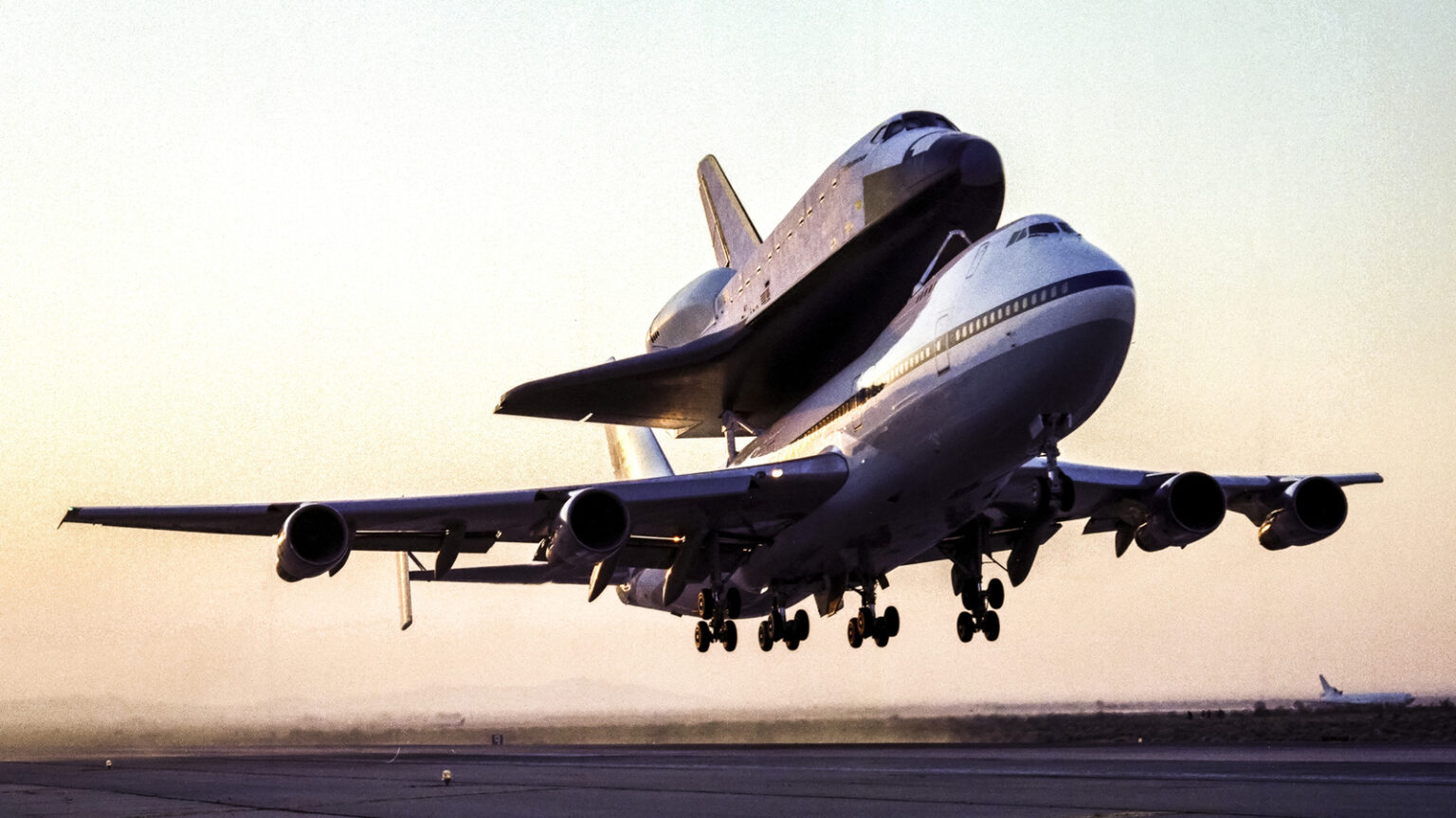
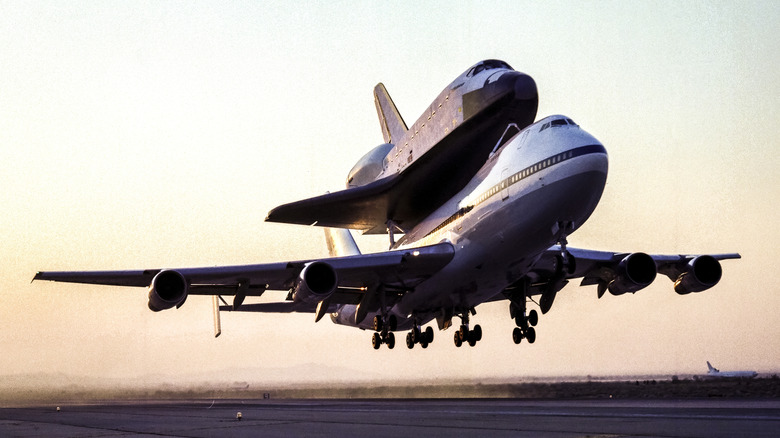
Now retired, the Shuttle Carrier Aircraft (SCA) were a pair of planes designed to transport orbiters from their landing sites back to Kennedy Space Center throughout the Space Shuttle Program, one of the most expensive space missions of all time. The two planes were Boeing 747s modified to carry massive spacecraft through the air.
While the space shuttle may look like an airplane, it doesn’t fly the same way. They lack the turbofan engines typical of commercial planes, and are literally shuttles for people and cargo that use rocket engines to launch and simply glide when it’s time to land. So, the 747 stepped in as the space shuttle’s transportation between landing and launching sites.
In choosing an aircraft for this job, NASA narrowed its options to the Lockheed C-5 Galaxy and the Boeing 747. It ultimately chose the 747 for two main reasons. First, the design of its wings were better suited for carrying an orbiter. Second, the C-5 Galaxy is a military plane, so NASA would have had to borrow it from the Air Force. Instead, the agency could simply purchase 747s and have complete ownership, an option that became cheaper due to an economic downturn in the 1970s.
How a Boeing 747 was modified to carry a space shuttle
Rawpixel.com/Shutterstock
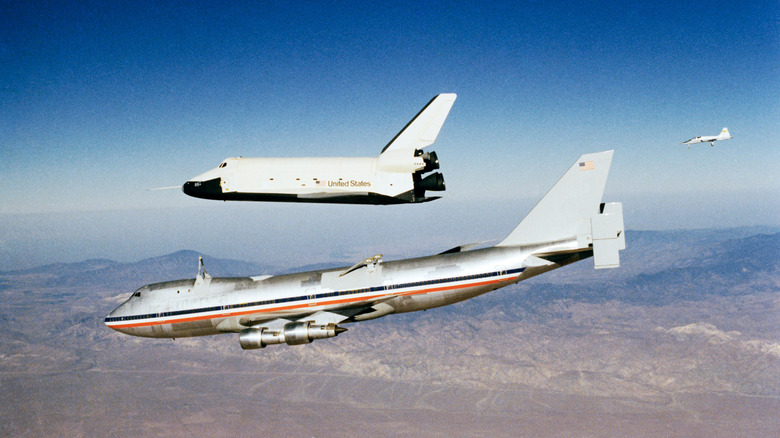
Once NASA had the planes, it needed to make them capable of flying with a space shuttle mounted on top. The Shuttle Carrier Aircrafts are different from typical Boeing 747s — the rare airplane that still uses floppy disks — in several key ways. The interior was stripped of seats and other furnishings, with only the first-class cabin remaining for the crew. In its place was equipment that would allow the crew to monitor electrical loads before, during, and after flights.
Three struts were installed on top of the plane’s fuselage to hold the orbiter, as well as two additional rear stabilizers on either side of the existing horizontal element, to keep the aircraft steady during flight. Before the first shuttle mission could take off, the SCA were used for tests that took place throughout 1977, four years prior to the first launch. These included free flights, where the modified 747 would release the orbiter at high altitude — by detonating explosive bolts — so the shuttle crew could check the spacecraft’s systems and practice landing.
What happened to the Shuttle Carrier Aircraft?
The Shuttle Carrier Aircraft were retired following the final space shuttle mission in July 2011. One of the aircraft, NASA 911 , took its final flight in February 2012, a brief trip from what is now called the Armstrong Flight Research Center in Edwards, California to the Joe Davies Heritage Airpark in Palmdale, California. It has remained there since then, as a loan from NASA and on display for visitors.
The NASA 905 aircraft was used to ferry the four retired orbiters to museums across the U.S. before ending up in one itself. Its final flight was from Edwards Air Force Base to Space Center Houston, where you can find it displayed with a replica space shuttle on top. Though Boeing stopped producing the 747 in 2023, these planes remain in use (even serving as America’s doomsday plane despite the 1980s tech), and will always hold an important place in the history of space exploration.