
Back to Article List
Today in the history of astronomy, a total eclipse serves up several photographic and scientific advancements.
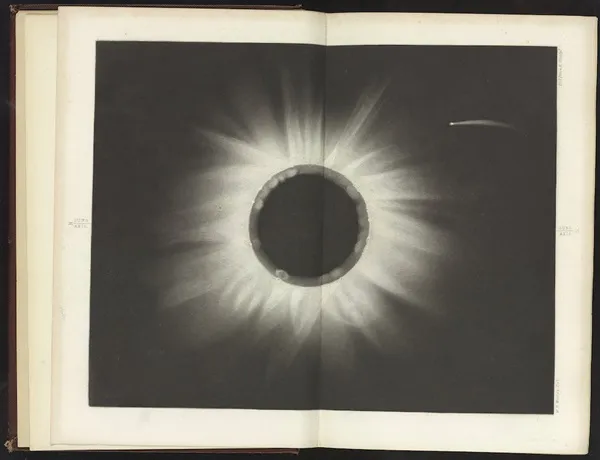
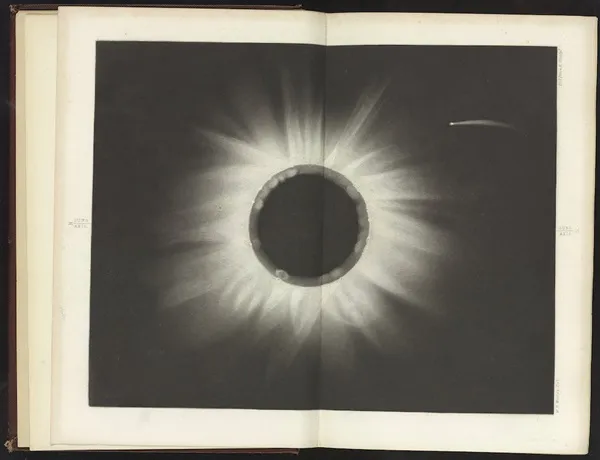
Arthur Schuster’s photographs of the May 17, 1882, were used to create this engraved plate, and displays the comet discovered near the Sun’s corona. The image appeared in Mabel Loomis Todd’s book, “Total Eclipses of the Sun.” Credit: Courtesy of Science History Institute
On May 17, 1882, an eclipse trekked across Africa, the Middle East, and Asia. Many scientists gathered in Egypt to witness it even though it was a fairly short-duration event, with maximum totality at only 1 minute 50 seconds and totality in Egypt at only 70 seconds.
J. Norman Lockyer, one of two astronomers who had discovered helium in the Sun’s spectrum during the 1868 eclipse, led a scientific expedition to study the corona and sunspot activity. Astronomer Arthur Schuster and Captain W. de W. Abney captured a groundbreaking photo: the first image of the coronal spectrum. Schuster also captured the first photo of a comet during a solar eclipse; Comet Tewfik was a sungrazer, observed by spectators during the eclipse and confirmed with Schuster’s image.