
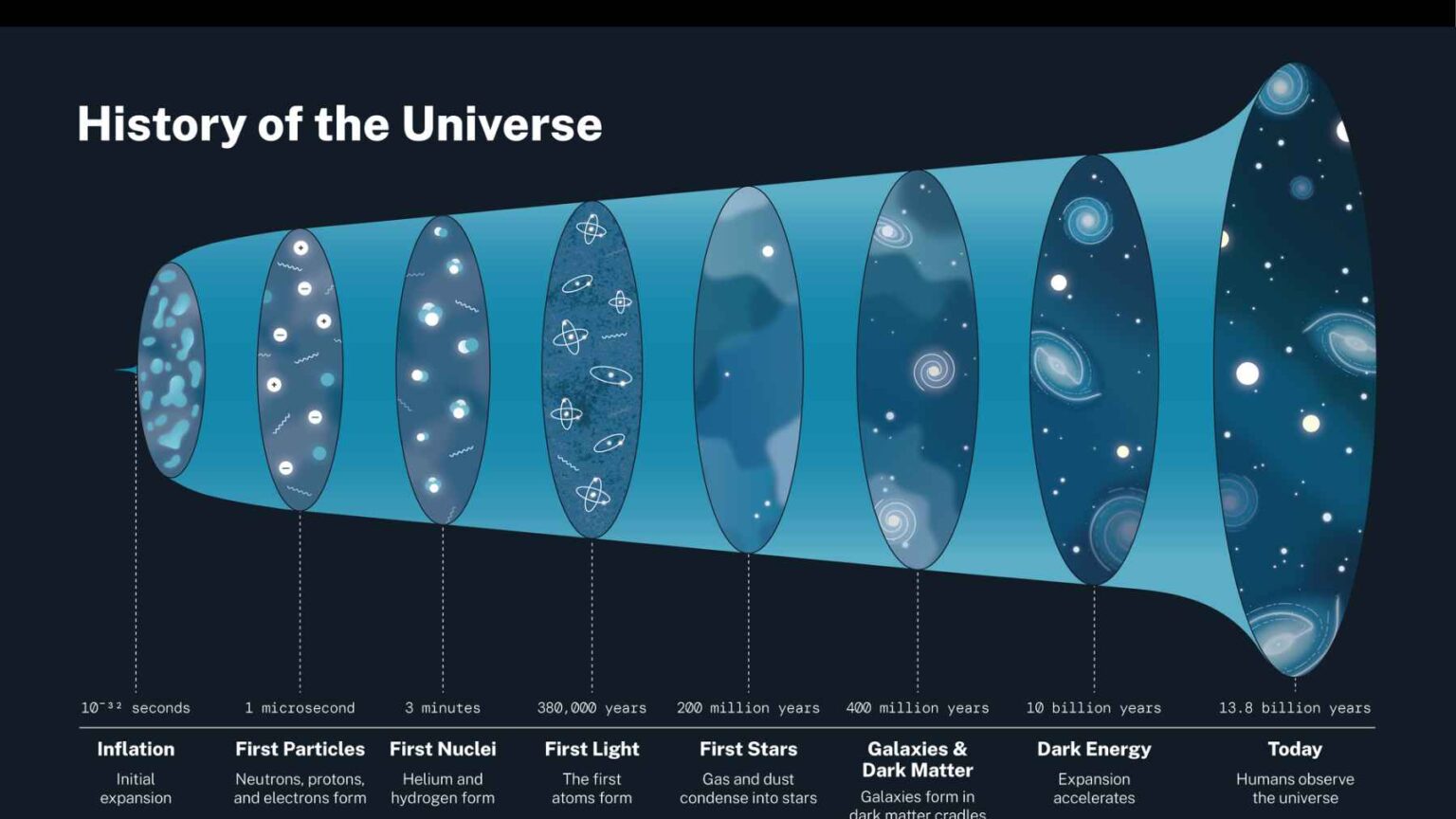
The universe may not drift forever into a cold, empty future. A new study suggests that, under one dark energy model, cosmic expansion could eventually stop, reverse, and end in a “Big Crunch” about 33.3 billion years after the Big Bang.
That does not mean the end is 33.3 billion years away. Since the universe is already about 13.8 billion years old, the proposed countdown leaves roughly 20 billion years. Still, for cosmologists, that is surprisingly soon compared with the familiar idea of a universe that keeps stretching out for trillions of years.
A universe with a deadline
For decades, many scientists leaned toward a quieter ending. In that picture, the universe keeps expanding, stars burn out, galaxies fade, and everything slowly settles into a cold, thin state often called heat death.
This new work points to a more dramatic possibility. The researchers argue that if the cosmological constant is negative, the universe may reach a maximum size and then collapse back inward. In practical terms, that means space itself would stop spreading out and begin shrinking.
That is where the Big Crunch comes in.
Why dark energy matters
Dark energy is the mysterious ingredient thought to drive the accelerated expansion of the universe. It is not something people can hold in a lab or see through a backyard telescope, but its effects show up in how galaxies move and how space expands.
Recent results from the Dark Energy Spectroscopic Instrument, known as DESI, strengthened hints that dark energy may not behave like a fixed “cosmological constant” after all. DESI’s first three years of data span nearly 15 million galaxies and quasars, giving researchers one of the clearest views yet of cosmic expansion over the past 11 billion years.
Taken alone, DESI’s data still fit the standard model of cosmology. But when combined with other measurements, including the cosmic microwave background, supernovae, and weak gravitational lensing, the case for changing dark energy becomes harder to ignore. The evidence is not final, but it is getting interesting.
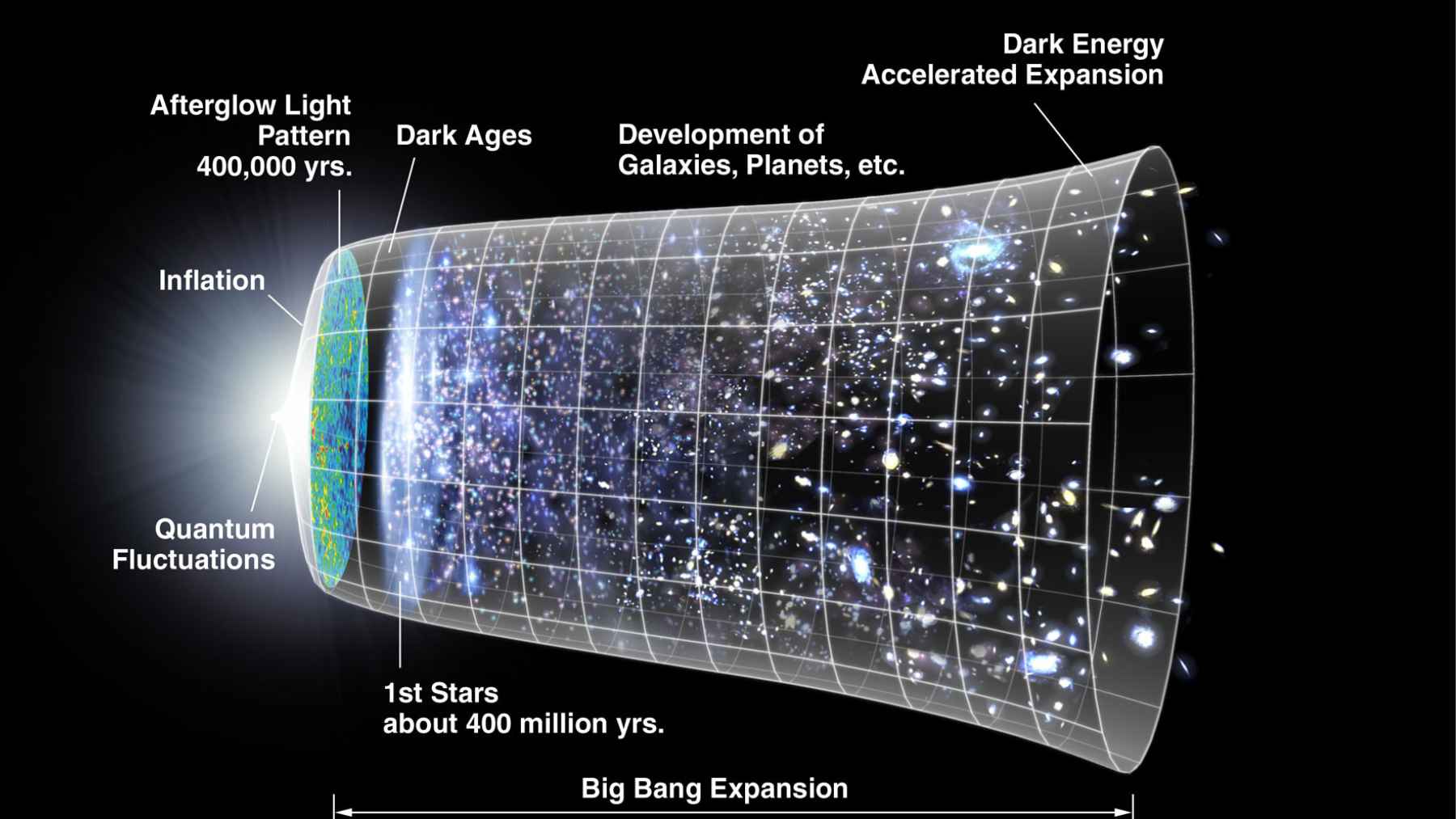
This cosmology diagram illustrates the expansion of the universe from the Big Bang through the era of dark energy and galaxy formation.
The axion idea
The study uses what is called an axion dark energy model. Axions are hypothetical ultralight particles that scientists have discussed for years as possible pieces of the dark matter and dark energy puzzles.
In this model, dark energy is not just one simple background force. It comes from a mix of an axion field and a cosmological constant. The twist is that the best-fit version of the model points to a negative cosmological constant, which would pull the universe toward eventual collapse instead of endless expansion.
S.-H. Henry Tye, one of the authors and a Cornell physicist, put it plainly in Cornell’s report. “The new data seem to indicate that the cosmological constant is negative, and that the universe will end in a big crunch.”
What would happen next
According to Cornell’s summary of the work, the universe would continue expanding for about 11 billion more years before reaching its peak size. After that, contraction would begin, slowly at first and then more dramatically as the final collapse approached.
It is a strange thing to picture. Galaxies that now race apart would, under this scenario, eventually be carried back toward one another as the whole fabric of space reversed course.
Would anyone be around to see it? Almost certainly not. The Sun, Earth, and the familiar night sky would face their own much earlier futures long before any final cosmic crunch.
Not settled science yet
This is not a confirmed forecast carved into the stars. The authors themselves stress that the conclusion depends on two big things holding up: the recent Dark Energy Survey and DESI dark energy observations, and the validity of the axion dark energy model.
DESI scientists have also been careful with their language. The preference for evolving dark energy has not reached the 5-sigma threshold usually treated as the gold standard for discovery. Different data combinations put the signal between 2.8 and 4.2 sigma, which is intriguing but still short of final proof.
So the smart takeaway is not panic. It is that the old, tidy picture of dark energy may be wobbling, and the next wave of cosmic data could decide whether this Big Crunch model survives.
The bigger picture
For most people, 20 billion years is an almost meaningless number. It is far beyond any electric bill, work deadline, or summer plans. But in cosmology, it changes the story.
If the study is right, the universe is not a young thing with an endless road ahead. It is closer to middle age, moving through a life cycle with a beginning, a peak, and possibly an end.
That is the real news here. The question is not only how the universe began, but whether scientists can now start measuring how it ends.
The study was published in the Journal of Cosmology and Astroparticle Physics.