
A former justice minister from Poland who is wanted there on abuse of power charges has somehow turned up in the United States. Zbigniew Ziobro had been living in Hungary since October, when the Polish government lifted his immunity and sought to prosecute him for acts of corruption. He announced in January that he had been granted asylum by Hungarian Prime Minister Viktor Orbán.
But after opposition leader Peter Magyar was elected prime minister in April, he made clear that he would not maintain Ziobro’s grant of asylum, declaring, “Hungary will not be a dumping ground for internationally wanted criminals.” Upon taking office May 9, Magyar doubled down, commenting on his intent to pursue accountability for crimes and corruption committed by Fidesz party members and affiliates. Ziobro apparently left the country that weekend.
Ziobro received his U.S. visa – and the protection that confers – just three weeks after Polish Foreign Minister Radosław Sikorski reportedly received assurances from U.S. Ambassador Tom Rose that the United States would not provide refuge to Ziobro. Polish Justice Minister Waldemar Żurek has now announced that Poland will immediately seek his extradition, and the Polish government is seeking further clarification from the White House after sending an initial diplomatic note over the weekend.
Ziobro’s arrival in the United States was even more remarkable because his travel documents had been canceled by the Polish government, and he and his wife did not have U.S. visas when they fled Poland. On Sunday, Ziobro appeared on the Polish right-wing television station Republika, where he confirmed he was in the United States, claiming he had traveled on a refugee visa, and announcing his new role as a political commentator for the station.
Despite President Donald Trump’s persistent focus on deporting “criminal aliens” from the United States, one of Poland’s top news outlets, Gazeta Wyborcza, reported that Trump had personally granted Ziobro’s request for a U.S. visa, despite the criminal charges he faced and over Rose’s objections and those of Secretary of State Marco Rubio. Other outlets, however, reported this personal action by Trump had not been confirmed.
Charges Against Ziobro
Ziobro faces 26 criminal charges in Poland, including leading an organized criminal group that misused 150 million złoty (about $41.4 million) from the Justice Fund, a fund intended for victims of crime, and for abusing his office during the right-wing Law and Justice government that lost power in 2023. Prosecutors indicated they have evidence that Ziobro issued orders to violate the law, manipulated grant competitions, and granted public funds to unauthorized entities. Charges also include the use of these funds to purchase Pegasus surveillance spyware that was misused to target opposition lawmakers. The charges carry a maximum penalty of 25 years in prison.
For years, Ziobro played a central role in dismantling the rule of law and targeting individual judges who issued rulings holding the Law and Justice Party accountable in Poland. One of these judges was Igor Tuleya, who was targeted for allowing an investigation to go forward when the Law and Justice Party used an irregular process to pass a budget in parliament, a process that appeared to prevent votes from the opposition. Ziobro also was the primary architect of other actions that were roundly criticized by the Court of Justice of the European Union, the European Court of Human Rights, and the European Commission – in addition to the U.S. government at the time – as violations of judicial independence and the rule of law.
Part of a Pattern
The U.S. award of a visa in this case with the support – if not the personal approval of – Trump (a grant of such a sensitive visa to a person wanted by a close U.S. ally would be highly unlikely without the president weighing in, even if he did not personally grant the visa) is in line with his attempts to protect foreign allies who, like him, allegedly exert power and executive control over government funds for personal gain. Orban, too, appears poised to seek refuge – or at least a vacation – in the United States since he lost the Hungarian election and faces the prospect of his own charges of corruption in that country. Last year, Trump apparently attempted to protect former Brazilian President Jair Bolsonaro by issuing Global Magnitsky sanctions against a Brazilian Supreme Court Justice in charge of a criminal investigation against Bolsonaro. (The sanctions were lifted months later.)
The latest apparent grant of protection and immunity to Ziobro is another example of the Trump administration’s misuse of government resources for personal reasons. The risk is that such actions will become reciprocal, resulting in a “corrupt international,” or as Anne Applebaum called it in Autocracy Inc., a collaboration of corrupt actors across borders in which political figures and officials facing well-founded charges of crime and corruption may seek their ideological allies’ protection outside any rule of law. This would undermine international standards of accountability and proper procedure.
The United States should not allow this tit-for-tat criminal protection racket to thrive. Public sentiment should be swift and clear – Minister Ziobro must go home.
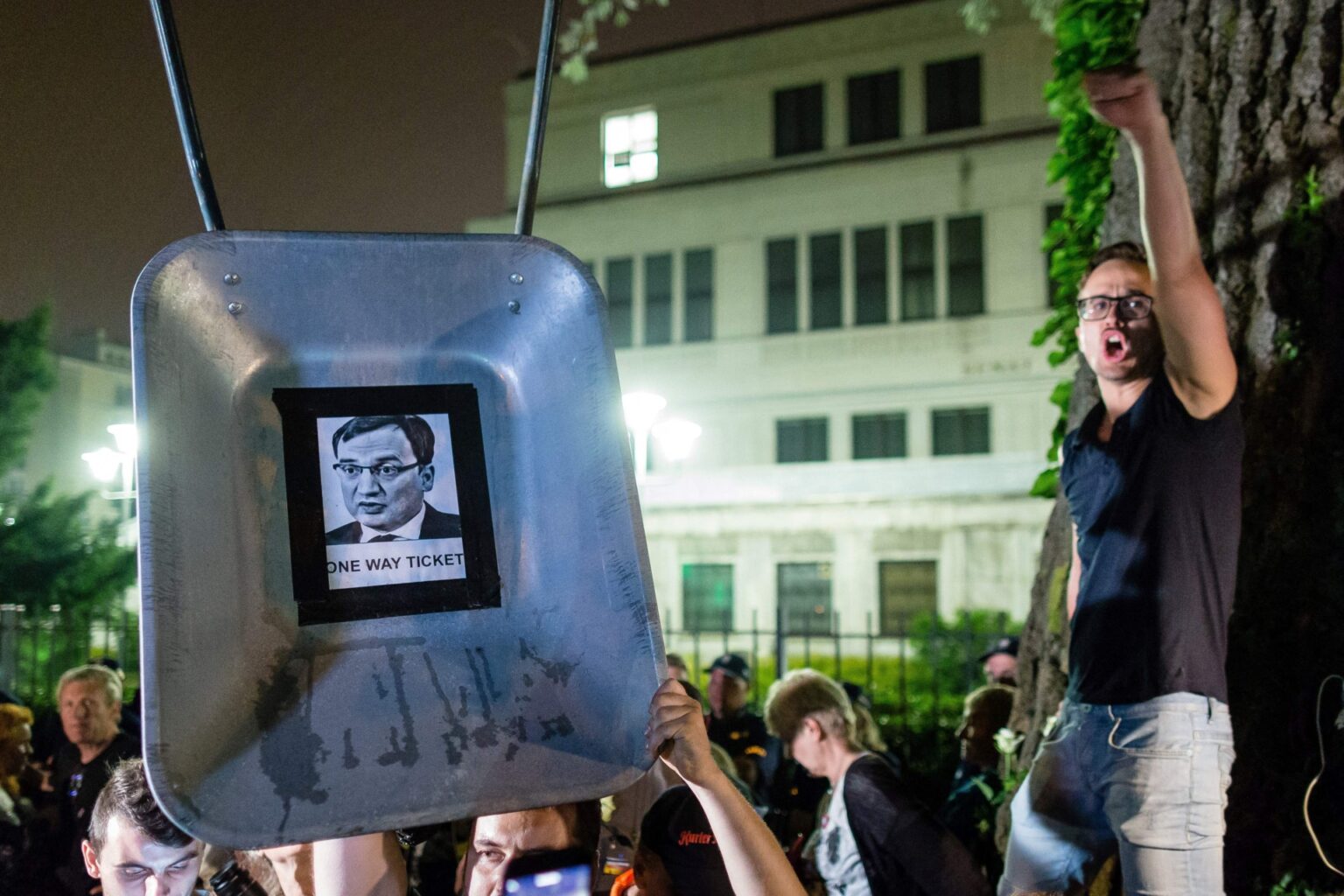
FEATURED IMAGE: A protester shouts slogans and gestures by a picture of Polish Justice Minister Zbigniew Ziobro stuck on wheelbarrow, as a symbol of dismissal, during a demonstration in front of the Polish Parliament as Polish Senators decide about new bill changing the judiciary system, in Warsaw, on July 21, 2017 (Photo by WOJTEK RADWANSKI/AFP via Getty Images)