
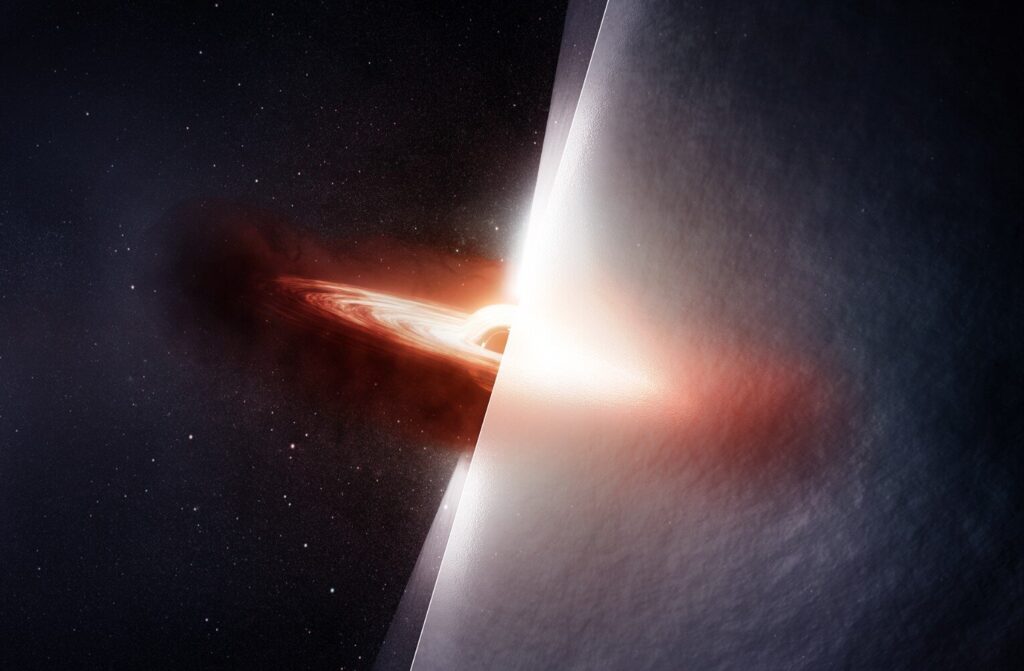
For the first time, astronomers led by the Center for Astrophysics at Harvard University and the Smithsonian Institution (CfA) have directly observed turbulence distorting light in the interstellar medium. These results will help scientists obtain a clearer image of the supermassive black hole at the center of the Milky Way.
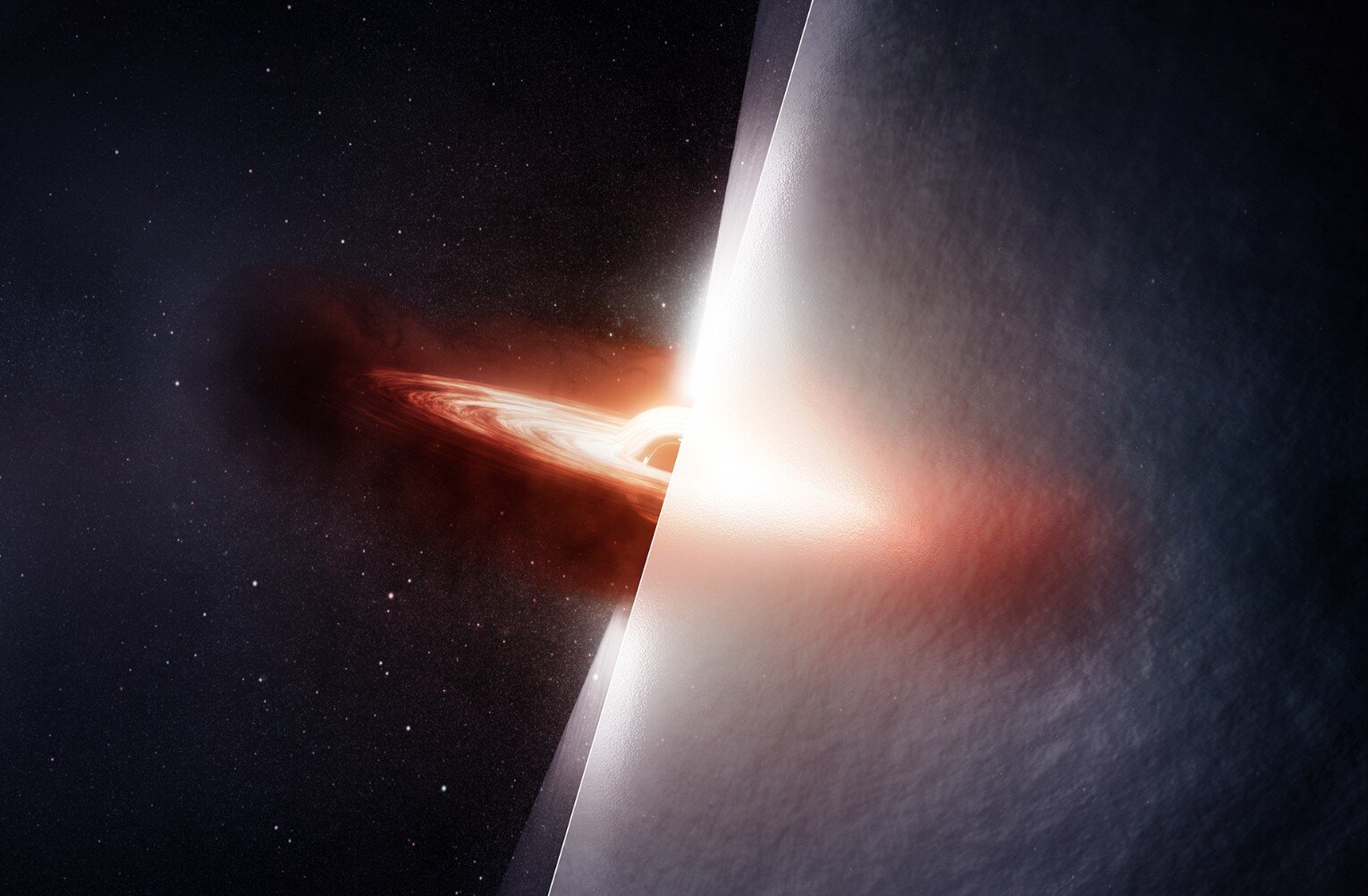 Radiation from the quasar TXS 2005+403. Source: phys.org
Turbulence in space
The space between the stars in our galaxy, known as the interstellar medium, is filled with clouds of ionized gas and electrons. When radio waves from distant objects pass through this turbulent medium, they are bent and distorted in the same way that heat haze rising above a fire distorts our view of everything behind it.
To measure turbulence, astronomers turned their attention to the quasar TXS 2005+403—a bright radio source powered by a supermassive black hole located about 10 billion light-years from Earth in the constellation Cygnus. As the quasar’s radio waves travel toward Earth, they pass through the Cygnus region of the Galaxy, one of the most turbulent and highly scattering environments in the Milky Way, causing the radio waves to be deflected and distorted.
However, most of what we see in the radio data does not come from the quasar itself, but from scattering caused by turbulence in this region of the Milky Way. According to the scientists, this scattering and the associated distortions allow us to study the turbulence, gain a better understanding of it, and draw conclusions about its structure.
Analysis of the radiation from the quasar TXS 2005+403 and detection of turbulence
To better understand the effect of turbulence on quasar light, scientists analyzed nearly a decade’s worth of archival observational data collected using the National Science Foundation’s (NSF) Very Long Baseline Array (VLBA). The NSF VLBA system, operated by the National Science Foundation’s National Radio Astronomy Observatory (NSF NRAO), consists of a network of ten radio telescopes located across the country.
Scientists expected that when the radio waves from TXS 2005+403 passed through the Milky Way, they would spread out into a uniform spot and disappear. They discovered stable, distinct patterns that created structured, non-uniform distortions in the light, which could only have been caused by turbulence.
Alexander Plavin, the lead author of the new paper, added that the scattering properties along this line of sight through the Galaxy remain constant over time.
Implications for astronomical research
These findings are of significant importance for future astronomical research. The turbulence detected here exists on a scale roughly equal to that of our Solar System. Understanding this helps explain how energy is distributed throughout the galaxy and how gas behaves before it condenses to form new stars.
These findings may also influence efforts to improve the resolution of black hole images. The images of Sagittarius A*, the supermassive black hole at the center of the Milky Way, obtained by the Event Horizon Telescope, are blurred precisely because of this interstellar scattering. Studying how turbulence scatters radio waves over time and at different frequencies paves the way for removing its effects from these images.
The team has begun a series of follow-up observations using the NSF VLBA radio astronomy network, which will continue through 2026. The goal of these observations is to measure the specific properties of the screen formed by this turbulence and to track how it changes as the gas moves relative to Earth.
According to phys.org