
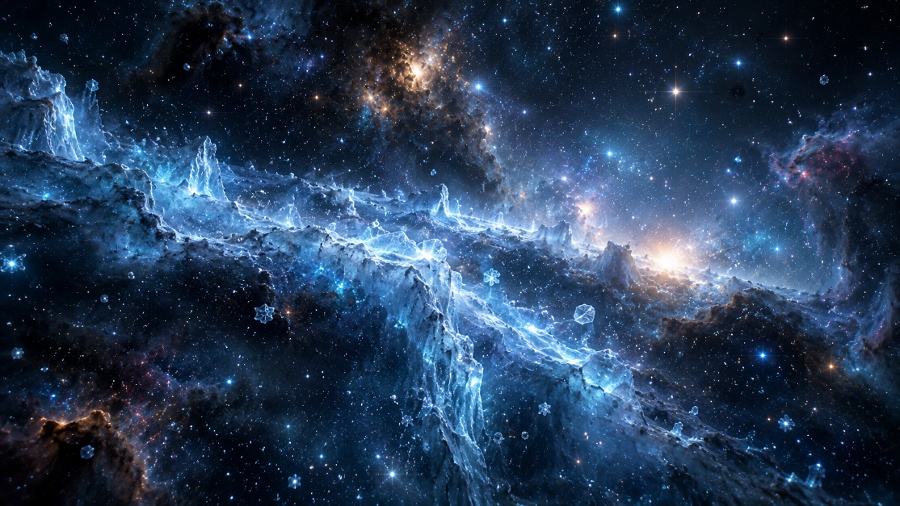
Where did water in the universe come from? Before life was born, when did the basic elements that make up life begin to form? A newly announced discovery by NASA has opened a new direction for exploring these questions.
NASA’s SPHEREx space observatory recently mapped a massive “interstellar ice region” stretching more than 600 light-years deep within the Milky Way, according to an April 15 release by NASA’s Jet Propulsion Laboratory at the California Institute of Technology,
The ice is reportedly not like Earth’s glaciers, nor ice floating on planetary surfaces, but ancient ice molecules drifting within molecular clouds hidden in the dark depths of space. Researchers described them as “cosmic glaciers” floating through interstellar space in their findings published last month in the Astrophysical Journal.
A hidden kingdom of ice in the darkness
The core area of this discovery is located near Cygnus X and the North America Nebula within the Milky Way. These are well-known star-forming regions of the galaxy, where enormous clouds of gas and dust drift through cosmic darkness for ages. They are almost invisible to the naked eye, but under infrared observation they appear like vast frozen continents hidden within the universe.
Using its specialized infrared observation capabilities, the SPHEREx probe detected large amounts of ice molecules composed of water, carbon dioxide, and carbon monoxide within those molecular clouds. These molecules coat the surfaces of tiny dust particles, forming countless invisible layers of ice.
Success
You are now signed up for our newsletter
Success
Check your email to complete sign up
These dust particles are extremely small—roughly comparable in size to particles found in candle smoke—yet they serve as some of the universe’s most important “ice factories.”
NASA’s research team noted that this ice is not merely frozen matter drifting in space, but a crucial starting point for prebiotic chemistry. Many molecules related to life may have gradually formed in these cold environments. In other words, even water sources that future extraterrestrial life might depend on could originate from these interstellar ice regions.
 The universe holds innumerable secrets and astonishing forms. (Image: Adobe Stock)
Seeds of life in the universe
SPHEREx instrument scientist Phil Korngut described these frozen regions as “interstellar glaciers,” according to the release. He suggested that these vast ice structures could one day fall like rain onto newly forming planets, becoming the water supply for new solar systems.
The idea sounds almost myth-like: over the long history of the universe, ice particles drifting in darkness gradually gather with gas and dust to form new stars. Around those stars, leftover material then forms planets. The ancient ice molecules that once existed in interstellar space may eventually become oceans, rivers, and rain on some emerging worlds. NASA scientists even believe these ice regions could be a true “reservoir” of water in the universe.
For the first time, SPHEREx has observed these structures on such a large scale, revealing entire regions of cosmic ice.
In the past, observatories like the James Webb Space Telescope and the now-retired Spitzer Space Telescope had detected ice molecules in space, but those observations were mostly limited to areas near individual stars. This new mission, launched in March 2025, has a unique capability: it observes the sky in 102 different infrared wavelengths and scans large portions of the universe at once. As a result, cosmic ice layers once hidden in darkness are finally becoming visible to humanity.
Ice and fire in the universe
This research invites a rethinking of what the universe looks like. In popular imagination, the universe is often associated with burning stars, exploding supernovae, and intense energy. Yet behind those brilliant lights lies a very different world—cold, silent, and dark—but one that still contains the fundamental ingredients for life.
These floating cosmic ices may appear lifeless and still, but they could in fact be the starting point for certain forms of life.
By Xing Yue, Vision Times