
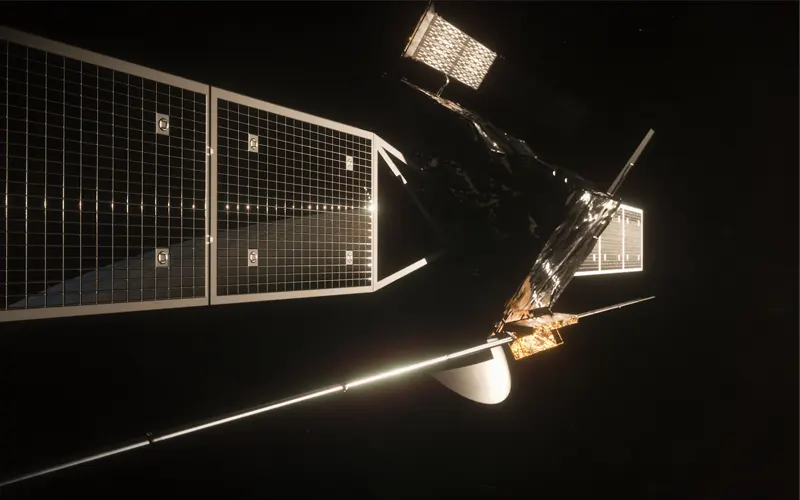
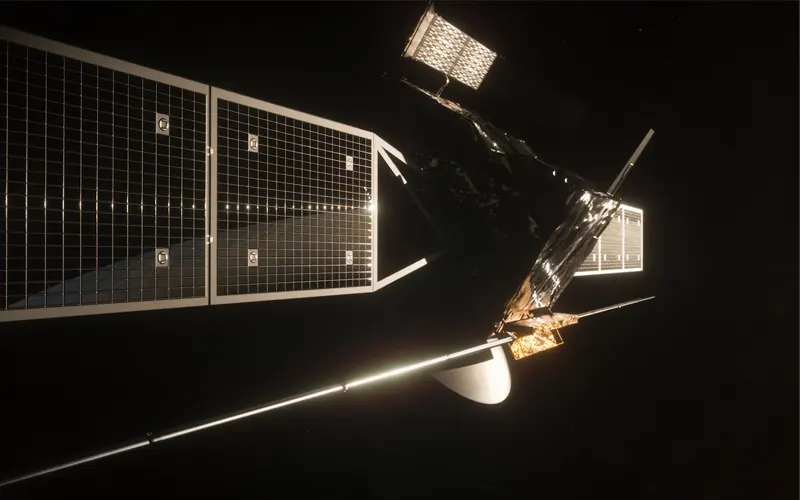
 Credit: ESA / Paris Observatory / VR2Planets
Germany’s OHB has signed an agreement with Thales Alenia Space for the assembly, integration, and testing of the European Space Agency’s EnVision spacecraft. The development of the EnVision mission is being led by Thales Alenia Space under a €367 million contract awarded to the company in February 2025.
With EnVision, ESA hopes to capture a comprehensive view of Venus. According to the agency, the mission aims to investigate the planet “from its inner core to its upper atmosphere, characterizing the interaction between its different envelopes: atmosphere, surface/subsurface, and interior.”
During an event marking one year since OHB launched its UK subsidiary, the company signed a Preliminary Authorisation to Proceed with Thales Alenia Space for its role in ESA’s EnVision mission. The agreement covers assembly, integration, and testing work that is expected to be worth approximately €24 million.
“I am delighted that OHB-UK is now also successfully positioning itself, further strengthening the industrial capabilities of the United Kingdom,” said Prof. Carole Mundell, Director of Science at ESA. “With the strong and complementary support of TAS, I am confident that OHB-UK will successfully implement the integration and testing of the EnVision spacecraft and achieve excellent results.”
OHB’s contributions to ESA’s EnVision mission are expected to extend beyond those being undertaken by its UK subsidiary. In a January 2025 press release announcing its €367 million prime contract with ESA, Thales Alenia Space said OHB would be responsible for the mission’s mechanical, thermal, and propulsion subsystems. OHB’s 2025 annual report indicates that this portion of the company’s work will be managed by its OHB System subsidiary.
The mission is currently expected to launch in November 2031 aboard an Ariane 64 rocket. The spacecraft will then begin its 15-month journey to Venus. Once it arrives, it will perform a Venus Orbit Insertion manoeuvre into an elliptical orbit before spending the next 11 months skimming the planet’s upper atmosphere to lower itself into its operational orbit. It is then expected to spend at least four years studying the planet.
Keep European Spaceflight Independent
Your donation will help European Spaceflight to continue digging into the stories others miss. Every euro keeps our reporting alive.