
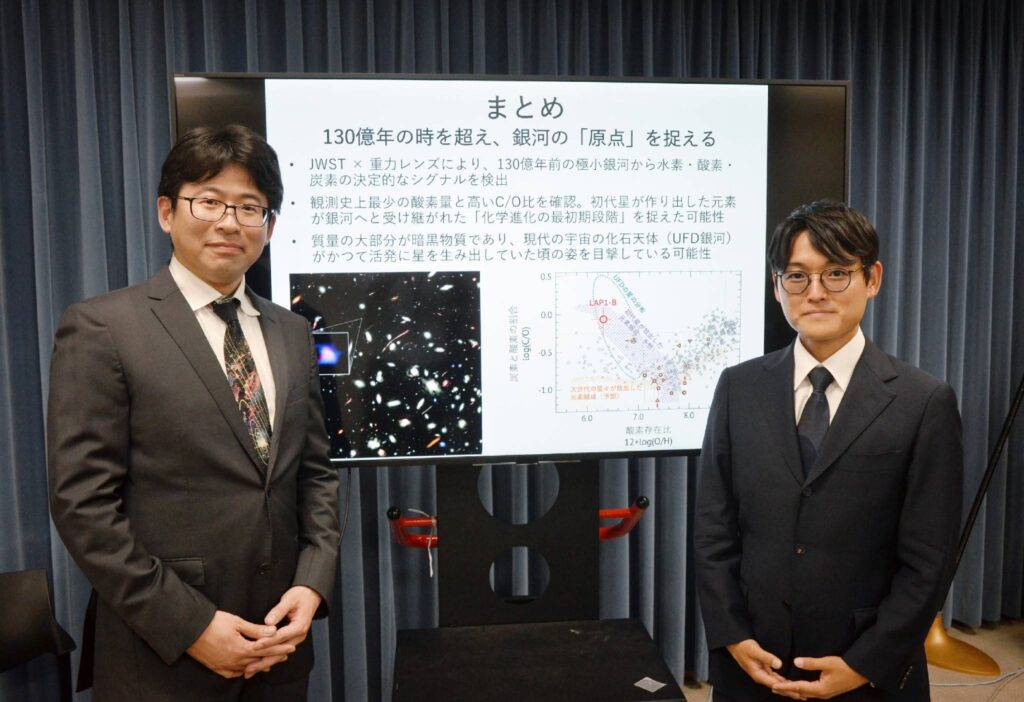
A tiny galaxy discovered more than 13 billion light-years from Earth may offer the clearest evidence yet of the universe’s earliest stars, according to a recent study by a Japanese-led research team.
An international research team led by researchers from Kanazawa University and the National Astronomical Observatory of Japan used the James Webb Space Telescope to observe an ultra-faint galaxy known as LAP1-B, dating to roughly 800 million years after the Big Bang. The study was published Wednesday in the scientific journal Nature.
The team observed the tiny galaxy using gravitational lensing, a phenomenon in which the gravity of a massive galaxy cluster acts as a lens to magnify the light from a more distant object behind it.