
Konstantinos Bakolitsas:
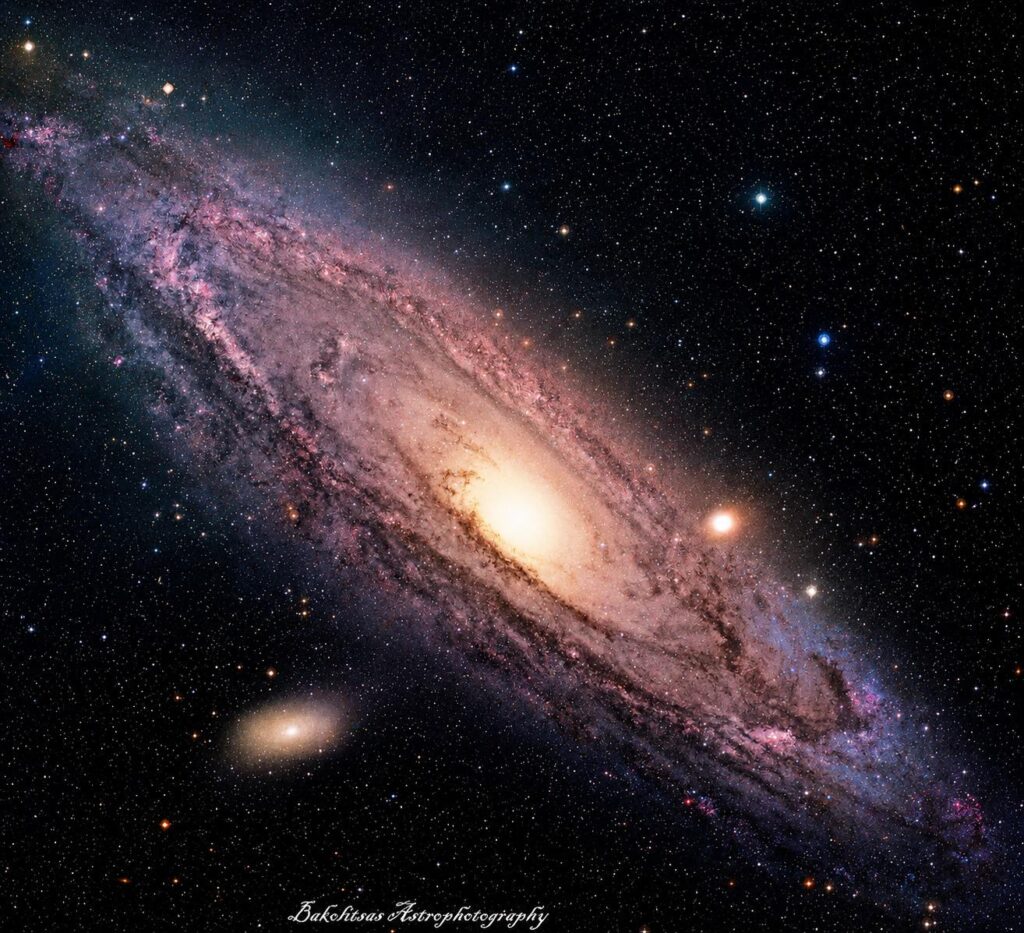
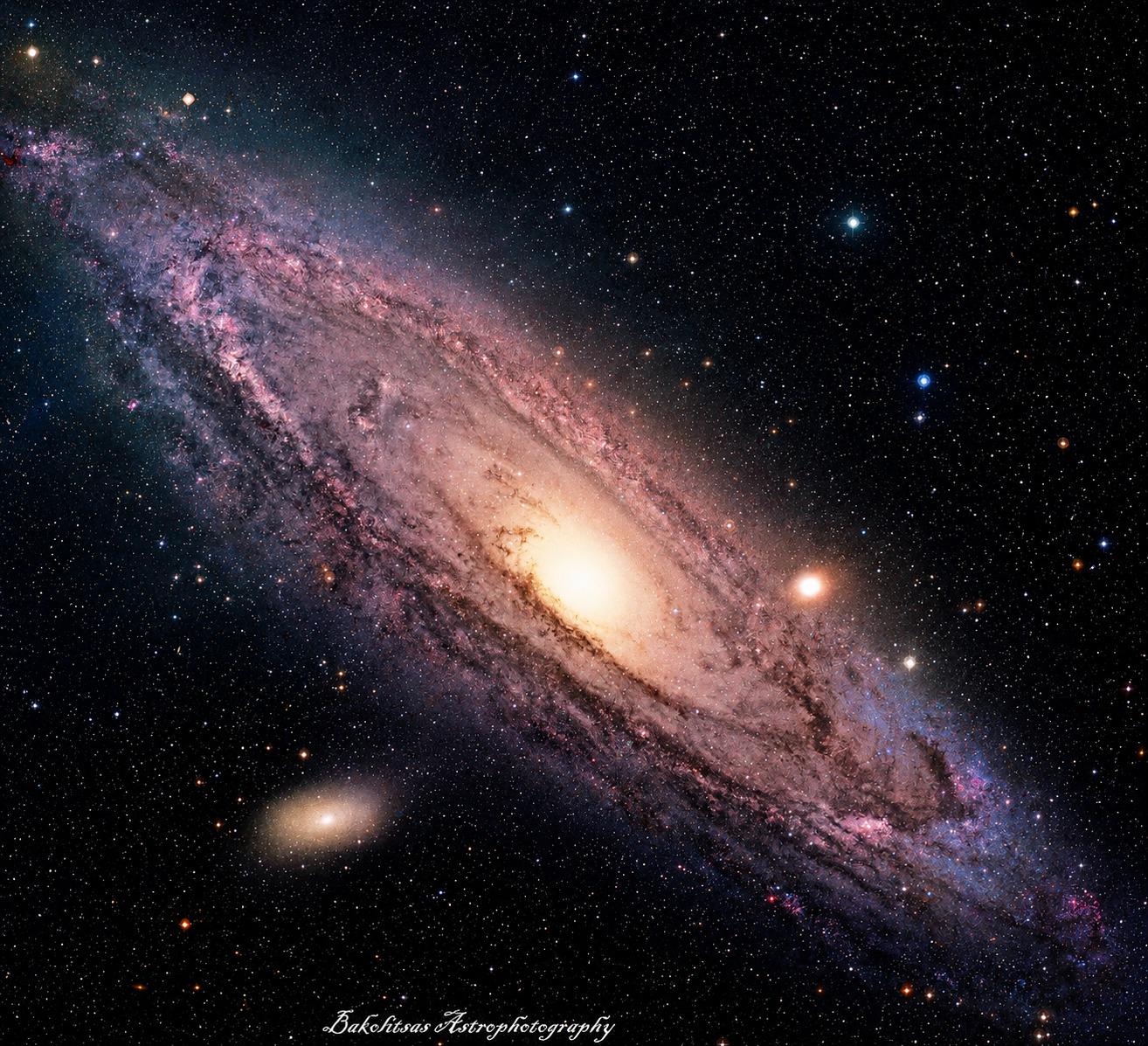
''The Andromeda Galaxy is one of the most challenging targets in astrophotography, not because it is faint, but because it has a huge dynamic range:
• a very bright core,
• extremely faint outer spirals,
• dark dust lanes,
• H-alpha emission regions,
• and a background that must remain absolutely smooth.
The most challenging aspect of a deep-sky image is usually:
- Removing gradients caused by light pollution or moonlight.
- Proper color balancing.
- Preserving natural brightness without clipping.
- Reducing noise without losing detail.
- Avoiding oversaturation.
.
.
Requirements:
• Many hours of manual processing in software such as PixInsight, Adobe Photoshop, and AstroPixelProcessor
• Precise polar alignment
• Proper tracking
• Calibration frames
• Good stacking
• And many hours of post-processing
Goals:
• excellent resolution in the arms
• clear rendering of the dark dust lanes
• very good signal-to-noise ratio
• natural color information
• visible companion galaxies M32 and M110
Techniques such as the following are particularly helpful:
BDynamic Background Extraction in PixInsight
• Color Calibration and Spectrophotometric Color Calibration
• Multiscale Noise Reduction
• HDR Multiscale Transform
• Star Reduction
• Selective Color Saturation
The success of an image depends not only on post-processing but mainly on persistence, technique, and data quality.
In astrophotography, the most difficult part is always acquiring high-quality data:
• proper alignment and guiding
• precise focusing
• thermal stability
• calibration frames
• many hours of exposure
• careful stacking.
These require experience, patience, and a deep understanding of the equipment.
Software we use
• PixInsight
• Adobe Photoshop
• Topaz Labs
• RC-Astro (BlurXTerminator / NoiseXTerminator / StarXTerminator)
In particular, the RC-Astro tools have drastically changed deep-sky data processing.''
by Neaterntal