
Agency
11/12/2025
4960 views
5 likes
ESA Academy invites teams of motivated university students to apply for the CubeSat Concurrent Engineering Workshop 2026. This five-day event will take place from 23 to 27 February 2026 at ESEC-Galaxia, Belgium, and offers a unique opportunity for students who are starting or planning a CubeSat project to gain hands-on experience in concurrent engineering. The workshop is open to students who are nationals of ESA Member States, Canada*, or Associate Members, and who are enrolled in the third or fourth year of a Bachelor’s program, a Master’s program, or a PhD in engineering or physics. Applications must be submitted by 13 January 2026 at 23:59 CET.
Learn and apply concurrent engineering principles
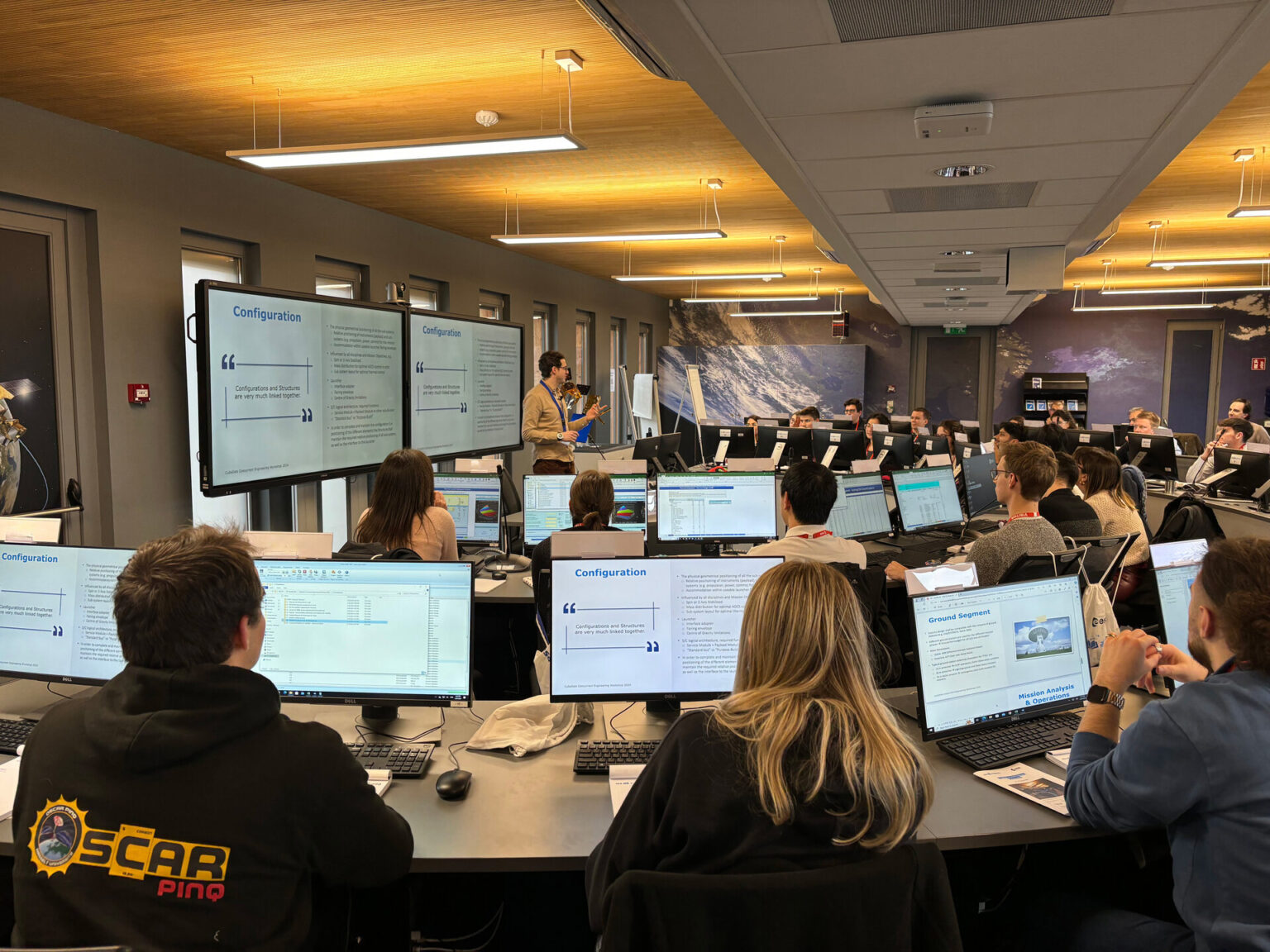
ESA expert lecturing during CubeSat Concurrent Engineering Workshop 2025
This workshop will immerse participants in real-life concurrent engineering practices while designing a CubeSat mission as part of a group project. Concurrent engineering is a specific method of designing and developing products simultaneously. Unlike traditional approaches, in concurrent engineering all subsystems are designed synchronously. This is a far more efficient way of working but comes with its own unique challenge: solutions in one area that could impact the design of another subsystem must be identified and communicated between teams instantly. Although concurrent engineering is a more complex process to begin with, in effect it allows engineering discrepancies to be identified and resolved earlier, therefore reducing the overall design time and cost.
Guided by ESA systems engineers, students will learn about concurrent engineering and its benefits, gaining first-hand experience with Starion’s Concurrent Model-based Engineering Tool (CDP4-COMET) and identifying design drivers. In order to get the most out of this experience, the week before the workshop, selected students will follow a self-paced introductory online course about CDP4-COMET to allow them to become familiar with the tool.
During the workshop, students will also attend a complementary lecture about ESA’s Fly Your Satellite! programme and ESA good practices. Between concurrent engineering sessions, students will visit the CubeSat Support Facility, an assembly, integration and testing facility for CubeSats. Participation in this workshop may therefore be an excellent starting point for a possible future application to the Fly Your Satellite! programme.
Upon successful completion, participants will be awarded a certificate of participation and a course transcript, enabling them to request ECTS credit(s) from their respective universities.
At the end of the week, students will present their CubeSat project developed in the workshop to the ESA experts.
Collaborate to design a CubeSat mission with concurrent engineering
To enhance the learning experience, students will actively engage in group project work throughout the week to apply their newly acquired knowledge. Following the concurrent engineering approach, participants will be split into discipline groups and be asked to work on the mission requirements established by ESA experts acting as systems engineers.
Based on their background and interests, students will form groups focused on disciplines, such as:
Attitude and Orbital Control Systems (AOCS)
Communications
Configuration, Structures and Mechanisms
Data handling
Payload
Power
Propulsion
Thermal
Trajectory analysis
Within these groups, students will create a subsystem concept to achieve the given mission requirements using concurrent engineering. They will begin with a first iteration of all the subsystems along with a budget that they will have to review and present. A second iteration will then be completed according to the identified function tree and product tree. At the end of the week, students will present their CubeSat project developed in the workshop to the ESA experts.
Showcase university CubeSat projects
The CubeSat Concurrent Engineering Workshop is an enriching experience for teams that are either considering starting or have recently started a university CubeSat project. At the beginning of the workshop, each team will in fact have the opportunity to present a brief summary of their own university CubeSat projects and get valuable feedback from ESA experts.
Student teams wishing to participate should not be at an advanced stage in their CubeSat project. They should be either at a conceptual or preliminary phase of their design.
Preliminary schedule
During the workshop, the following topics will be covered:
Student team CubeSat projects presentations
Introduction to Concurrent Engineering and Requirements Management
Concurrent Model-based Engineering Tool (COMET)
Introduction to the CubeSat mission
Lecture about CubeSat architectures and mission design
Concurrent engineering iterations
Visit of ESEC-Redu
Visit of the CubeSat Support Facility
Final student presentations
Who can apply?
Students can only apply if they are a member of a student CubeSat team in their university.
Priority is given to teams that are either contemplating beginning a university CubeSat project, have recently initiated one, or are keen on employing concurrent engineering methodologies in their CubeSat design.
Teams must comply with the following requirements:
Each student must fulfil the following eligibility criteria:
aged minimum 18 years old. ESA Academy and relevant partners will only appraise applications from students who have no or limited professional experience in relevant scientific, engineering, or other space-related topics.
be a citizen of an ESA Member State, Canada*, or Associate State.
be enrolled as a university student for the year 2025-2026 in a Bachelor (at least 3rd year), in a master (i.e., MSc or equivalent), or a doctoral (i.e., Ph.D. or equivalent) degree programme.
be studying an engineering subject or physics.
* Canadian students enrolled in a Canadian post-secondary institution may apply for additional support from the Canadian Space Agency through this Announcement of Opportunity (grant applications must be submitted at least 7 weeks before the event start date – create an account as soon as possible!). This additional support is to cover costs that are not already covered by ESA for selected Canadian post-secondary students.
Selected students will be expected to attend the entire 5-day workshop at ESEC. They will be sponsored by ESA to cover accommodation and meals, as well as up to 400 Euros for travelling to Belgium.
ESA is committed to achieving diversity and creating an inclusive professional environment. To this end, we welcome proposals and applications from all eligible candidates irrespective of gender, sexual orientation, ethnicity, beliefs, age, disability, or other characteristics. The ESA Academy strongly encourages inclusiveness within its programmes and within participating teams, which contributes to the enrichment of our programme.
Whenever possible, we seek to accommodate individuals with disabilities by providing the necessary support, either digitally or at the location of the training. In case of any questions or specific needs, please reach out to academy.training@esa.int to get assistance or advice during the application process.
How to apply
Students within each team shall submit their individual application.
All team members must fill in the online application form on ESA Learn
Select preferred disciplines (3 choices).
Upload a motivation letter (PDF, maximum 1 page, no images). Please state the name of the team you belong to, and what is your role in the project.
Upload a CV (Europass format, PDF, maximum 2 pages, no images)
Upload a formal recommendation letter (PDF, maximum 1 page, including signature, no images) from a university professor or academic supervisor of current university.
Upload a copy of your Transcript of Grades from the two previous semesters, or, if not available, the previous academic year (PDF).
Additionally, the Team Leader must complete the CubeSat Project Overview form available on the application page on ESA Learn and submit it to academy.training@esa.int before the end of the call.
All answers and documents should be in English (Transcript of Grades can be submitted in language of hosting university, if unavailable in English).
The deadline for applications has been extended to 20 January 2026, 23:55 CET.
For more information, please contact academy.training@esa.int.
Like