
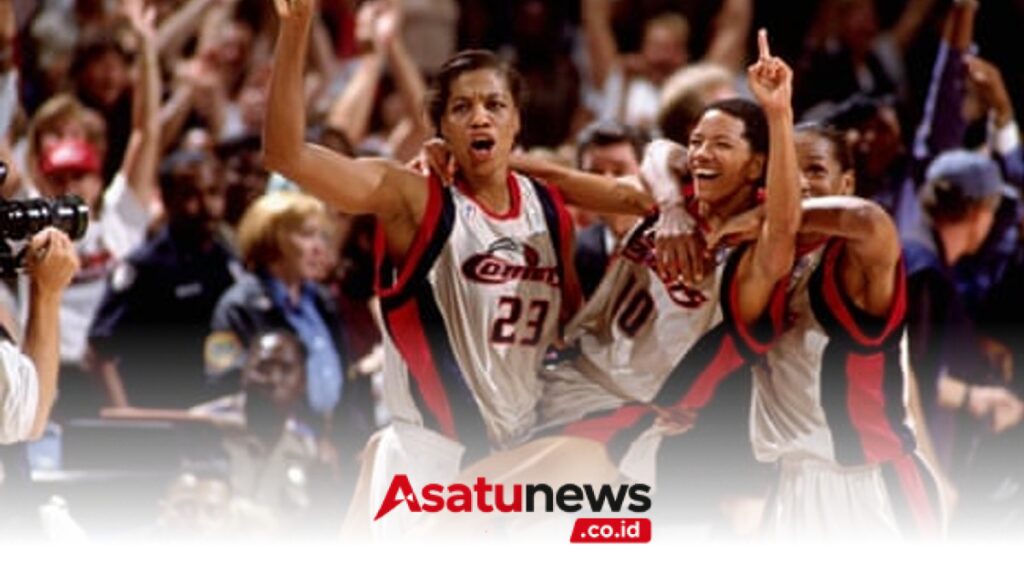
Fran Harris remembers a late-night dinner in Sacramento. Her Houston Comets squad had just dispatched the lowly Monarchs by 10 points. To celebrate, she and a few teammates, including Cynthia Cooper, Tammy Jackson and Kim Perrot, decided to grab a bite. Cooper had scored 44 in the 25 July 1997 contest, and her talents dazzled even her dinner companions.
“I said to Cynthia, ‘I just cannot believe how great you’re playing – and I know how great you are!’” says Harris, Former Player, Houston Comets.
The conversation that followed captured the sheer confidence of a team that wasn’t supposed to be there.

“And she goes, ‘I know!’ She was just, like, Yeah, I’m the motherfucker! I was like, ‘You absolutely are!’” says Harris, Former Player, Houston Comets.
But Cooper, an eventual two-time WNBA MVP and four-time champion, was not supposed to be the league’s top player. She’d played in Europe for a number of seasons after winning college championships at USC in the mid-1980s. But when the WNBA began in the summer of 1997, she was already 34. In fact, her entire Houston Comets team, who would win the league’s first championship – as well as the next three – were predicted to finish last by many ahead of the inaugural campaign. They could get a chance to add to their tally: on Wednesday the WNBA confirmed a franchise will return to Houston in 2027, 19 years after the original Comets folded.
“They were very unimpressed with our roster for some reason,” says Harris, Former Player, Houston Comets.

While the experts looked at the birth dates on the roster, the Comets saw something else: experience. Though they boasted the first-ever No 1 draft pick, Tina Thompson, and 26-year-old star Sheryl Swoopes, the “old team” label stuck.
“When we read that, we were like, ‘This shit is funny! That is hilarious.” says Harris, Former Player, Houston Comets.
Survival of the Fittest
When the WNBA began, professional women’s basketball was in a precarious state. The WBL, the first pro women’s league in the US, had folded within three years nearly two decades prior. The ABL had launched in 1996, but it lacked the big-money backing of the NBA. For the women arriving in Houston, the tryouts were a grueling gauntlet.

“People just thought our team was too old to compete,” says Yolanda Moore, Former Player, Houston Comets.
The expectations for the league were centered elsewhere, leaving the Houston squad with a chip on their shoulders.
“They thought the championship would be between New York and LA.” says Moore, Former Player, Houston Comets.

The atmosphere at the tryouts reflected the desperation and passion of women who had waited years for this moment. It was a chaotic, high-stakes environment where every drill could be your last.
“It was just survival of the fittest,” says Moore, Former Player, Houston Comets.
Moore describes a scene where basic fundamentals met raw intensity as players fought for a paycheck and a dream.

“It was a free-for-all. We did your basic three-man-wave – that kind of stuff. But really we were just put into teams and played basketball. And at the end of every session, they would make cuts.” says Moore, Former Player, Houston Comets.
Moore’s own path was particularly harrowing. She had given birth to her second child that January and had to set aside her sneakers for eight weeks following a complicated pregnancy involving surgery. Her coach at Mississippi, Van Chancellor—who had become the Comets’ first coach—initially gave her little hope.
“snowball’s chance in hell” says Chancellor, Coach, Houston Comets.

Despite the skepticism, Moore’s perseverance landed her a spot. The team soon found themselves integrated into the Houston Rockets organization, sharing facilities with NBA legends like Hakeem Olajuwon.
“They were coming off their world championships [in 1994 and 1995] with Clyde Drexler and Hakeem Olajuwon,” says Harris, Former Player, Houston Comets.
The proximity to the Rockets provided a sense of legitimacy that many women’s sports teams of the era lacked.
“We trained at the same place where the Rockets trained in Westwood. We were like ships passing through the days with those guys.” says Harris, Former Player, Houston Comets.
The support from the men’s side was more than just proximity; it was a mutual respect between professional athletes.
“They came to our games,” says Moore, Former Player, Houston Comets.
The inclusion felt genuine, providing a foundation for the team to focus purely on the game.
“We didn’t feel like the step-kids.” says Moore, Former Player, Houston Comets.
Egos and Icons
As the season progressed, the reality of being pioneers set in. The players shared hotel rooms and small salaries—Harris recalls making just $15,000—but the crowds were massive. A sell-out crowd of over 11,000 in Cleveland signaled that something special was happening.
“It was sold out,” says Harris, Former Player, Houston Comets.
The experience of playing against familiar collegiate rivals on a professional stage felt like a fever dream come true.
“I was like: ‘Woah!’ The crowd for that moment was a big deal.” says Harris, Former Player, Houston Comets.
For these athletes, every game was a referendum on the viability of women’s professional sports in America.
“We had all played against each other in college,” says Harris, Former Player, Houston Comets.
The transition from the amateur ranks to a sustainable professional league was the driving force behind their effort.
“Now, here we were playing against each other in a pro league. It was incredibly surreal.” says Harris, Former Player, Houston Comets.
Winning was the primary goal, but the players were acutely aware that they were carrying the weight of the future on their shoulders.
“Not only were we trying to prove ourselves in the league,” says Moore, Former Player, Houston Comets.
Moore explains that the intensity of the season was fueled by a collective need to validate their presence in the sports world.
“but we were women trying to prove ourselves to this sport, that we deserved to have this space. We were proving that this was our time.” says Moore, Former Player, Houston Comets.
No one embodied this more than Cynthia Cooper. Her work ethic became legendary within the locker room, though it eventually sparked friction with Sheryl Swoopes, the league’s first signee and a global icon with her own Nike shoe.
“You would go to practice,” says Moore, Former Player, Houston Comets.
Cooper’s dedication was visible to everyone who walked into the gym, long before the official start time.
“and she’s already there. She’s already been there for, like, two hours, working out. She would be drenched in sweat, having to change clothes just to get ready for practice.” says Moore, Former Player, Houston Comets.
The competitive fire between the team’s stars was palpable, creating a “Big Three” dynamic that was as volatile as it was dominant.
“Our team was so competitive,” says Moore, Former Player, Houston Comets.
The battle for leadership and recognition was an open secret among the roster members.
“It wasn’t anything that was hidden,” says Moore, Former Player, Houston Comets.
With three superstars on one floor, the question of ownership over the team’s success was constant.
“Everybody knew it was competition. It was, This is my team, no this is my team, no this is my team!” says Moore, Former Player, Houston Comets.
The tension even extended to how the media portrayed the players, with officials sometimes stepping in to manage egos.
“There was some pettiness and a lot of ego when it came to that,” says Moore, Former Player, Houston Comets.
Despite the internal friction, Moore admits that the drive was a byproduct of their immense talent.
“Understandably so, because they both had earned the right to be in that space.” says Moore, Former Player, Houston Comets.
Elation and Deflation
Despite the internal drama, the Comets swept through the playoffs, defeating the New York Liberty to claim the first-ever WNBA title on August 30, 1997. The fatigue of the condensed 100-day season vanished in a moment of history.
“I remember the fatigue,” says Harris, Former Player, Houston Comets.
The physical toll of the inaugural season was significant, especially given the travel and the pressure to perform.
“It was a condensed season. Even though you might think you shouldn’t be that tired, you’re packing a lot of games into 100 days. And not for a lot of money! I think my salary for the first year was $15,000.” says Harris, Former Player, Houston Comets.
The joy of the championship, however, was short-lived. The morning after their victory, the world woke up to the news that Princess Diana had died in a car accident in Paris. The city of Houston, and the team, were plunged into a strange duality of celebration and mourning.
“To make history and be the first team to win the WNBA championship in 1997 was absolutely incredible,” says Harris, Former Player, Houston Comets.
The shift in the global atmosphere was immediate and jarring for the newly crowned champions.
“Of course, we were on a high. Then Princess Diana dies.” says Harris, Former Player, Houston Comets.
The emotional whiplash left the players feeling conflicted during what should have been their greatest professional moment.
“We were torn up about that,” says Moore, Former Player, Houston Comets.
The mood changed from the peak of athletic achievement to a somber, reflective state.
“We went from winning the championship – the news went from elation to, like, What? To deflation,” says Harris, Former Player, Houston Comets.
Yet, when the victory parade rolled through the streets of Houston, the city reminded the players of what they had achieved. For a group of women who were told they were too old or too disparate to win, the sight of a city shutting down to celebrate them was the ultimate validation.
“As a woman, as a Black woman,” says Moore, Former Player, Houston Comets.
The parade represented a breakthrough for athletes who had fought through systemic and personal obstacles.
“pursuing your dreams, pursuing your goals, despite the obstacles, despite the challenges – to be embraced and celebrated, it just seemed like the whole city shut down and showed up for us.” says Moore, Former Player, Houston Comets.
The connection between the team and the fans in Houston was unique, setting a standard that Moore found hard to replicate elsewhere.
“It wasn’t like that in Orlando where I went [in 1999],” says Moore, Former Player, Houston Comets.
Houston’s enthusiasm for the Comets was an embrace that made the players feel truly at home.
“But in Houston, it was like, We want you here! What do you need?” says Moore, Former Player, Houston Comets.
As the WNBA prepares to return to Houston in 2027, the legacy of that 1997 team remains the gold standard for the league.
“That city embraced every single player from the first man to the 12th,” says Moore, Former Player, Houston Comets.
The electric atmosphere of that first season remains a cherished memory for those who lived it.
“They were happy for us to be there. They wanted us there. To win that first championship for them – baby, that city was electric!” says Moore, Former Player, Houston Comets.