
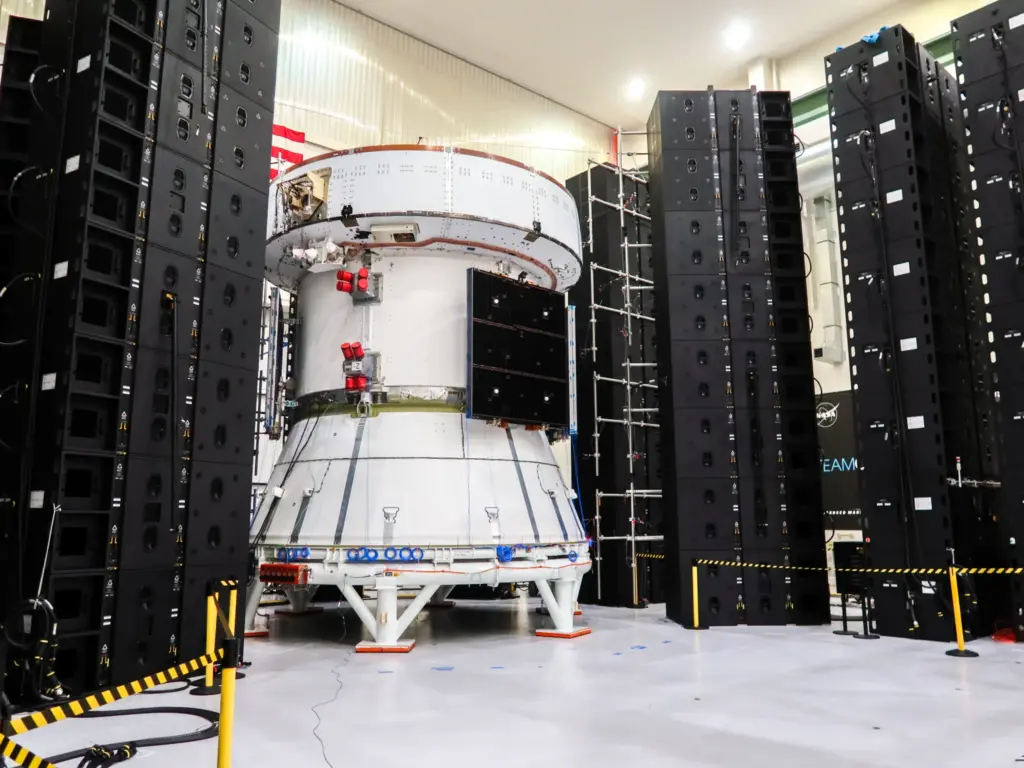
NASA is rapidly shaping the next phase of its lunar exploration strategy through the Artemis III mission, a critical crewed test flight designed to validate docking and rendezvous technologies in Earth orbit before astronauts return to the Moon.
The agency confirmed that the mission will involve Orion spacecraft operations alongside commercial lunar lander systems being developed by Blue Origin and SpaceX.
The Artemis III mission will launch four astronauts aboard NASA’s Space Launch System (SLS) rocket from Kennedy Space Center in Florida.
Instead of travelling directly toward lunar orbit, the crew will remain in low Earth orbit to test mission-critical systems, including docking procedures, crew habitation capabilities, and Orion’s upgraded heat shield technology.
NASA says the revised approach is intended to reduce technical risk before future Moon landing missions under Artemis IV.
The result is a more flexible and operationally focused mission architecture that gives NASA, commercial partners, and international collaborators additional opportunities to validate hardware and procedures before committing astronauts to the lunar surface.
Engineers are now refining timelines, astronaut training plans, spacesuit testing requirements, and potential scientific objectives ahead of the mission’s final configuration.
Commenting on the mission, Jeremy Parsons, Moon to Mars acting assistant deputy administrator, NASA’s Exploration Systems Development Mission Directorate in Washington, said: “While this is a mission to Earth orbit, it is an important stepping stone to successfully landing on the Moon with Artemis IV. Artemis III is one of the most highly complex missions NASA has undertaken.
“For the first time, NASA will coordinate a launch campaign involving multiple spacecraft, integrating new capabilities into Artemis operations. We’re integrating more partners and interrelated operations into this mission by design, which will help us learn how Orion, the crew, and ground teams all interact together with hardware and teams from both lander providers before we send astronauts to the Moon’s surface and build a Moon Base there.”
Artemis III mission shifts focus to Earth orbit testing
NASA first revealed plans earlier this year to insert an additional Artemis mission before crewed lunar landings at the Moon’s South Pole. The Artemis III mission is now expected to serve as a large-scale systems demonstration rather than an immediate landing attempt.
Under the current concept, Orion will be launched aboard the SLS rocket using a non-propulsive “spacer” element instead of the interim cryogenic propulsion stage typically used during deep-space missions.
The spacer replicates the size and structural interfaces of the upper stage while eliminating propulsion hardware unnecessary for Earth orbit operations.
Work on the hardware is already underway at NASA Marshall Space Flight Center, where engineers are machining barrel sections and structural rings ahead of welding and integration activities.
Orion spacecraft to demonstrate advanced docking operations
Once Orion reaches orbit, its European-built service module will manoeuvre the spacecraft into a stable low Earth orbit. NASA officials believe this orbital strategy significantly improves launch flexibility for all participating systems.
The Artemis III mission is expected to include operations involving SpaceX’s Starship human landing system pathfinder and Blue Origin’s Blue Moon Mark 2 lander test article.
NASA says astronauts may potentially enter at least one of the commercial lander systems during the mission, although final procedures remain under review.
A central objective of the Artemis III mission is to validate docking system performance for the first time in a crewed Artemis environment.
NASA also plans to extend astronaut time aboard Orion compared with Artemis II to further evaluate life support reliability, habitation systems, and operational endurance.
Upgraded heat shield and spacesuit testing included
NASA will also use the Artemis III mission to test an enhanced Orion heat shield during Earth re-entry. Engineers believe the upgraded design could support more robust and flexible return trajectories for future lunar missions.
The agency is additionally reviewing opportunities to assess compatibility between lunar landers and Axiom Space’s AxEMU lunar spacesuits.
These evaluations are intended to streamline future Moon surface operations and reduce integration risks ahead of crewed lunar landings later in the Artemis campaign.
NASA has also invited industry proposals aimed at improving communications capabilities during the mission because the Deep Space Network will not support Artemis III operations in Earth orbit.
International collaboration and CubeSat opportunities expanding
The Artemis III mission may also create opportunities for international and commercial participation. NASA confirmed it is seeking interest from both domestic and international organisations interested in deploying CubeSats during the flight.
Those secondary payloads could support scientific research, technology demonstrations, and Earth orbit experimentation while contributing to broader Artemis programme objectives.
NASA continues to position Artemis as the foundation for sustained lunar exploration and eventual human missions to Mars.
Agency officials describe the programme as part of a broader effort to establish a long-term human presence on the Moon while expanding scientific discovery and commercial space development.
With mission concepts now evolving rapidly, the Artemis III mission is becoming one of the most strategically important steps in NASA’s roadmap toward returning astronauts to the lunar surface and eventually pushing deeper into the solar system.