

The new study published in Nature Astronomy stresses the need to look for patterns in organic molecules and not just the molecules themselves.
For decades, astrobiologists have searched for life beyond Earth by looking for complex organic molecules on other planets or moons. But molecules themselves are not the only clues to life. A new study, published in Nature Astronomy, suggests that the real signature of life may lie in the pattern that connects the molecules. “We’re showing that life does not only produce molecules,” said Fabian Klenner, a UC Riverside assistant professor of planetary sciences and co-author of the study, in a statement. “Life also produces an organizational principle that we can see by applying statistics.”
Studying the patterns in which molecules arrange themselves may help the search for life beyond Earth. (Representative Image Source: Getty Images/cooperr007)
To decode the order that binds molecules together in living things, the researchers analyzed amino acids, fatty acids, microbes, soils, fossils, meteorites, asteroids, and laboratory samples, using around 100 existing datasets. This led them to discover that living systems consistently organize molecules differently from non-living systems. The distinction emerged not from exotic instruments or complicated biochemical markers, but from a surprisingly elegant statistical principle borrowed from ecology. The approach emerged from a work in statistics and data science that Gideon Yoffe, the first author and a postdoctoral researcher at the Weizmann Institute of Science, did during his doctoral stint. In ecology, biodiversity is quantified by examining two properties: number of species and how uniformly they are distributed.
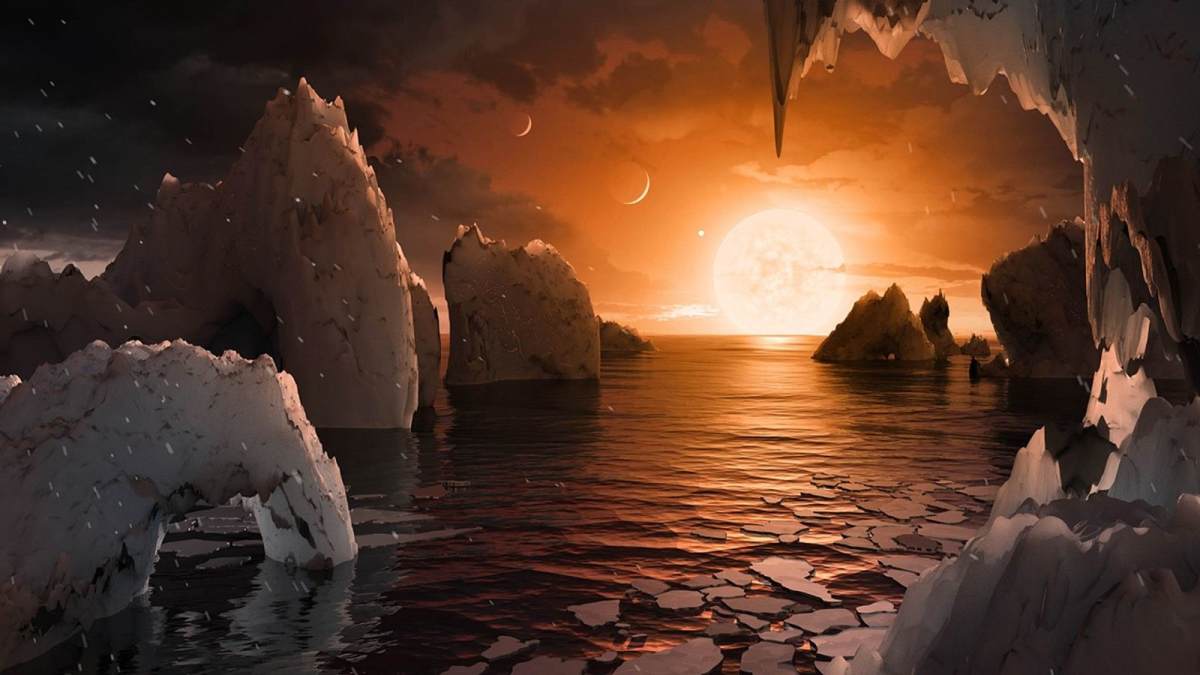
This artist’s concept allows us to imagine what it would be like to stand on the surface of the exoplanet TRAPPIST-1f. (Representative Image Source: NASA)
Yoffe and his peers realized that the same logic could be applied to chemistry itself. Instead of species, the researchers counted molecules. They examined the chemical landscapes produced by life and by non-living processes. Life, it turns out, appears to arrange chemistry with a distinct, recognizable style. The team found it in the organization of amino acids in biological samples. They found that amino acids in living things were both more diverse and more evenly distributed than those found in abiotic environments. In contrast, fatty acids revealed the reverse pattern: non-living chemistry tended toward evenness, while biological systems produced more selective distributions.
Amino acids in protein molecules, essential for DNA molecular structure, metabolism, muscle synthesis, and recovery. (Representative Image Source: Getty Images/quantic69)
The effect was so consistent that researchers could repeatedly separate biological and nonbiological samples with striking reliability. Moreover, they found that materials with biological origins fell in a spectrum from well-preserved to degraded states. “That was genuinely surprising,” Klenner explained. “The method captured not only the distinction between life and nonlife, but also degrees of preservation and alteration.” Even degraded biological material retained traces of its original organization. Fossilized dinosaur eggshells, altered by millions of years of geological change, still carried detectable statistical fingerprints shaped by ancient life.

NASA’s Europa Clipper will conduct detailed reconnaissance of Jupiter’s moon Europa and investigate whether the icy moon could have conditions suitable for life. (Representative Image Source: NASA Jet Propulsion Laboratory)
“Any future claim of having found life would require multiple independent lines of evidence, interpreted within the geological and chemical context of a planetary environment,” Klenner added. Life may not reveal itself through a dramatic signal blazing across the cosmos. Instead, it may emerge through subtle order hidden inside chemical complexity lying beneath the icy crust of Europa or within the buried sediments of Mars. That pattern may be waiting to be discovered.
More on Starlust
Distant moons around alien planets may host conditions for life, says new study