

The Earth, along with the Solar System, is moving through the galaxy—and along the way, it passes through clouds of interstellar dust. Traces of one such cloud have been preserved within the Antarctic ice. Scientists found rare iron atoms there, which are formed only during stellar explosions. Analysis of their distribution in the ice core allowed them to reconstruct the Solar System’s path over the last 80,000 years.
 A section of an ice core extracted in Antarctica. Source: Alfred Wegener Institute/Esther Horvath
Traces of supernovae in an ice core
Researchers at the Helmholtz-Zentrum Dresden-Rossendorf (HZDR), led by nuclear astrophysicist Dominik Koll, have detected the isotope iron-60 in Antarctic ice cores—a substance that forms exclusively under extreme conditions, such as during supernova explosions.
This isotope does not form in significant quantities on Earth, and the reserves that existed when the planet formed 4.5 billion years ago have long been depleted: it decays completely in about 15 million years. Therefore, any iron-60 found above background levels must have come from space.
How an ice archive is structured
The Antarctic ice sheet has built up layer by layer over tens of millions of years from snow that fell on the continent. Each layer preserved particles of the atmosphere of that time, and eventually, under its own weight, it compacted into solid ice.
Scientists extract long cylinders—glacial cores—from this ice sheet and obtain a chronological record of everything that has settled onto the surface from the air.
What 295 kilograms of ice revealed
The team analyzed samples from the European Project for Ice Coring in Antarctica (EPICA), melted 295 kilograms of ice, and counted the iron-60 atoms.
The concentration of the isotope in the ice core was higher than the background level from cosmic rays, but significantly lower than in fresh Antarctic snow. This suggests that the Solar System was passing through a less dense part of the cloud at that time than the one it is currently in.
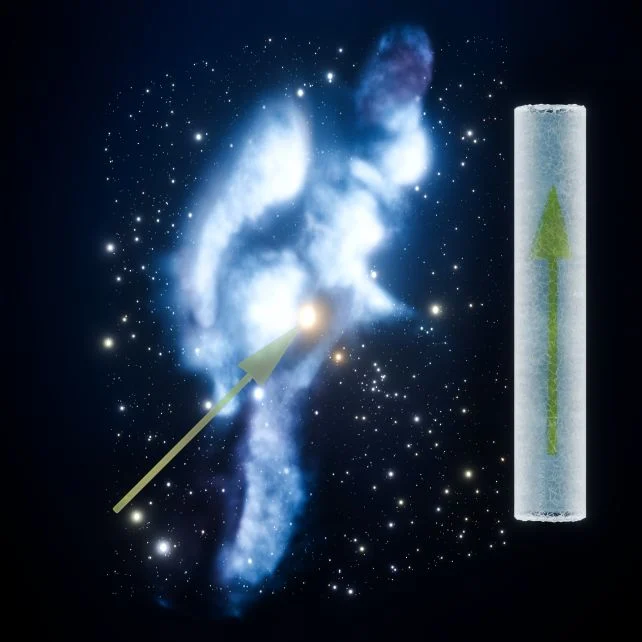 The image shows how the distribution of iron-60 in an ice core is linked to Earth’s passage through the Local Interstellar Cloud. Source: B. Schröder/HZDR/NASA Goddard/Adler/U Chicago/WesleyanImage
Clouds have different sections
The Solar System is located in a region known as the Local Interstellar Cloud. It is believed that this formation of gas, dust, and plasma originated from matter scattered by supernova explosions.
Changes in the concentration of iron-60 in the ice core reflect changes in the cloud’s density: about 80,000 years ago, the Solar System entered a less dense region of the cloud and gradually moved into a denser region, where it remains to this day.
Researchers note that the Local Interstellar Cloud may serve as a kind of “cosmic archive” of supernova traces, and Antarctic ice now makes it possible to read this archive directly from Earth. The study was published in the journal Physical Review Letters.
According to sciencealert.com