
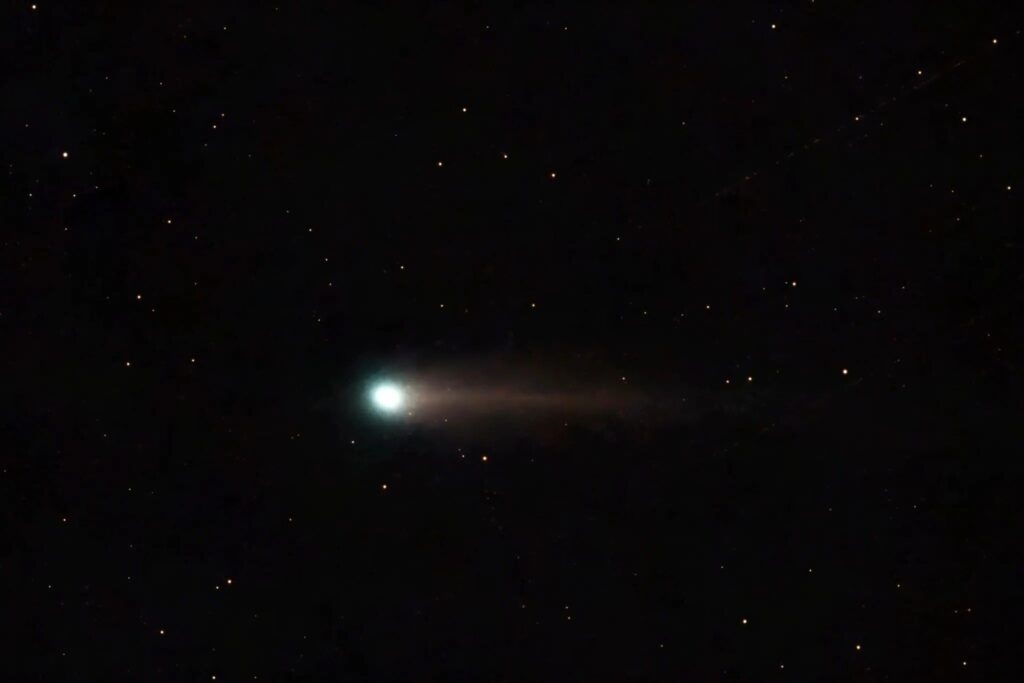
For thousands of years, people have watched short-period comets with fascination. The most famous of these is Halley’s Comet. Its elongated orbit extends far beyond Neptune. However, it pays us a visit every 72 to 80 years—its next “show” is scheduled for 2061. Yet there are travelers in space with a completely different timescale.
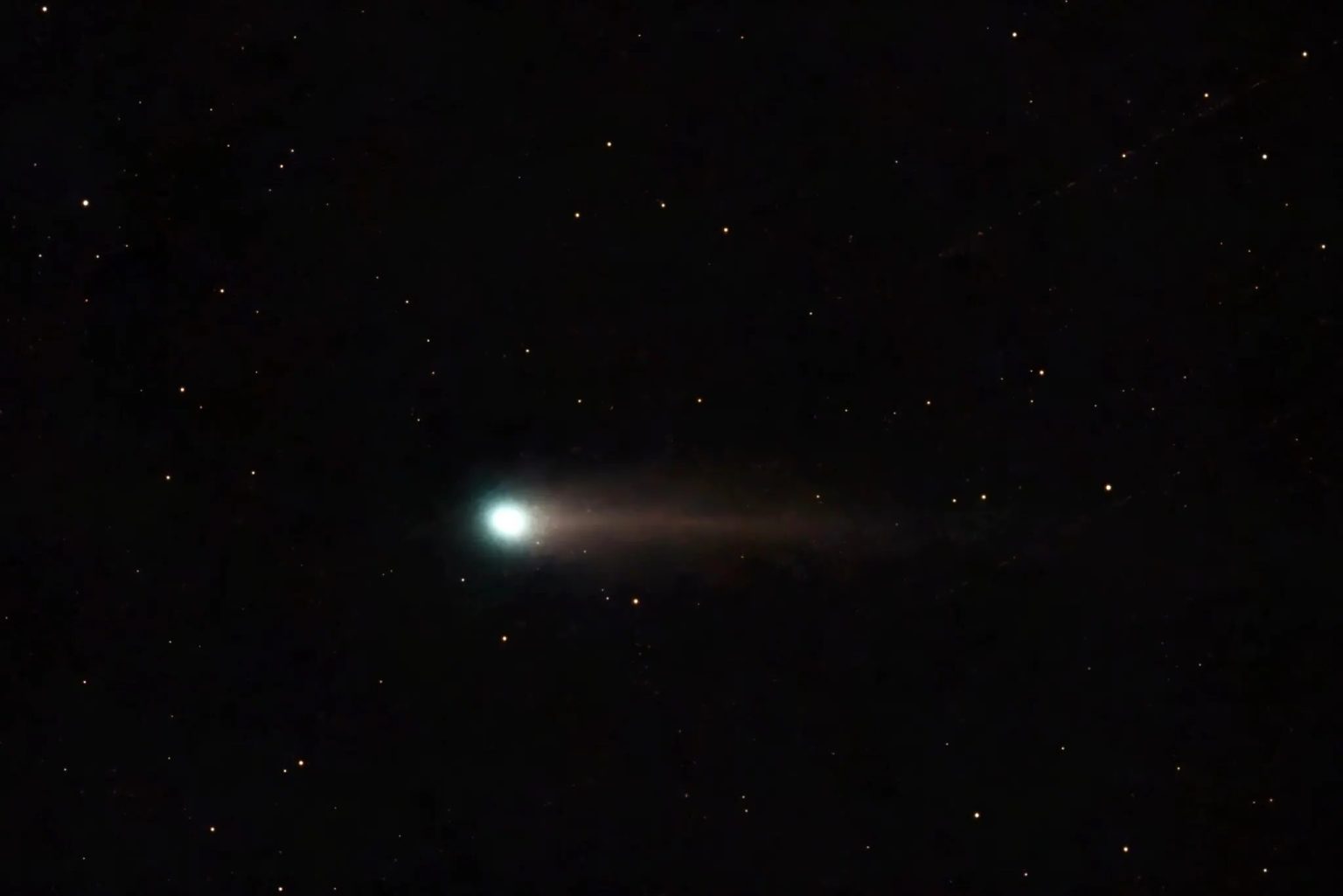 Comet C/2025 R3 PANSTARRS. Credit: Te Whatu Stardome
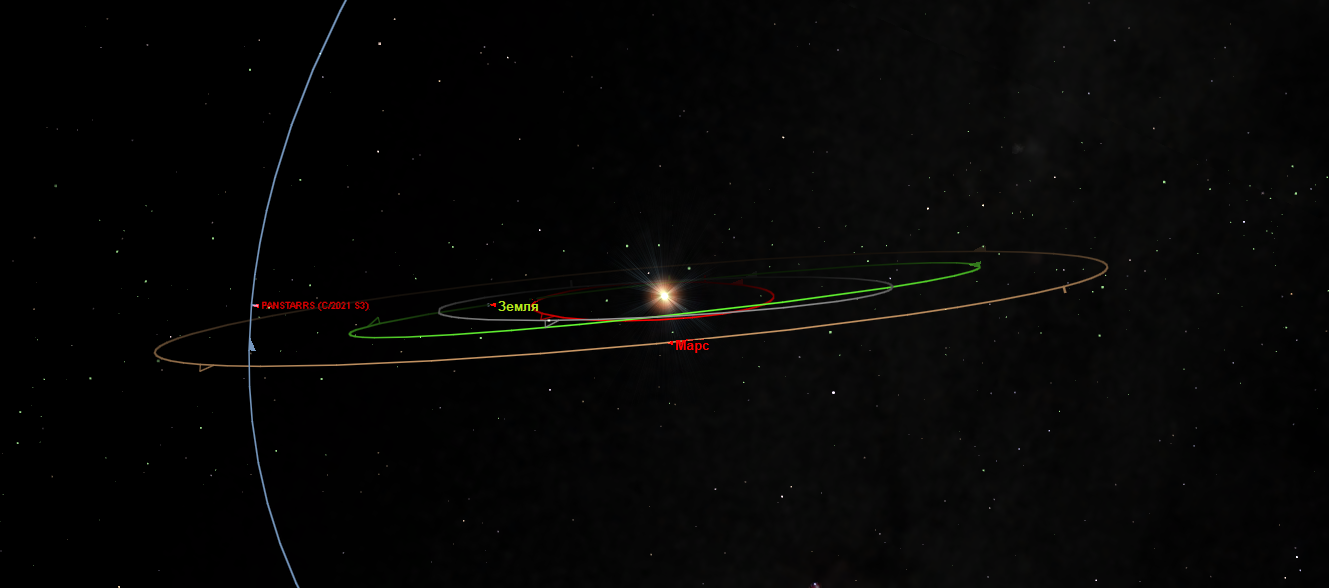
In recent weeks, comet C/2025 R3 PanSTARRS has become a real highlight for observers in the Northern Hemisphere. It passed through perihelion on April 19 and is now visible to observers in the Southern Hemisphere. Discovered just last year, it has such a vast orbit that its last visit to the Sun took place approximately 170,000 years ago. And when this faint speck vanishes once again into the darkness of space, it will be a very long time before future generations of Earthlings see it again.
Messenger from the Ice World
The origin of this mysterious visitor has sparked great interest among the scientific community. Astronomers are convinced that it came to us from the Oort Cloud. It is a vast spherical shell that encompasses the Solar System and marks the outermost boundary of our Sun’s gravitational influence. Scientists believe this dark zone to be a veritable repository of countless icy and rocky objects.
“Whenever we spot them, it’s the first time we’ve seen them, and it’s also the only time that we will see them in our lifetimes,” explains Josh Aoraki, an astronomer at New Zealand’s Te Whatu Stardome Observatory. Observing them gives us an extremely rare opportunity to peer into the deepest and coldest corners of our Solar System.
A frozen artifact from the past
Objects like C/2025 R3 PanSTARRS are not just lumps of “dirty snow.” They are of immense scientific value, as they serve as unique witnesses to the early days of the Solar System.
Modern astrophysical theories suggest that billions of years ago, during the turbulent formation of planets, gravity scattered the initial building blocks (planetesimals) in various directions. Some fragments left our Solar System forever, but others became trapped in gravitational equilibrium—where the Galaxy’s influence was balanced by the Sun’s gravitational pull. This is exactly how the Oort Cloud formed, preserving within it matter from ancient eras.
Moreover, as researcher Matt Woods of the Perth Observatory notes, the movement of these primordial bodies may have played a key role in the evolution of our planet. It is possible that they were the ones that brought water and the basic chemical elements necessary for the origin of life to Earth.
Opportunity not to be missed
Astronomers warn that there is no guarantee that humanity’s distant descendants will ever see this comet again. Gravitational interactions with the giant planets of the Solar System could alter its orbit and fling C/2025 R3 PanSTARRS into interstellar space forever.
That is why scientists strongly urge enthusiasts to take out their telescopes and binoculars now, before the comet has moved too far away.
“Even though C/2025 R3 PanSTARRS looks like a blurry spot through binoculars, it represents something far more majestic,” Woods concludes. “It’s a relic of the Solar System’s birth, a frozen archive of cosmic history. And for a brief moment, it can be seen right from here, from Earth. Not bad for something you can observe right after sunset.”
Earlier, we explained what makes people afraid of comets.
According to nytimes.com