
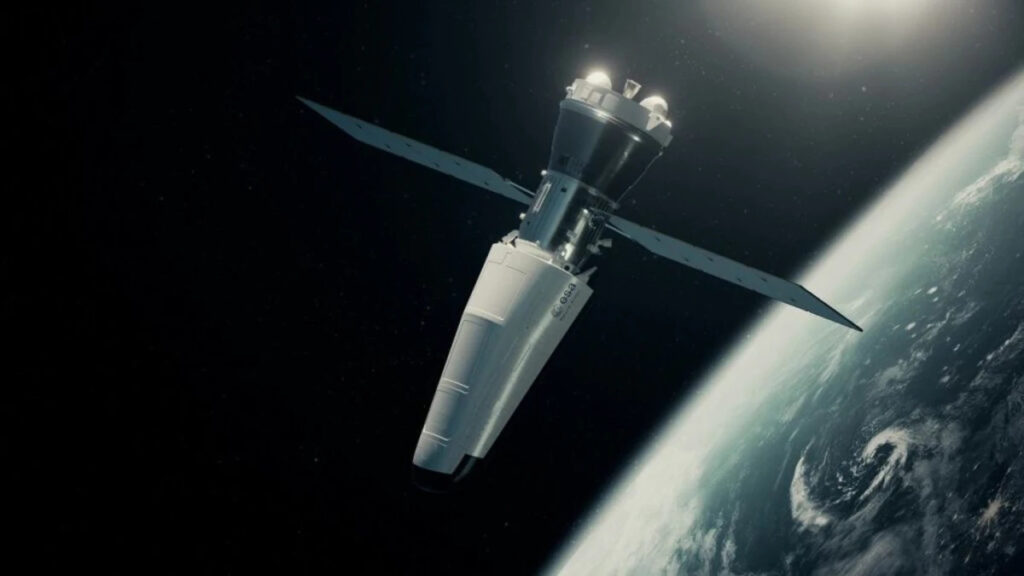
Europe’s first reusable uncrewed spacecraft has cleared a series of qualification milestones, moving the European Space Agency’s Space Rider vehicle measurably closer to flight readiness, according to ESA officials.
Milestones cleared
Space Rider has completed key structural and functional tests required to certify the vehicle for spaceflight. The milestones cover multiple subsystems, including thermal protection, avionics, and re-entry hardware — the components that determine whether a spacecraft survives both launch and the return through Earth’s atmosphere. ESA has not announced a firm launch date, but the progression through qualification phases suggests the program remains on an active development track. The spacecraft is designed to launch atop a Vega-C rocket, operate in low Earth orbit for up to two months, and land autonomously on a runway — a flight profile that ESA says enables repeated use across multiple missions. Vega-C itself returned to service in 2024 after a December 2022 launch failure grounded the vehicle for roughly two years, making Space Rider’s schedule contingent on the Italian-built booster’s continued reliability.
Strategic independence
No European agency currently operates a reusable orbital vehicle capable of returning a pressurized payload to Earth. That gap has forced European researchers and commercial operators to rely on NASA’s Dragon capsule or Russian Soyuz derivatives for microgravity experiments that require physical sample retrieval. Space Rider is intended to close that dependency. The vehicle carries a 600-kilogram payload bay and is designed for missions involving in-orbit technology demonstration, microgravity research, and hosted payloads. Reusability is the economic argument: ESA says the spacecraft is designed to fly at least 6 missions over its operational life, spreading development and manufacturing costs across repeated launches rather than discarding hardware after a single flight. For context, Europe’s ambitions in reusable launch infrastructure extend beyond this spacecraft. American operators like Blue Origin are targeting high launch cadences for their own reusable systems, and the competitive pressure on European launch providers to demonstrate comparable capability has grown steadily.
Proven pedigree
Space Rider is derived from the Intermediate eXperimental Vehicle (IXV), an ESA lifting-body demonstrator that flew a single suborbital re-entry mission in 2015. The IXV proved out the blunt-body aerodynamic shape and thermal protection system that Space Rider now inherits in a more capable, operational form. The thermal protection system is one of the most demanding subsystems on any re-entry vehicle. Space Rider uses a combination of ablative and reusable insulating tiles — similar in concept to the material families used on NASA’s Space Shuttle, though updated in formulation — to manage the heat flux generated during hypersonic deceleration from orbital velocity. Qualification testing for these materials involves exposing them to simulated re-entry thermal loads and verifying that structural integrity and dimensional tolerances are preserved for subsequent flights. The spacecraft’s autonomous runway landing capability relies on a combination of GPS-guided navigation and a deployable parafoil system, which slows the vehicle from hypersonic speeds to a manageable approach profile before a final powered or unpowered runway rollout. ESA has identified the Tàrrega airfield in Spain as a candidate recovery site.
Countdown to launch
ESA and prime contractor Thales Alenia Space still need to complete remaining qualification campaigns before a launch readiness review can be scheduled. The Vega-C availability cadence will be a practical constraint: ESA currently has a limited number of Vega-C launches per year, and Space Rider competes for manifest slots with institutional and commercial payloads. If the qualification campaign proceeds without anomalies, ESA could be in a position to schedule a first orbital demonstration flight within the next two years — a timeline that would make Space Rider operational well before ESA’s longer-horizon crewed transportation ambitions reach comparable maturity.