
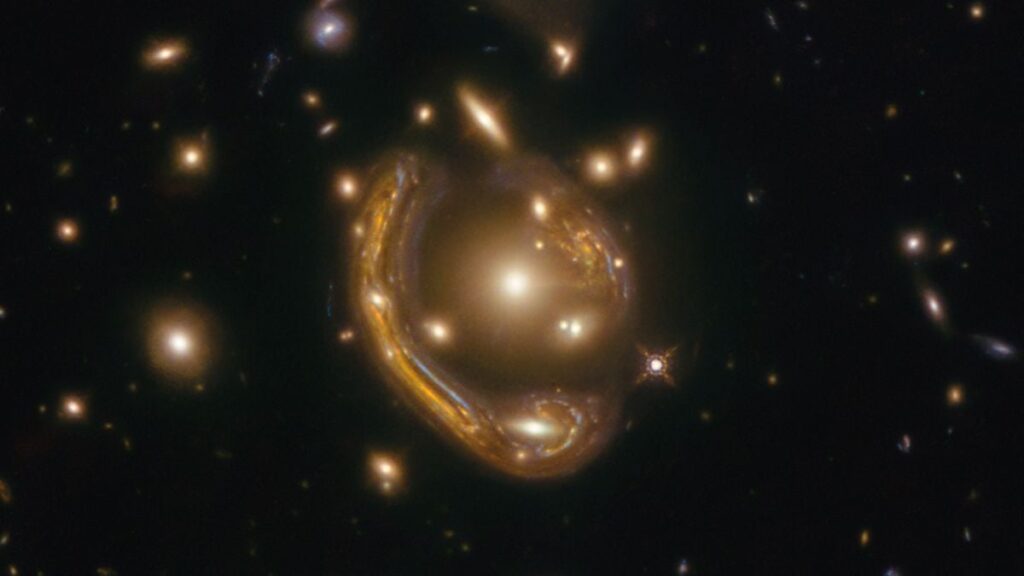
The motion of galaxy clusters in the distant Universe has just yielded the largest-scale test yet of the laws of gravity.
Across scales that span hundreds of millions of light-years, gravity continues to behave the way Isaac Newton predicted in his universal law of gravitation.
According to this law, every particle in the Universe exerts a gravitational force on other particles proportional to its mass, and inversely proportional to the square of the distance between the centers of mass of the two particles.
Observing this effect in galaxy clusters billions of light-years away strengthens our current understanding of gravity – and it also strengthens the case for the mysterious theoretical source of unexplained gravitational pull known as dark matter.
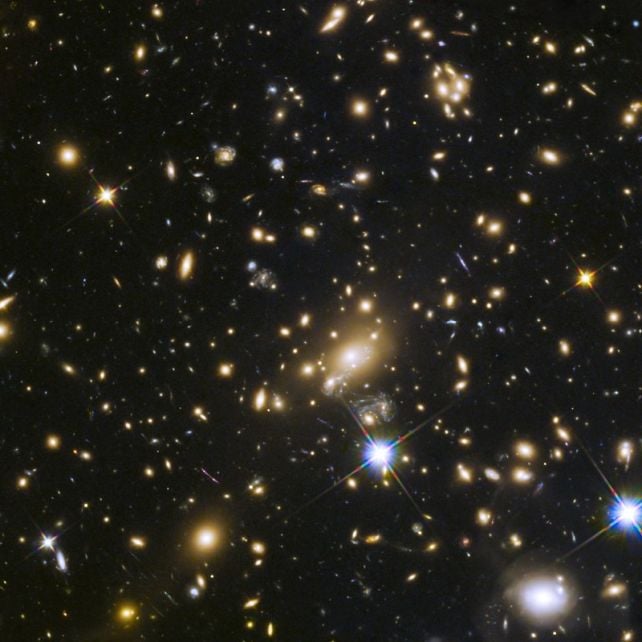 Galaxy clusters can contain thousands of galaxies, and can be used to probe extreme physics. This one is MACS J1149.6+2223. (NASA, ESA, and S. Rodney/JHU and the FrontierSN team; T. Treu/UCLA, P. Kelly/UC Berkeley, and the GLASS team; J. Lotz/STScI and the Frontier Fields team; M. Postman/STScI and the CLASH team; and Z. Levay/STScI)
“It is remarkable that the law of the inverse of the squares – proposed by Newton in the 17th century and then incorporated by Einstein’s theory of general relativity – is still holding its ground in the 21st century,” says cosmologist Patricio Gallardo of the University of Pennsylvania.
When we gaze out upon the Universe, a strange discrepancy emerges.
Based on a census of all the normal, baryonic matter out there – that’s the stuff that everything we can see is made of, including stars, galaxies, black holes, planets, dust, and even us – and our understanding of how that matter behaves, things don’t move the way they should.
Galaxies rotate too fast. Light traveling through the Universe follows a space-time gravitational curvature too pronounced for baryonic mass alone.
Galaxy clusters that should fly apart are instead bound tightly together. Tiny ripples in the cosmic microwave background only make sense if most of the matter in the Universe is invisible.
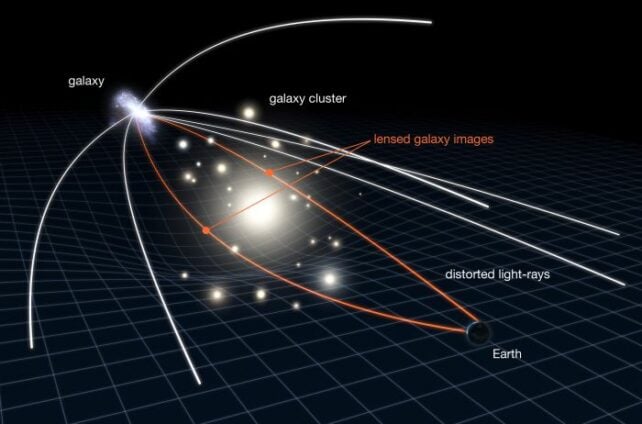 Diagram illustrating gravitational lensing. (NASA, ESA & L. Calçada)
There are two main explanations for these discrepancies. One of them is dark matter – something we can’t directly detect that only interacts with the baryonic Universe through gravity.
Based on measurements of the aforementioned phenomena, roughly 85 percent of the matter in the Universe is dark.
The other explanation is that there’s something missing from our definitions of gravity, first delivered by Newton and then refined by Albert Einstein.
“That is the central puzzle,” Gallardo says. “Either gravity behaves differently on very large scales, or the Universe contains additional matter that we cannot directly see.”
One way to interrogate these options is to look for new evidence of dark matter. Another is to test whether gravity behaves in a manner consistent with the laws of physics.
Gallardo and his colleagues chose the latter, measuring the velocities of distant galaxy clusters in a volume of space around 5 to 7 billion light-years away.
This sample contains around 686,000 galaxies, many of which are bound up in clusters gravitationally moving towards each other.
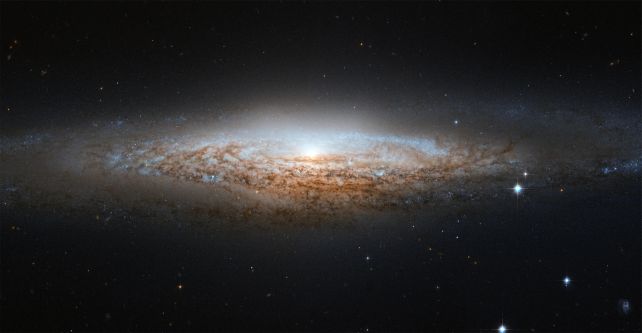 The outer edges of galaxies move way too fast to be explained by baryonic mass. (ESA/Hubble & NASA)
To measure the velocities of these clusters, the researchers used something called the kinematic Sunyaev-Zeldovich effect. The first light to stream freely through the Universe is everywhere around us today – that’s the cosmic microwave background, or CMB.
On its way towards us, light from the CMB often passes through the vast clouds of hot gas that surround galaxy clusters. If the cluster is not moving, then the light just travels in a straight line; but if the cluster is moving, then CMB photons scatter off free electrons, slightly shifting the CMB signal.
By measuring the extent of the shift, scientists can determine how fast the cluster was traveling when light was passing through it. The velocities at which two clusters are racing towards each other can then be used to probe the masses involved and the behavior of the gravitational forces at play.
If a modification were required to our theories of gravity, the gravitational forces would be stronger at large distances from the masses involved; that is, they would weaken more slowly with distance.

What the researchers observed instead was that the gravitational pull between clusters faded quickly at greater distances – consistent with the theories of Newton and Einstein.
Related: Spectacular New Einstein Cross Discovered Warping Space-Time
This suggests that dark matter is a better supported explanation for the strange gravitational effects observed throughout the Universe than modified gravity, but it still leaves many questions unanswered.
“This study strengthens the evidence that the Universe contains a component of dark matter, but we still do not know what that component is made of,” Gallardo says.
“With so many unanswered questions, gravity remains one of the most fascinating areas of research. It’s a naturally attractive field.”
The research has been published in Physical Review Letters.