
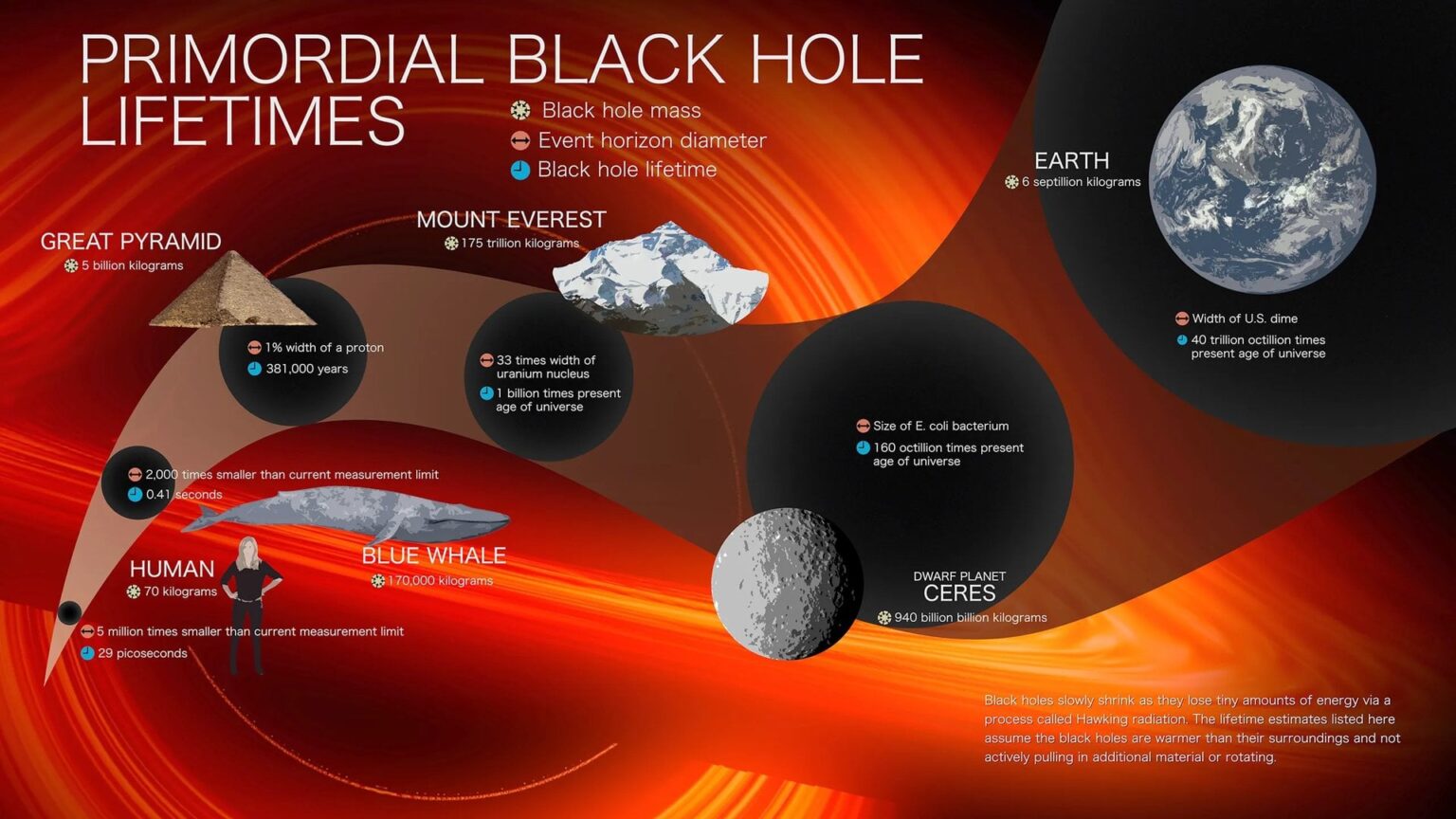
Black holes live forever, at least according to general relativity. Once material crosses a black hole’s event horizon, it is trapped forever. Until the last day of cosmic time. But we know that isn’t true. General relativity is a classical model. It doesn’t take into account the fuzzy, indeterminate nature of the quantum. We don’t have a complete and consistent theory of quantum gravity, but we do have some understanding of quantum black holes.
One major feature of quantum black holes is that matter and energy can escape them through the process of Hawking radiation. Very roughly, quantum particles can tunnel through the event horizon now and then, which means quantum black holes slowly lose mass. The smaller the mass of a black hole, the greater the rate of Hawking radiation. So as a black hole ages, it loses mass, which makes it radiate more, and so on until it completely evaporates. In his original 1974 paper, Hawking calculated the lifetime of a black hole to be about 2 x 1067 M3 years, where the mass of the black hole is in solar masses. Given that the age of the Universe is only about 1010 years old, your typical black hole is effectively immortal.
There is, however, a problem with Hawking’s result. Mainly in that Hawking assumes the quantum effect is small enough that it doesn’t affect the classical spacetime. It is a semi-classical result. This assumption breaks down when the mass of a black hole gets much smaller than the Sun. It’s not a big deal for normal black holes, but it is for primordial black holes. These hypothetical black holes have been proposed as a possible solution for dark matter, and their lifetimes would affect cosmic evolution.
Which brings us to a recent work on the arXiv. The study calculates the minimum lifetime of a black hole in a more robust way. It starts with an assumption that spacetime is asymptotically semi-classical. In other words, no matter how quantum-strange things are near a black hole’s event horizon, as you get far enough away from the black hole, Hawking’s assumption still holds. The authors also assume that any effect of entanglement entropy will fade in time. This is a way of dealing with the “information paradox” problem with black holes. Depending on how the paradox is solved, the lifetime of the black hole might be longer than their result, but it won’t be shorter.
What they find is that given an initial mass M, the minimum lifetime of a black hole is at least M4/ℏ3/2, which is a surprisingly simple result. They also show how black hole evaporation has three main phases. The first is that of standard Hawking radiation, the second is a transition phase, and the third is the entanglement phase. It’s this last phase that will require a theory of quantum gravity, which is why they can’t calculate a maximum lifetime.
What’s interesting is that given their constraints, it’s possible that small black holes could behave like white holes. Depending on the nature of quantum gravity, black holes could enter a metastable period where the redshift factor of their radiation becomes negative. In this case it would appear that the black hole is pushing material away rather than pulling it in. This is how hypothetical white holes would behave. If primordial black holes exist, they would have had a Hawking radiation phase of about a billion years or so, after which they could have entered a metastable phase where they look similar to white holes.
We’ll need a complete quantum theory of gravity to be sure, but it’s worth looking for objects that look similar to white holes. We haven’t found one yet, but this new study means we can’t rule them out.
Reference: Hawking, Stephen W. “Black hole explosions?.” Nature 248.5443 (1974): 30-31.
Reference: Bianchi, Eugenio, et al. “Minimum lifetime of a black hole.” *arXiv preprint* aarXiv:2605.03922 (2026).