
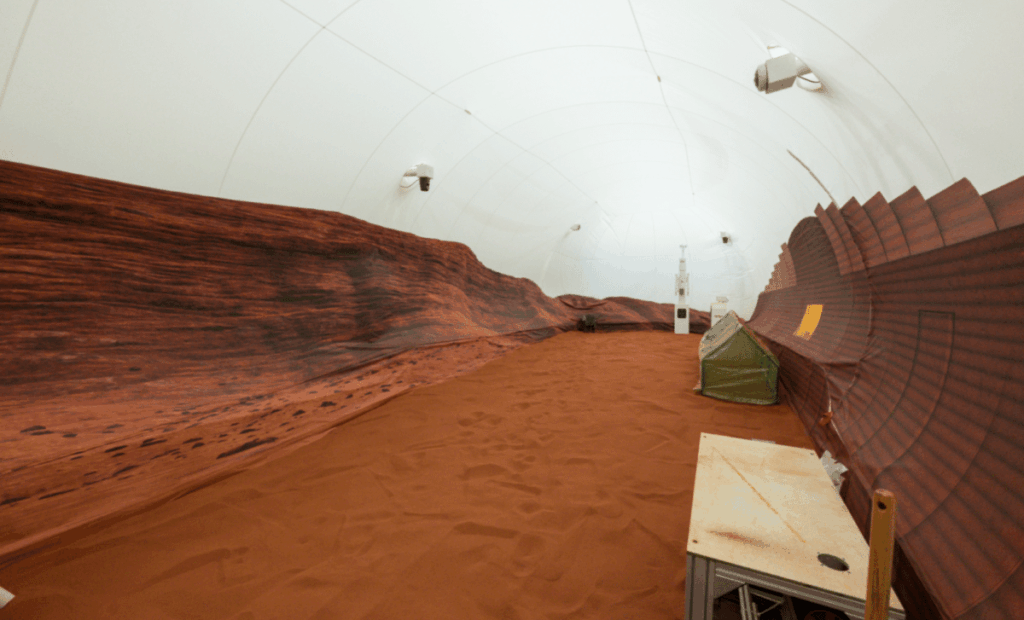
NASA’s CHAPEA mission, designed to simulate the challenges of long-duration Mars exploration, has now reached a milestone, 200 days inside their habitat. As the crew of four astronauts continues their 378-day mission, the data being collected from this study could transform our approach to future space missions, particularly for the Moon and Mars. This experiment, which includes isolation, limited resources, and delayed communications, provides critical insights into the human factors essential for sustaining life beyond Earth.
200 Days in Isolation: NASA’s Simulated Mars Mission Reaches Key Milestone
The CHAPEA mission, NASA’s Crew Health and Performance Exploration Analog, has reached a significant moment in its 378-day mission. The crew is experiencing a simulated Mars mission, where they are confined to a 1,700-square-foot habitat at NASA’s Johnson Space Center in Houston. This extended isolation helps simulate what future astronauts will experience during their journey to Mars. As of May 7, the team celebrated 200 days, halfway through their mission, and they are now in a two-week communication blackout, an environment that mimics the communications delay that would occur when Mars is positioned behind the Sun.
This mission is not just about surviving the isolation but learning how to thrive under extreme conditions. The four astronauts, commanded by Ross Elder, with Ellen Ellis as medical officer, Matthew Montgomery as science officer, and James Spicer as flight engineer, are tasked with performing a range of duties that simulate the variety of activities required on an actual Mars mission, from geology to medical tasks, to exercise, and even growing crops inside their habitat.
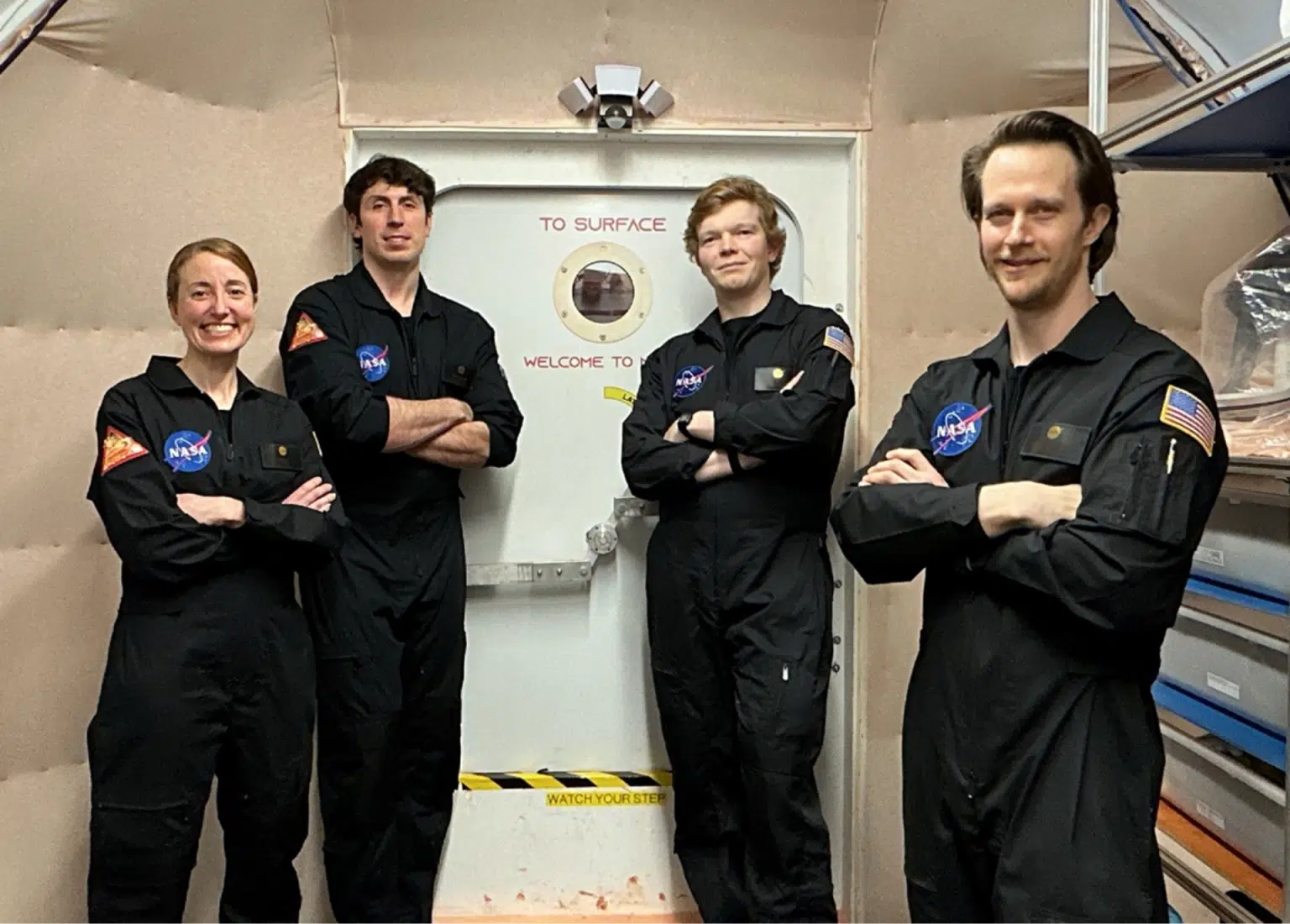 Members of NASA’s CHAPEA (Crew Health and Performance Exploration Analog) mission 2 pose for a group photo. (From left to right: Ellen Ellis, Ross Elder, James Spicer, and Matthew Montgomery)
Credit: NASA
Facing the Challenges of Limited Resources
One of the key lessons learned during the CHAPEA mission is how astronauts will cope with limited resources. From a lack of internet access to simulated equipment malfunctions, the crew is pushed to their limits, creatively solving problems with whatever tools and supplies they have on hand.
“Having limited resources, be it tools, equipment, software, supplies, or no internet, really bounds what you have to solve problems,” said Montgomery. “Finding creative and clever solutions has been both challenging and rewarding.”
This kind of resourcefulness is vital for deep space missions where resupply opportunities will be infrequent and communication with Earth will not always be possible.
NASA is closely monitoring how the astronauts handle these stresses to inform the design of future missions. The results will guide how astronauts manage both physical and cognitive challenges in environments where immediate solutions aren’t available.
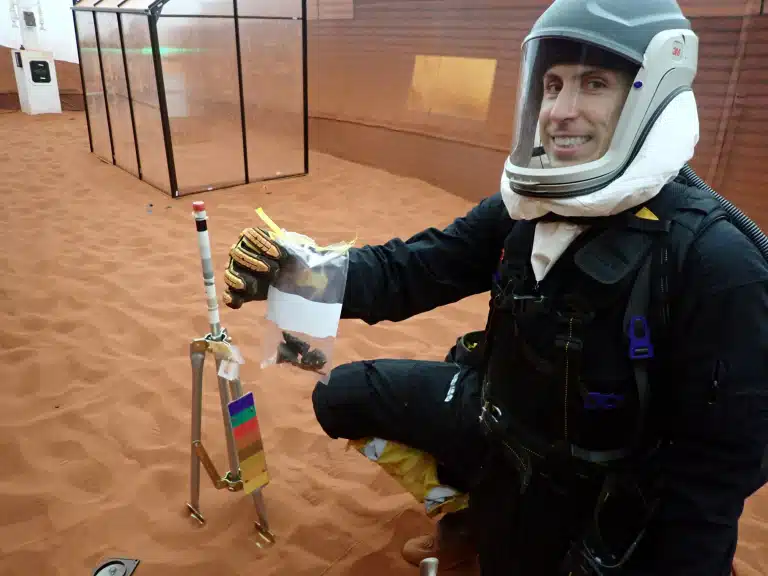 CHAPEA mission 2 commander Ross Elder shows geological samples collected during a simulated extravehicular activity.
Credit: NASA
Stress, Isolation, and Adaptation: Human Performance Under Pressure
Another vital component of the CHAPEA study is understanding how isolation affects human performance. The extended duration of the mission allows NASA to gather data on cognitive and physical health while the crew adapts to their confined environment. The simulation provides researchers with insight into the psychological impact of long-duration space travel, which will be essential when planning for the future of human missions to Mars.
“I’m proud of the crew’s accomplishments over the past 200 days—facing each challenge with fortitude and finding new ways to improve our performance and efficiency daily,” said Ellis.
The crew’s adaptability, and ability to handle stressful situations, will be crucial when they eventually face real-life challenges in deep space.
Beyond physical health, the study is tracking how the isolation affects interpersonal dynamics, decision-making, and the ability to maintain morale under pressure. These findings will play a critical role in shaping the support systems and infrastructure necessary to ensure the well-being of astronauts on long-duration missions.
The Role of Simulated Missions in Preparing for Mars Exploration
NASA’s CHAPEA mission serves as a critical testbed for the future of Mars exploration. With every simulated spacewalk, maintenance task, and crop-growing experiment, the crew is providing invaluable data for future space exploration. Their experiences could influence habitat designs, mission planning, and even the technologies used in future space missions.
“We approach every day committed to doing our best work, whether we’re doing a simulated spacewalk, geology, exercise, a medical activity, or anything in between,” said Spicer. “What keeps us motivated is knowing that we’re contributing directly to NASA’s deep space exploration objectives.”
Their dedication to excellence, despite the challenges, has been a testament to the resilience needed for missions that will push humanity to new frontiers.
The Impact of CHAPEA Data on Lunar and Mars Missions
The insights gained from the CHAPEA mission are not only relevant for Mars but will also directly inform the planning and execution of future missions to the Moon, particularly those aimed at establishing a sustainable lunar presence. According to Sara Whiting, the project scientist and mission manager for NASA’s Human Research Program,
“Extended-duration missions are relatively rare in NASA’s history to date. The operational lessons learned, along with the detailed health and performance data this crew is providing, come at the perfect time to inform the development of a sustainable lunar presence and longer-term objectives for crewed Mars missions.”
This data will be used to refine NASA’s strategies for long-term human space exploration, ensuring astronauts can not only survive but thrive on Mars or the Moon, regardless of the isolation and challenges they face. NASA’s focus on cognitive and physical health will be pivotal to achieving the long-term goal of sustained human presence on Mars.