


Image showing the European Space Agency’s (ESA) advanced time measurement facility, the Atomic Clock Ensemble in Space (ACES), attached to the exterior of the International Space Station’s (ISS) Columbus module. Courtesy of ESA.
To establish a new definition of ‘one second’ in 2030, South Korean research institutes will begin full-scale collaboration on an international project comparing optical clocks worldwide.
The Korea Research Institute of Standards and Science (KRISS) and the Korea Astronomy and Space Science Institute (KASI) announced on the 7th that they have signed a ‘Memorandum of Understanding for Collaborative Research on Ultra-Precise Optical Clock Comparison Using SLR’ and will officially commence their participation in an international joint project to precisely compare the atomic clock on the International Space Station (ISS) with Korea’s ytterbium optical clock.
The current unit of time, one second, is defined based on the cesium (Cs) atomic clock. With the advent of optical clocks, which are over 100 times more precise than cesium atomic clocks, they are gaining attention as the next-generation standard for time. A precise comparison among optical clocks worldwide is necessary for the new definition, but both the low-accuracy satellite-based method and the intercontinentally challenging optical fiber network method have limitations.
The European Space Agency (ESA) is conducting the ‘Atomic Clock Ensemble in Space (ACES)’ international space project, which uses an ultra-precise atomic clock system installed on the ISS in April 2025 to verify Einstein’s theory of relativity and precisely test fundamental laws of physics. Capable of comparing time between space and Earth with 10 times greater precision than satellite methods, it is considered the optimal alternative for verifying the performance of optical clocks worldwide.
South Korea is participating in the ‘European Laser Timing (ELT)’ project, a laser-based time comparison method within the ACES mission. After Germany, South Korea is the second country to receive ESA approval to join the project.
South Korea and Germany have a geographical advantage as their ISS observation time slots are staggered, and they are expected to provide key data necessary for verifying the stability of the ISS atomic clock.
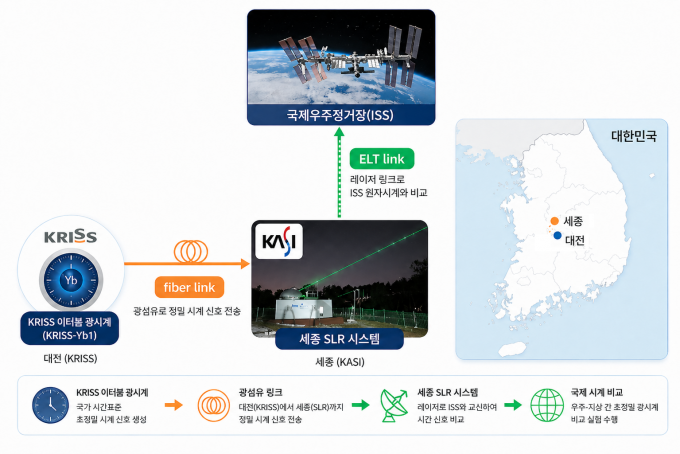
Overview of the collaboration plan between KRISS and KASI for participation in the ACES-ELT mission. Courtesy of KRISS.
To participate in the ACES-ELT project, KRISS and KASI connected KRISS’s ytterbium optical clock and KASI’s ‘Sejong Satellite Laser Ranging (SLR)’ system via a dedicated optical fiber network last year. The principle involves transmitting the precise time signal from the optical clock to the Sejong SLR, which then sends a laser signal into space for direct comparison with the ISS atomic clock.
Under this agreement, the two institutions will promote joint use of major research equipment such as SLR and atomic clocks, collaborative research on optical clock comparison based on SLR including the ACES-ELT mission, and exchange of research personnel and training of experts.
Lee Ho-seong, President of KRISS, stated, “We are now able to verify the performance of optical clocks, which has been difficult due to technical limitations, through international collaborative research. We will confirm the excellence of our measurement technology on the world stage and lay the groundwork to contribute proactively to the redefinition of the ‘second’ scheduled for 2030.”
Park Jang-hyun, President of KASI, said, “It is very meaningful that the two government-funded research institutes have embarked on a convergence research project, utilizing their respective technologies centered on the Sejong SLR, a national strategic infrastructure.”
Copyright ⓒ DongA Science. All rights reserved.