
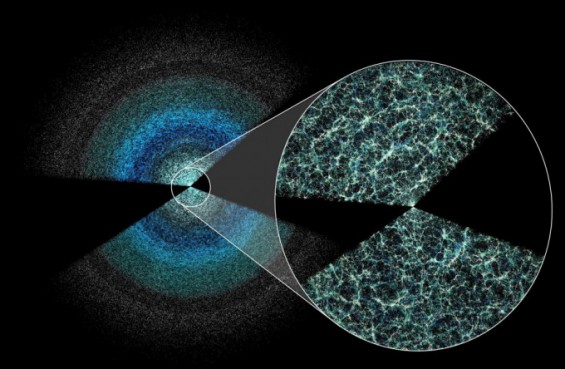
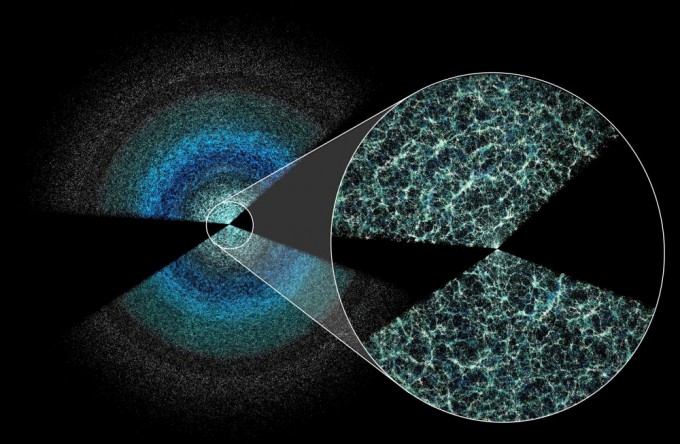
A cross-section of the new 3D map of the universe. Galaxies extend like a spiderweb with the Milky Way at the center. Credit: Claire Lamman, DESI collaboration.
From a new 3D map of the universe and a leather handbag born from a dinosaur fossil to vitamin crystals reminiscent of golden ornaments, the international scientific journal *Nature* has selected its ‘Best Science Images for April.’ The photos capture the fruits of scientists’ long-accumulated research, from the brief moment of a space launch to a five-year record of cosmic observation.
Each month, *Nature* selects and releases images that capture major scientific discoveries and research sites. The selections for April span various fields, from astronomy to chemistry and synthetic biology.
● A new map of the universe
On the night of April 14, a five-year cosmology research project aimed at creating the most detailed 3D map of the universe concluded. The Dark Energy Spectroscopic Instrument (DESI) in Arizona, U.S., precisely measured the distances to 47 million galaxies and quasars over five years. A cross-section of the 3D map, centered on the Milky Way, shows galaxies clustered together like a spiderweb under the influence of gravity.
● Cherry blossom curator
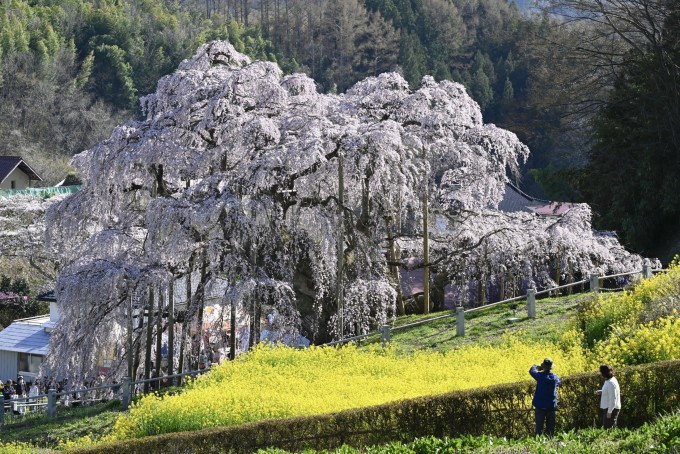
A view of cherry blossoms in Japan. Credit: Newscom, Alamy.
Every year between late March and April, Japan’s streets are colored with pink cherry blossoms. Climate scientist Yasuyuki Aono, who passed away last August, spent his life tracking the peak bloom times of cherry blossoms. He unearthed historical records to compile an unprecedented long-term climate dataset stretching back more than 1,200 years. Last month, Genki Katata, an environmental biophysicist at the Canon Institute for Global Studies in Japan, agreed to continue this record.
However, it may become difficult to see spring cherry blossoms in the future. According to a study published in the *International Journal of Biometeorology* by a research team from the Kyushu Research Center of Japan’s Forestry and Forest Products Research Institute, climate change and warmer winters are delaying the blooming of cherry blossoms and reducing the percentage of flowers that are open during the peak bloom period.
● A skink in hiding
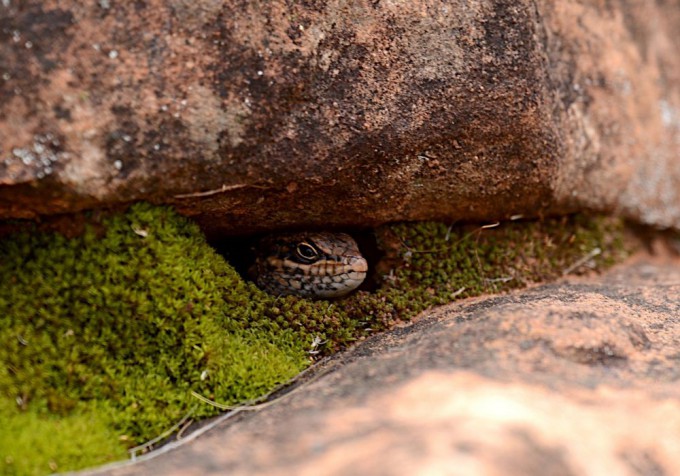
A new lizard species, ‘Liopholis mutawintjiensis,’ discovered in Australia’s Mutawintji National Park. Credit: Tom Parkin CC BY-ND.
A research team from the Australian Museum Research Institute discovered a new species of skink lizard in Australia’s Mutawintji National Park. The Wilyakali Aboriginal community named the species ‘Kungkaak.’ The research team published their findings on the genetic differences of the Kungkaak in the international journal *Zootaxa* last month, giving it the scientific name *Liopholis mutawintjiensis*. With fewer than 20 individuals discovered so far, it is considered one of the most endangered reptiles in Australia.
● Dinosaur fashion
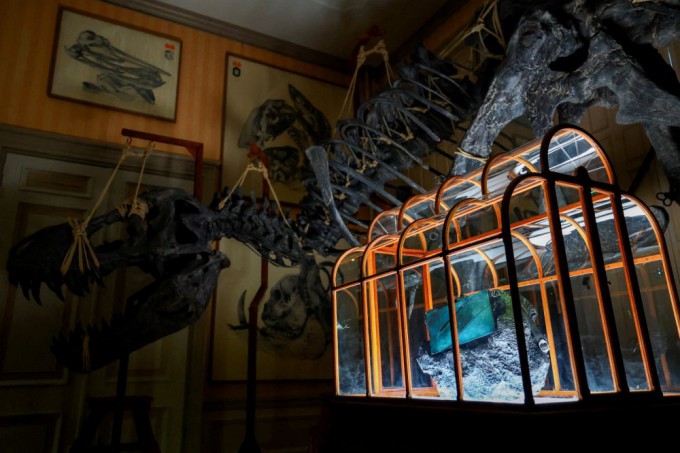
A leather handbag made from protein extracted from a dinosaur fossil was unveiled for the first time last month. Credit: REUTERS/Piroschka van de Wouw TPX IMAGES OF THE DAY.
A leather handbag made from lab-grown collagen extracted from a dinosaur fossil was exhibited for the first time last month at the Artis-Micropia museum in Amsterdam, Netherlands. Ancient protein fragments from a *Tyrannosaurus rex* fossil found in the U.S. were used to develop a protein-based biomaterial, which was then inserted into animal cells to produce collagen. This was then processed into a leather-like material to create the handbag.
● Golden vitamin crystals
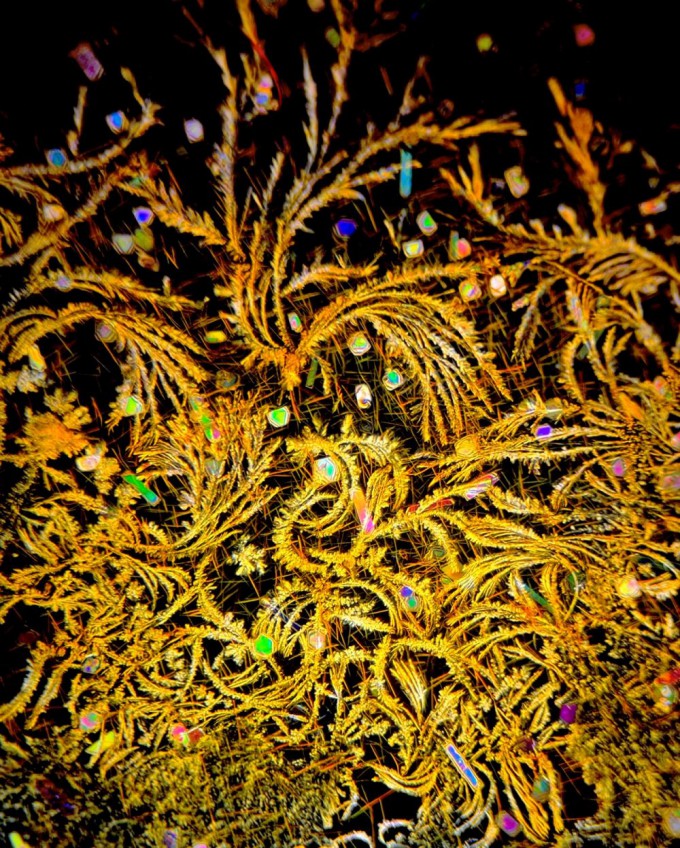
Vitamin B crystals observed under a polarized light microscope. Credit: Hélène Lambert.
When viewed under a polarized light microscope, vitamin B crystals look like ornate golden decorations, as seen in the photo. The vitamin crystals are formed by dissolving them in a solvent like water or alcohol and then evaporating the solvent. As the solution dries, the vitamin molecules self-assemble into branch-like structures. This photo, taken by Hélène Lambert, a student at the University of Geneva in Switzerland, was also a winner of the 2026 Swiss National Science Foundation’s Scientific Image Competition.
● 3, 2, 1, lift-off!
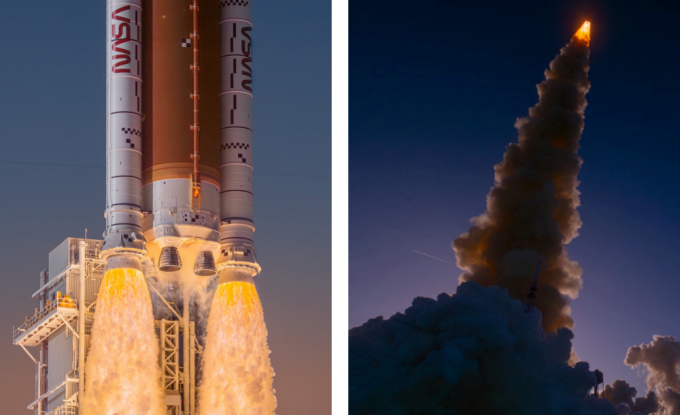
A NASA SLS booster spews flames, launching the Orion spacecraft. Credit: Andrew McCarthy/cosmicbackground.io.
The U.S. National Aeronautics and Space Administration (NASA)’s Space Launch System (SLS) launched the Orion spacecraft toward the Moon in a single powerful blast. The two boosters attached to its sides each generate more thrust than 14 large passenger jets with four engines apiece. The boosters burn a synthetic propellant for about two minutes after launch before separating from the core stage and falling back to Earth.
● Seeing the far side of the Moon
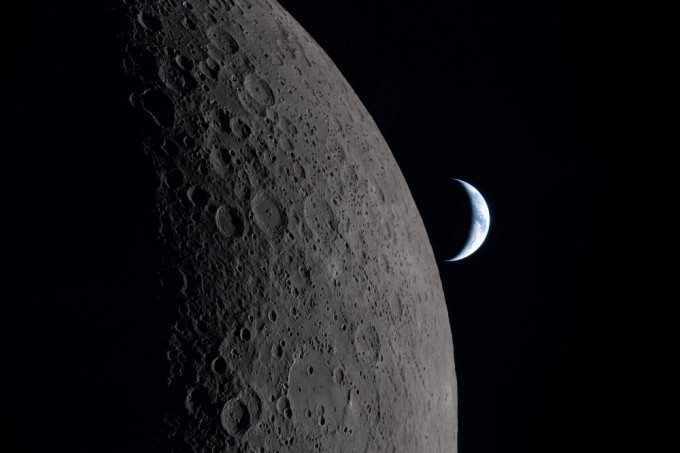
Astronauts aboard the Orion spacecraft observed the far side of the Moon with their naked eyes for the first time in human history last month. Credit: NASA.
The four astronauts of the Artemis II mission made history last month by flying around the Moon. The Orion spacecraft traveled 400,000 kilometers from Florida, U.S., and its crew became the first humans to observe parts of the Moon’s far side with the naked eye. They observed mountain ranges and cliffs on the lunar surface and also experienced a total solar eclipse that lasted nearly an hour. The spacecraft safely splashed down in the Pacific Ocean off the coast of San Diego, California, on the 10th of last month.
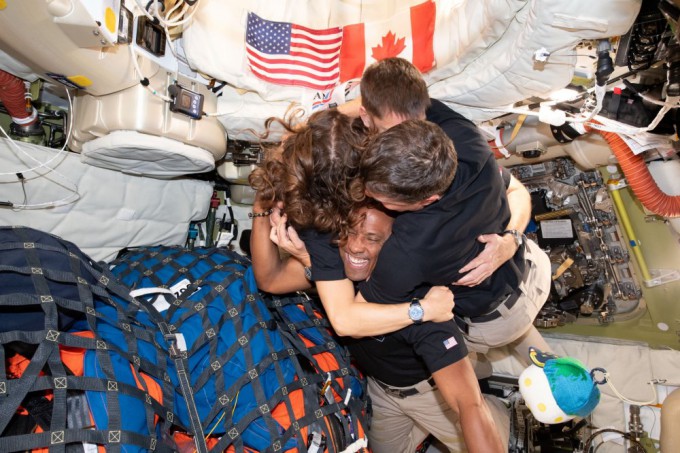
The four astronauts of the Artemis II mission. Credit: NASA.
Copyright ⓒ DongA Science. All rights reserved.