
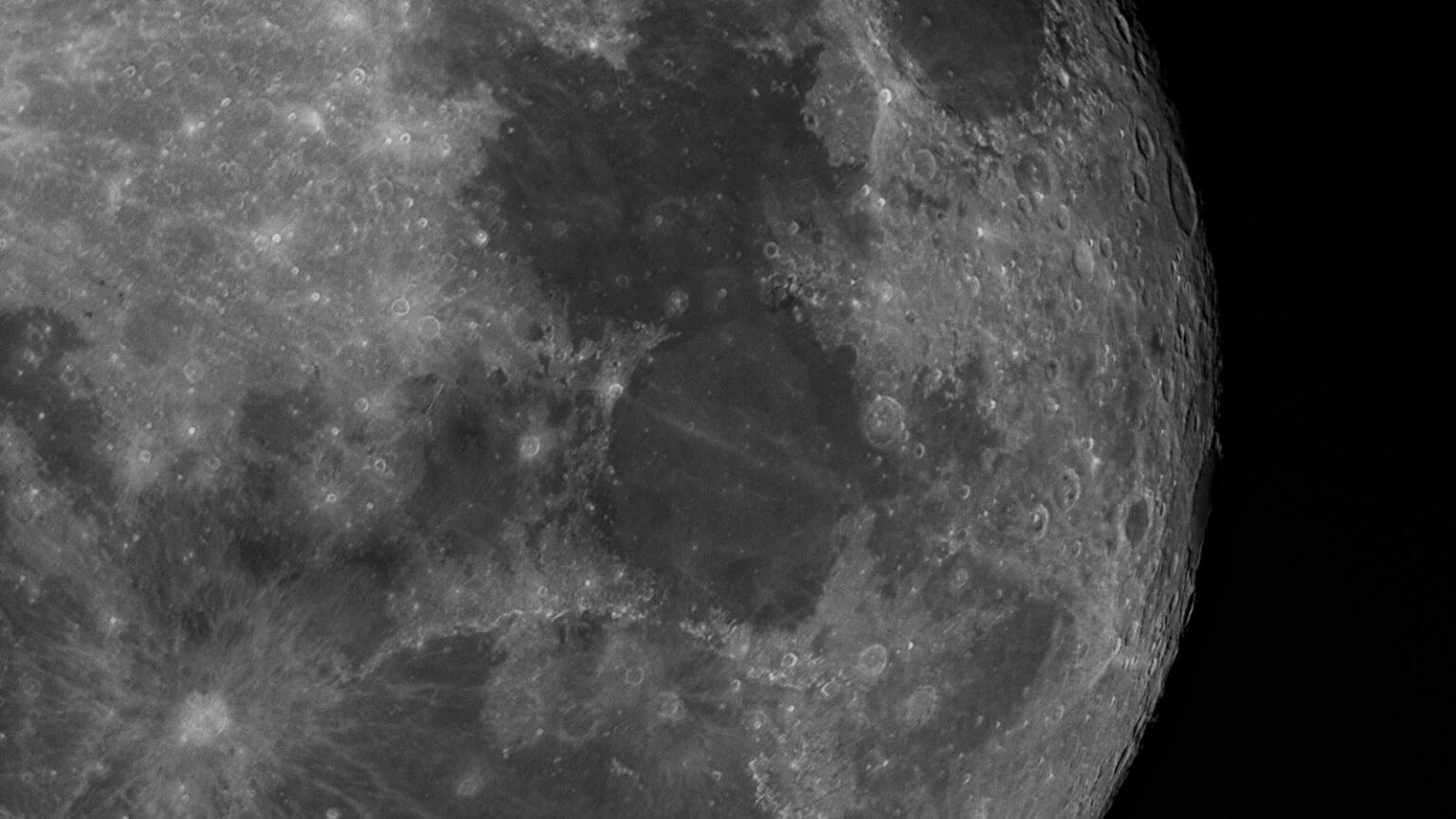
Interlune has secured a $6.9 million NASA award to build what the company says will be the first payload designed to extract solar-wind volatiles, including helium-3, directly from lunar regolith on the moon. The Seattle-based startup announced that the payload, dubbed Prospect Moon, is being developed for a targeted 2028 lunar launch.
The award is a Small Business Innovation Research Phase III project with NASA’s Space Technology Mission Directorate’s Game Changing Development program. Interlune says the project will support the development, testing and production of flight hardware for Prospect Moon, a mission intended to demonstrate in-situ measurement and extraction of lunar volatiles.
What Prospect Moon will actually do
The payload is, in essence, a field laboratory for one specific question: how efficiently can solar-wind volatiles, including helium-3, be released and measured from moon dirt?
Interlune says Prospect Moon will combine NASA-developed instruments with commercial technologies to obtain in-situ measurements of lunar volatiles and demonstrate extraction on the lunar surface. The company has said the payload will draw on NASA technology heritage, including volatile-detection and regolith-processing systems, while building on Interlune’s own mechanical-processing demonstrations in simulated lunar gravity.
The goal is not to open a mine in 2028. It is to gather the operational data needed to design one. Prospect Moon is a proof-of-concept and calibration step: a way to understand how real lunar regolith behaves when heated, sorted, agitated and processed outside the laboratory.
The economics behind the science
Helium-3 is rare on Earth and increasingly sought after. It has applications in neutron detection, medical imaging, national-security sensors and as a working fluid in dilution refrigerators used for ultra-low-temperature physics, including systems that keep quantum computers near absolute zero.
That demand is no longer purely theoretical. In 2025, the U.S. Department of Energy Isotope Program agreed to purchase three liters of helium-3 harvested from the moon, with delivery no later than April 2029. Interlune has also announced commercial helium-3 supply agreements, including a large purchase commitment from Bluefors, a major supplier of cryogenic cooling systems for quantum technology.
The market case is therefore unusually concrete for a lunar resource company. Interlune is not merely arguing that helium-3 might someday be valuable. It is trying to convert existing scarcity into a supply chain before terrestrial demand outruns available sources.
That creates an awkward timing problem. Some customer timelines begin years before lunar extraction can happen at meaningful scale.
The terrestrial bridge
To meet near-term obligations and develop its separation technology, Interlune is also working on ways to separate trace helium-3 from commercially available terrestrial helium supplies. The company has said that technology developed for the moon can also apply on Earth, allowing it to separate helium-3 from terrestrial gas sources before lunar production is ready.
That bridge matters. It reframes Interlune as both a helium-3 supplier and a lunar-mining startup. The terrestrial work can help prove the separation technology, satisfy early customers and fund the harder lunar version of the same industrial process.
The lunar business remains the harder bet. Extracting useful quantities of helium-3 from regolith requires excavation, sorting, heating, separation, storage and return logistics. Interlune has said that delivering just three liters of helium-3 to the Department of Energy would require processing enough lunar regolith to fill a large backyard swimming pool.
Riding the Artemis surge
The 2028 target puts Prospect Moon in the middle of a changing lunar-exploration landscape. NASA’s current Artemis III plan is no longer a crewed surface landing. The agency now describes Artemis III as a 2027 low-Earth-orbit mission to test rendezvous and docking operations between Orion and commercial lunar landers from SpaceX and Blue Origin.
NASA lists Artemis IV as the mission intended to return astronauts to the lunar surface, with an early 2028 launch and a crewed landing near the lunar south pole. That makes robotic and commercial precursor work increasingly important. Before people can live and work on the moon for long periods, companies and agencies need to understand which resources can actually be located, processed and used there.
Prospect Moon fits into that larger shift. Interlune says the payload is being designed to be inexpensive enough to produce in multiple copies, which could allow it to fly on more than one lander if mission opportunities become available.
Not Interlune’s first lunar payload
Prospect Moon will not be Interlune’s first hardware sent toward the moon. The company’s earlier Crescent Moon mission includes a multispectral camera called METAL, short for Moon Exploration for Titanium using Active Lighting, which is set to fly on Astrolab’s FLEX Lunar Innovation Platform, or FLIP, rover.
Interlune says METAL will estimate helium-3 quantities and concentration in lunar regolith by using images to study mineralogical signals. The logic comes from Apollo-era sample analysis: Interlune notes that helium-3 measurements in returned lunar samples correlated with titanium content and with regolith maturity, with ilmenite acting as one relevant mineral marker.
The two payloads form a logical sequence. Crescent Moon is a mapping and remote-sensing step. Prospect Moon is an extraction and measurement step. Find promising regolith first, then test how well useful volatiles can actually be released from it.
Commercial partner, not base operator
Interlune does not need to operate directly beside NASA astronauts to benefit from the Artemis infrastructure buildout. NASA’s planned crewed surface work is focused on the lunar south pole, where water ice and permanently shadowed regions are central scientific and operational targets. Helium-3, by contrast, is implanted in lunar surface material by the solar wind and is often discussed in relation to broad regolith exposure, maturity and mineral composition.
That means Interlune’s best early targets may not be the same locations NASA selects for crewed landings. But the relationship could still be symbiotic. A sustained lunar program creates demand for landers, mobility systems, communications, power, navigation and surface operations. Commercial resource companies, in turn, give that infrastructure more possible customers and use cases.
This is the emerging bargain behind much of the lunar economy: government programs lower the cost of access and prove the operating environment, while commercial companies try to identify narrow products valuable enough to justify doing business there.
What it means
A $6.9 million award is not large by NASA standards. The significance is what it funds: hardware that could demonstrate that a specific category of lunar resource can be processed on the surface rather than merely sampled, mapped or imagined.
The push toward in-situ resource use extends well beyond helium-3. NASA, European teams and commercial companies are all studying ways to use lunar materials for exploration, construction, power systems, propellant and industrial feedstocks. The shared assumption is simple: hauling everything from Earth will not scale.
Interlune’s bet is narrower and more commercial: that a single isotope, scarce on Earth and demanded by quantum computing, federal energy programs and other high-value users, can pay for the first lunar industrial process.
The 2028 Prospect Moon mission will not prove that lunar mining is an industry. But if it flies and works, it could answer a more immediate question: whether helium-3 and other solar-wind volatiles can be extracted from lunar regolith on the moon in a way that gives engineers real numbers to build around.
That is the step every plausible space-mining business has to clear. Interlune is now trying to clear it first.
Photo by Antonio Moura on Pexels
About this article
This article is for general information and reflection. It is not professional advice. For your specific situation, consult a qualified professional. Editorial policy →