
Chris Forrester — As a regular reader of this site you will no doubt be aware of the benefits that satellites give humanity. But a major study on April 30 from the European Space Agency (ESA) reminds us of the aids provided by satellites in zones of interest outside our individual specialities.
 The risks
And the benefits are not just considerable but in most cases they are growing in influence and revenues. But so are the risks associated with the failure of a sector.
The ESA study admits that its risk forecasts are hypothetical – and its numbers are very much focused on its European members – and Canada. Nevertheless, the predictions are by any measure worrying. It admits that in some sectors (and specifically mentions direct-to-device (D2D) connectivity) the forecasts could be underestimating the actual probabilities. As for D2D which ESA admits is a technology that is evolving quickly, “and [become] more automated, data-driven sectors, the potential economic consequences of future outages are likely to be even greater.” In other words, the upside benefits are immense, but so might the consequences be of a sector’s failure.
“The sudden loss of satellite communications would lead to widespread disruption, affecting vital services such as air travel, maritime logistics and emergency response with an estimated economic impact of up to €20 billion. To highlight the economic importance of satellite-enabled connectivity, London Economics prepared a report for the European Space Agency, examining the effects of a hypothetical week-long outage of satellite communications across ESA Member States and Canada,” says ESA.
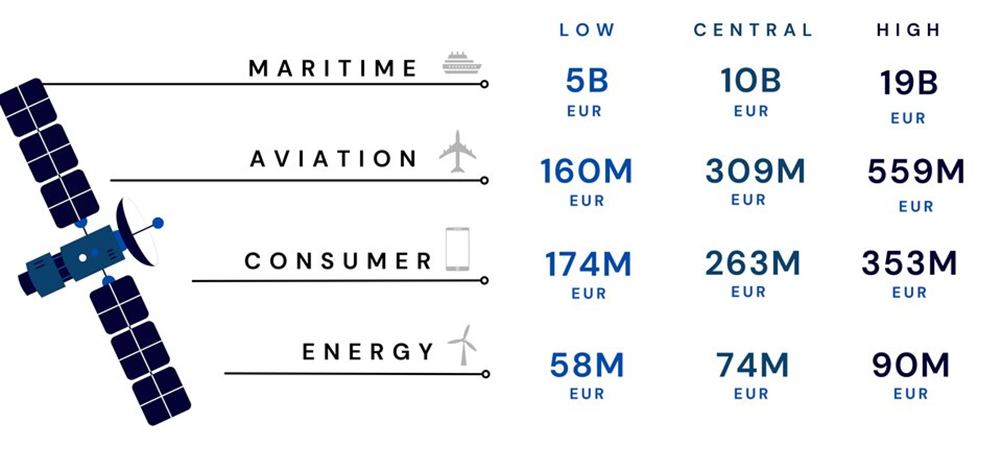
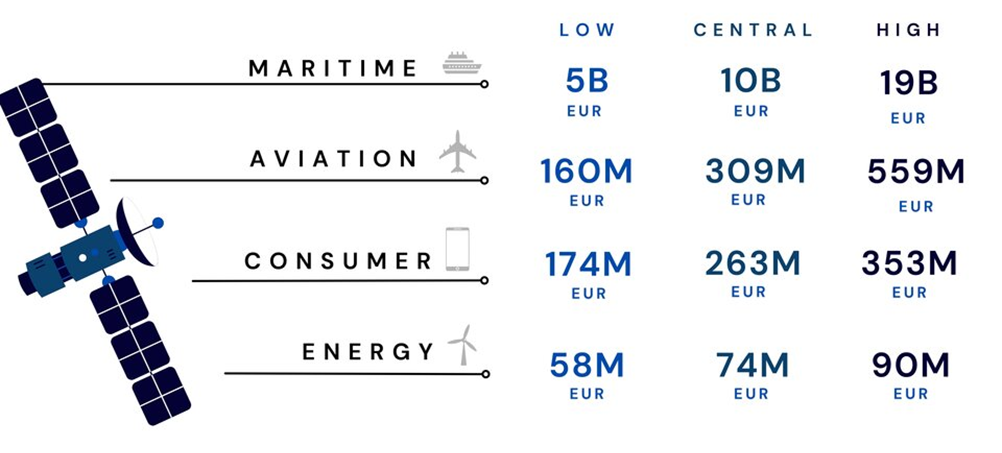
We only have to look at the current problems which revolve around the Straits of Hormuz and the impact from the stoppage of the flow of oil. The ESA report suggests that Maritime and Aviation “would suffer the greatest financial losses during a [satellite] outage”. ESA adds: “Maritime shipping supports the transport of essential goods for manufacturing, energy, food, and retail sectors. The interruption of satellite services would critically disrupt supply chains, affecting not only shipping companies but also related industries such as port operations and warehousing. The projected economic loss is approximately €19 billion, consisting of €3.5 billion in direct impacts and €15.5 billion in indirect effects related mainly to supply-chain logistics,” says ESA.
Air passengers are – at long last – beginning to enjoy ‘gate-to-gate’ connectivity thanks to much improved satellite communications for In-Flight broadband. But ESA is blunt: “In aviation, lack of satellite connectivity for air traffic management could result in the cancellation or delay of around 4,000 transatlantic flights, leading to approximately 1,800 hours of cumulative delays. The economic loss to the sector is estimated at €558.7 million.”
Despite the benefits of the likes of Starlink, and the upcoming offerings from AST SpaceMobile, Amazon Leo, Telesat Lightspeed, Viasat/Space42 Equatys and the existing services from Eutelsat OneWeb and Iridium, millions of citizens – unfortunately for our industry – depend on ‘conventional land-based and wireless services for their broadband and telephony. ESA states that around 2.2 million individuals in the ESA member states and Canada “particularly those in remote or mountainous regions, would be left without internet access . Emergency messaging systems, which rely on satellites to deliver critical information, would not be able to operate, compromising emergency response capabilities. The economic cost in this area is similar to that of aviation, at around €352.7 million.”
There would be another catastrophe in terms of cash supply. Despite more and more payments being made via a Smartphone, millions of us use ATMs regularly. “Cash machines and Point of Sale (POS) terminals in remote locations would not be operational. POS systems are devices used to process payments by card or mobile phone in shops and other venues. Because these systems rely on satellite connectivity in areas without reliable ground connections, their failure would stop physical transactions altogether,” says the report.
The ESA study used London Economics to research the core data. To arrive at these results, the research team reviewed existing data and reports and consulted 48 experts – including satellite operators, connectivity providers, national regulators, academics, and financial institutions. Five sectors were selected for analysis based on their reliance on satellite communications. The degree of dependence of the sector on satellites was categorised as high, medium, low. Using this information, they built an economic model to estimate the loss of economic activity (measured in Gross Value Added) and the loss of connectivity benefits for users. They also assessed wider social impacts, such as the number of households left without connectivity.
These three impact levels (Low, Central and High) are shown on the associated chart, and the numbers are shocking. We know that building in redundancy is a vital element in a system’s design, but the knock-on consequences are even greater than the threats listed.
However, all around us there are strong signs that the industry is building in compensation elements in order to avoid catastrophic consequences. FCC Commissioner Brendan Carr last week announced significant permissions for today’s satellite operators to raise power levels: “Even though high-speed next-gen satellite services provide essential connectivity across the country already, Americans are now about to see a big upgrade. With today’s decision consumers could see a seven-fold increase in capacity for these high-speed satellite offerings,” said Commissioner Carr.
The FCC decision is good news for operators and consumers. Higher power levels, suitably coordinated between operators, can only benefit everyone and reduce the risks associated with a sector’s collapse.