
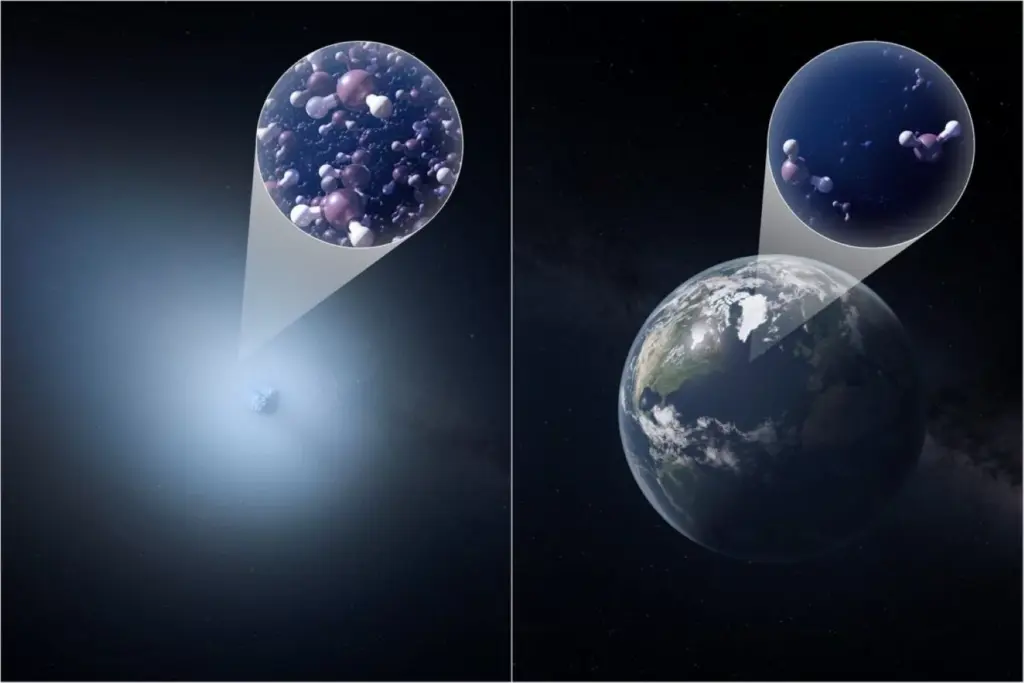
Water in the Solar System has a unique chemical signature: it is deuterated, that is, enriched in deuterium, which is a heavy isotope of hydrogen. This enrichment is common at very low temperatures (T < 30 K), such as those found in prestellar clouds, the sites of star formation, or the pervasive zones of distant protoplanetary disks.
Not all stars are born in the same stellar nursery, and that means they each have unique evolutionary histories. The deuterium to hydrogen (D/H) ratio of water across a planet reveals these differences in the environment and thus acts as a degree-of-freedom birth certificate for that star system.
Using ALMA radio telescope observations, astronomers studied the interstellar comet 3I/ATLAS and measured the ratio of deuterium to regular hydrogen in its water. This unusual signal was detected only days after the comet’s closest approach to the Sun. ALMA gathered data very close to the Sun’s direction, which most optical telescopes cannot do.
This comet 3I/ATLAS was chemically very special, containing 30 times more semi-heavy water (HDO) than comets have formed in our Solar System. Such a tell-tale sign of chemistry provides an unfiltered look inside the freezing, ultra-frigid locale from which it was born, encoding in ice long-preserved memories about conditions much rougher than those that formed our own planetary backyard.
PhD student Luis E. Salazar Manzano at the University of Michigan said, “Our new observations show that the conditions that led to the formation of our Solar System are much different from how planetary systems evolved in different parts of our Galaxy.”
Semi-heavy water (HDO) is highly subsolar in Solar System comets, with one molecule of HDO for ~10,000 molecules of normal water (H₂O). In the interstellar comet 3I/ATLAS, that ratio is at least thirty times bigger and over forty times what’s found in the oceans of Earth.
It is also important to note that ALMA did not directly detect this comet’s normal water (H2O). Instead, astronomers used HDO tracers and methanol signals to estimate the total water content, rather than measuring it directly. This complex model enabled them to determine the D/H ratio and shows ALMA’s capability to gather chemical information from faint signals.
The exceptionally high ratio points to an origin in a remarkably frigid, chemically different environment; one that is dramatically unlike the cradle of our Solar System.
Astronomers find unexpected organic molecules in interstellar comet 3I/ATLAS
Salazar Manzano said, “The chemical processes that lead to the enhancement of deuterated water are really sensitive to temperature and usually require environments colder than about 30 Kelvin, or about minus 406 degrees Fahrenheit. The ratio was set as the comet’s home system formed and has been preserved intact throughout its interstellar journey.”
ALMA’s instrumental role in this discovery was essential. Paneque-Carreño noted: “Most instruments can’t point toward the Sun, but radio telescopes like ALMA can. We were able to observe the comet within days after perihelion, just as it peeked out from its transit behind the Sun. This gave us a constraint on these molecules that’s not possible using other instruments.”
Journal Reference:
Salazar Manzano, L.E., Paneque-Carreño, T., Cordiner, M.A. et al. Water D/H in 3I/ATLAS as a probe of formation conditions in another planetary system. Nat Astron (2026). DOI: 10.1038/s41550-026-02850-5